

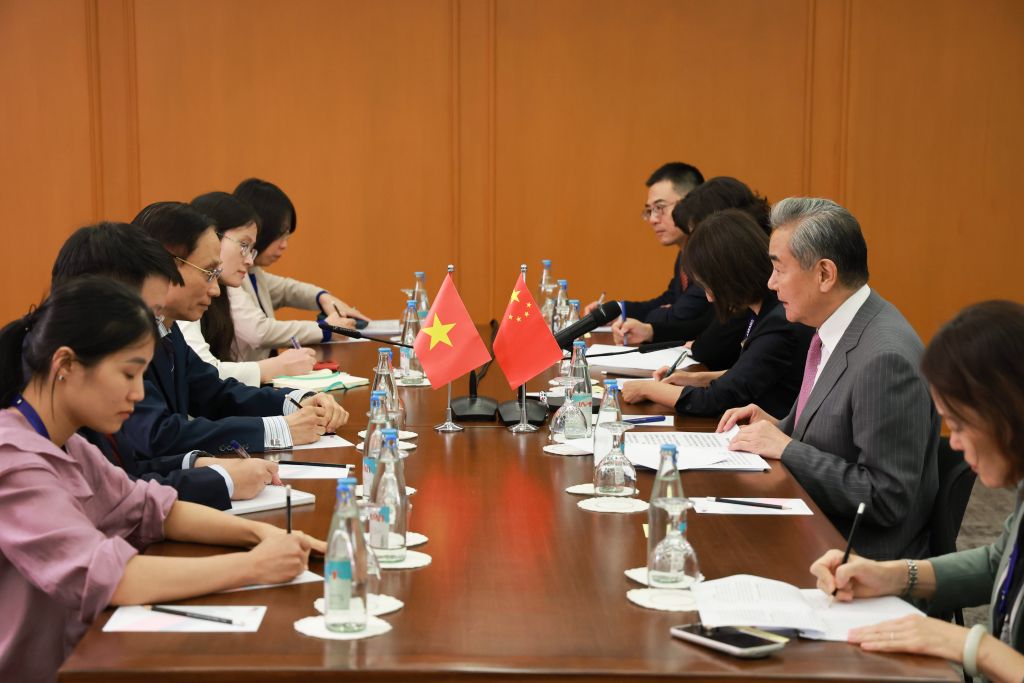
MANILA – Chinese Foreign Minister Wang Yi emphasized the importance of strengthening unity and cooperation with other nations, highlighting China's commitment to fostering strategic partnerships and regional stability when he met top diplomats from other nations on the sidelines of the ASEAN Foreign Ministers' meetings in Manila on Wednesday.
During meetings with foreign ministers from Vietnam, Brazil, India, Brunei, and Papua New Guinea, Wang underscored the need for enhanced collaboration in areas such as trade, artificial intelligence, and international governance.
China-Vietnam unity
China and Vietnam should proceed from the overall interests of their respective long-term development and effectively strengthen unity and cooperation, the top Chinese diplomat said when he met Vietnamese Foreign Minister Le Hoai Trung.
As socialist countries and two major developing countries, China and Vietnam must conscientiously implement the common understanding reached between the leaders of the two parties and two countries, said Wang.
ALSO READ: Wang: S. China Sea issue shouldn't be obstacle to Sino-ASEAN ties
The two sides should continue to intensify high-level exchanges, promote practical cooperation in areas such as connectivity and artificial intelligence, and jointly maintain a good situation for regional peace and development, he added.
For his part, Trung said that Vietnam is willing to work with China to enhance exchanges at all levels, promote practical cooperation in railways, agriculture and other fields, and strengthen multilateral communication and coordination with China to safeguard the common interests of the two countries and the region.
China-Brazil strategic communication
While meeting his Brazilian counterpart Mauro Vieira, Wang said it is necessary for China and Brazil to maintain strategic communication, strengthen strategic coordination and deepen strategic cooperation.
Under the strategic guidance of the two heads of state, China and Brazil have made positive progress in jointly building a community with a shared future for a more just world and a more sustainable planet, said Wang.
The strategic partnership between the two countries has always been at the forefront internationally, he said, noting Brazil is an emerging economy with global influence and a representative force of the Global South.
China is ready to work with Brazil to implement the important consensus reached by the two heads of state, strengthen cooperation in areas such as aerospace, connectivity, and artificial intelligence, and provide greater impetus for each other's development, he said.
ALSO READ: Wang stresses overarching positioning of ties with Europe as partnership
China welcomes Brazil to join the World Artificial Intelligence Cooperation Organization to safeguard common interests and deepen mutually beneficial cooperation in the new round of technological revolution, said the Chinese foreign minister.
Vieira noted that the leaders of both countries have maintained close communication, established a high level of mutual trust, and jointly guided bilateral relations to a high level. The two sides have maintained frequent exchanges at all levels, and bilateral trade volume reached a new high last year.
He said Brazil is very pleased to join the World Artificial Intelligence Cooperation Organization initiated by China and looks forward to taking this as an opportunity to advance scientific and technological innovation cooperation.
Momentum in China-India ties
China and India should bear the well-being of humanity in mind, demonstrate a sense of responsibility as major countries, consolidate the positive momentum in bilateral relations, and strengthen coordination and cooperation in international and regional affairs, Wang said when he met Indian External Affairs Minister Subrahmanyam Jaishankar.
Calling on the two countries to make positive contributions to advancing multipolarity and greater democracy in international relations, the Chinese diplomat said China stands ready to work with India to implement the important common understandings reached by the leaders of the two countries, maintain close high-level exchanges, strengthen cooperation in areas including economy and trade, media, and people-to-people and cultural exchanges, and properly handle sensitive issues.
READ MORE: Wang: Philippines must make right choices as ties with China at crossroads
He also called on the two sides to strengthen coordination and cooperation, promote the growth of the greater BRICS cooperation mechanism, and better represent and safeguard the common interests of developing countries. China will continue to support India in hosting a successful BRICS summit this year, he added.
India's positions on issues concerning Taiwan and Xizang have not changed and India respects China's sovereignty, Jaishankar said, adding that India has consistently advanced a positive and cooperative bilateral relationship with a forward-looking approach.
China-Brunei bilateral ties
China-Brunei relations have become a model of equality and win-win cooperation between large and small nations, Wang said while meeting Prince Abdul Mateen, Brunei's minister of foreign affairs.
China stands ready to work with Brunei to implement the important common understandings reached by the two heads of state, deepen cooperation in areas such as economy and trade, energy and artificial intelligence, advance joint maritime development and deliver more tangible outcomes from practical cooperation between the two sides, said Wang.
For his part, Prince Mateen said that China is Brunei's most trustworthy friend and largest trading and investment partner, adding that Brunei attaches great importance to cooperation with China.
The foreign minister also said Brunei firmly adheres to the one-China policy and stands ready with China to consolidate the strategic cooperative partnership, intensify high-level exchanges, strengthen exchanges and cooperation in trade, investment, artificial intelligence, people-to-people and cultural fields.
PNG role in intl affairs
China attaches great importance to its relationship with Papua New Guinea (PNG) and is willing to see it play a greater role in international affairs, the Chinese foreign minister told his PNG counterpart, Justin Tkatchenko.
Noting that this year marks the 50th anniversary of the establishment of diplomatic relations between the two countries, Wang said China is willing to work with PNG to implement the important consensus reached by the two leaders of state to deepen cooperation in various fields and enrich the comprehensive strategic partnership between the two countries.
China appreciates PNG for closing the Taipei economic office, he said. The decision is another key measure by the PNG government to implement the one-China principle and will further consolidate the political foundation of the relationship between China and PNG, he said, adding that it also provides a model for other countries to handle issues related to Taiwan institutions.
READ MORE: China, US agree to prepare for high-level exchanges
China's development of relations with Pacific island countries does not involve geopolitical games or seek a so-called sphere of influence, Wang said, adding that these countries have the right to independently choose their development partners and should not be interfered with by third parties.
Tkatchenko said PNG firmly adheres to the one-China principle and believes that Taiwan is a part of China, adding that closing the Taipei economic office sent a clear and powerful message of firmly developing its relations with China. The move is a unanimous decision made by the top leadership of PNG, and the country will ensure its implementation, Tkatchenko noted.
PNG is willing to deepen its cooperation with China on areas such as trade and investment, infrastructure and medical and health care, and strengthen communication and collaboration in APEC and other multilateral platforms, Tkatchenko added.
