

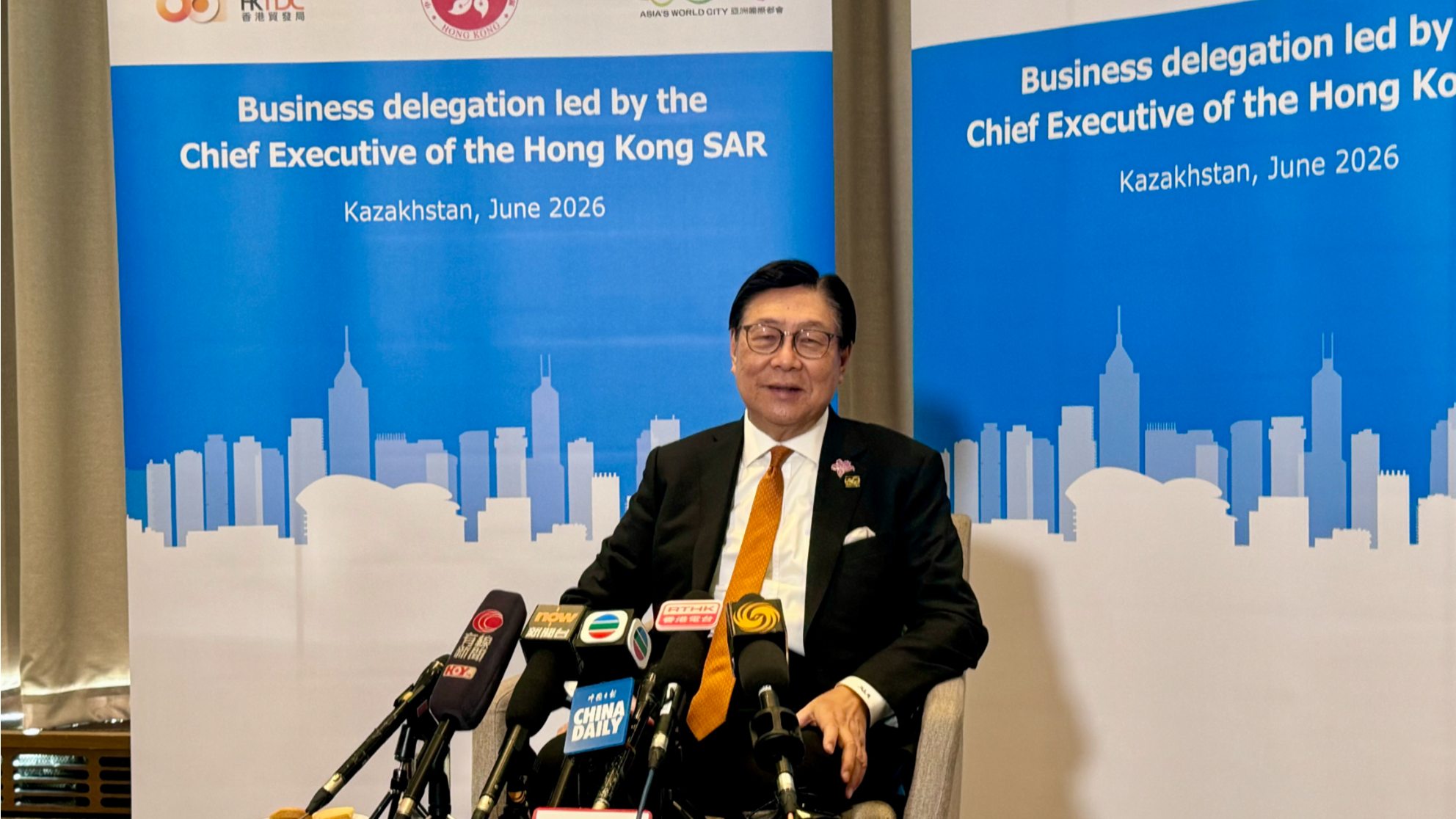
As the Hong Kong Trade Development Council (HKTDC) celebrates its 60th anniversary, its chairman, Frederick Ma Si-hang, speaks on Straight Talk about what's in store for Hong Kong trade for the next 60 years, what came out of the latest trade delegation to Central Asia, and how he hopes the convention center in Wan Chai can expand to meet Hong Kong’s growing needs.
Check out the full transcript of TVB’s Straight Talk host Eugene Chan’s interview with Frederick Ma:
Chan: Welcome to Straight Talk. I'm Eugene Chan. What's in store for Hong Kong trade in the next 60 years? To discuss this with us this evening is Frederick Ma, the chairman of the Hong Kong Trade Development Council. A former secretary for financial services and the treasury and secretary for commerce and economic development, Ma has extensive experience spanning banking, finance, international business and public service, bringing a wealth of insight into this discussion. He was awarded the Gold Bauhinia Star in 2009. Thank you for joining us again, Fred.
Ma: Thank you, Eugene.
Central Asia mission outcome
Chan: Firstly, congratulations on the Trade Development Council’s 60th anniversary. Time has gone very quickly. Before we look into the next 60 years, maybe we can start by telling the viewers a bit more about the HKTDC and the role it plays to help Hong Kong in connecting with the world.
Ma: Thank you, Eugene. HKTDC was established in 1966. So, this is our 60th anniversary birthday. And when it was established 60 years ago, the whole idea was to promote trade for Hong Kong. Hong Kong, as you may know, 60 years ago was a light industry hub. We produced textile, toys, electronics, and even wigs, and we sell overseas. And from then on, Hong Kong has transformed itself from a manufacturer to a design center to a service center today. And we're now also, you know, pushing companies to go overseas, I mean, (Chinese) mainland companies to go overseas. So, our role has changed in the last 60 years a lot. But we're doing it for Hong Kong. We are transforming Hong Kong from a small, shall I say, manufacturing hub, into today's ... We are No. 5 in merchandise trade after the mainland, the United States, the Netherlands, and Germany. We are well ahead of countries like the United Kingdom, Japan and others, France. So, I think we should be proud of that.
Chan: Chairman, today is a very special day because actually earlier today, we held a cocktail reception and what we call as “Next 60 Forum.” Maybe the world would watch it on television, but I'm sure they would like to hear from the chairman's mouth what inspired this forum to be held. And I understand many of the past chairmen have also appeared as well.
Ma: Yes, well, this is our 60th birthday. And as I mentioned earlier, we have gone through a lot and we have witnessed the change of Hong Kong's economic landscape. So, we gathered the former chairmen to talk about what they envisage for Hong Kong, for TDC in the next 60 years. It's too lengthy to tell you what exactly they said. You have to go back to the tape to watch what they said. But basically, we are part of China, and China is also doing very well, transforming its own economy. I mean, you look at the EVs, for example. Twenty years ago, China didn’t have EV. Today, EV is a major industry in China and is also a major exporter to countries like Europe primarily.
So, as a result, the role of Hong Kong has also changed. We need to bring the mainland companies to go global, as the chief executive said in his Policy Address. Our role as a superconnector and super-value adder will not change. We continue to perform that. And as an international city, as an international financial center, we do it very well.
Chan: Chairman, let's move on to one of your Council success stories, which is the trade delegation sort of organized by TDC that was led by the chief executive recently into Central Asia earlier this month. We had Nicholas Ho, the Belt and Road commissioner, here earlier, telling us about the government's approach and plans, as well as the region's strong economic potential. Many of the business delegates were, I was told, were there for the first time. I'm sure you have talked to many of them. How did that, from that perspective, did the mission sort of meet the expectation? Or actually, has that experience actually shaped the confidence in entering into those countries? How do you feel?
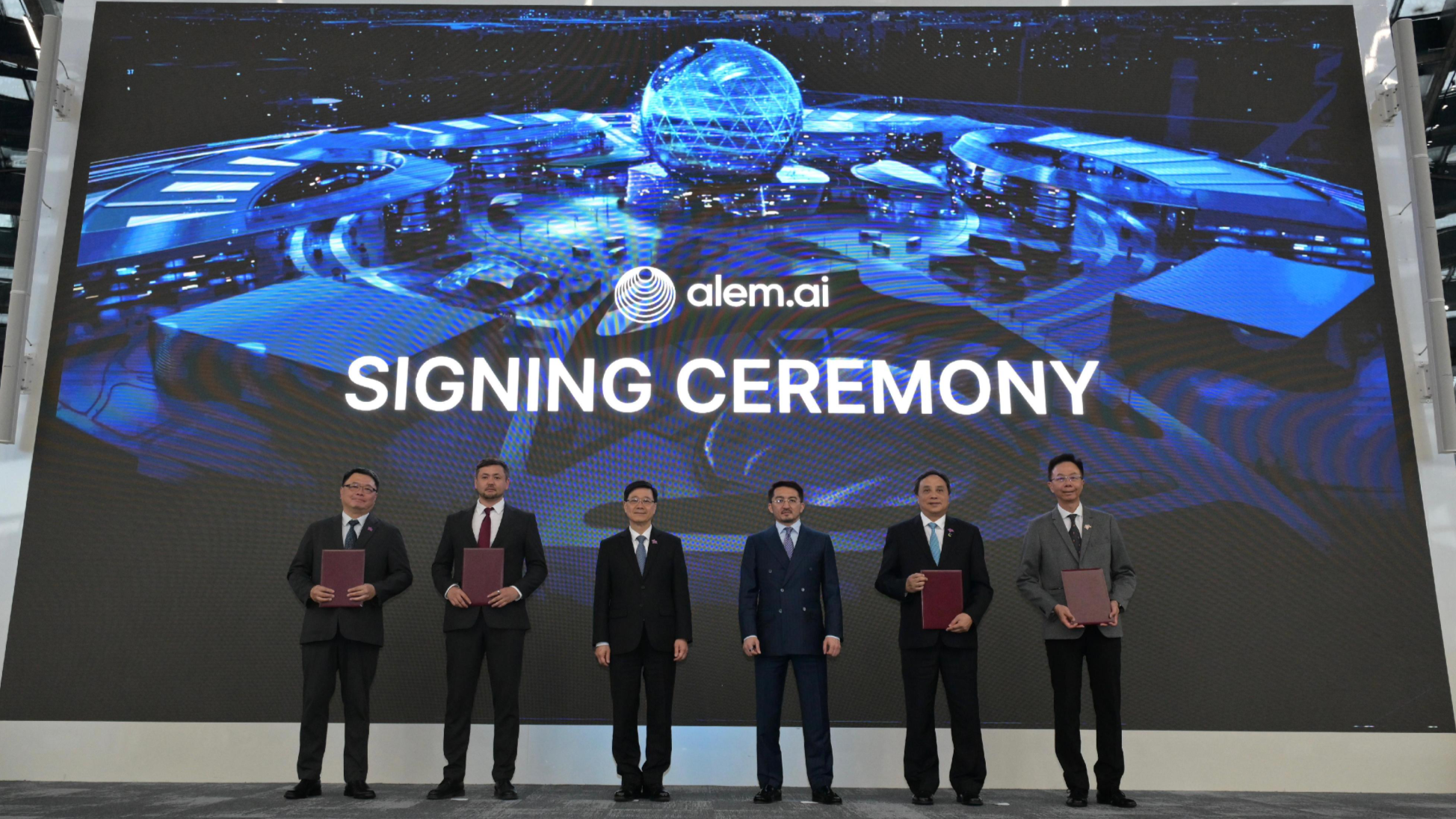
Ma: Well, first of all, I have been to Kazakhstan three times. This is my third visit with the Chief Executive. I called it a super successful mission. Why? Because we had signed 96 MOUs. Of those, 66 are trade and business-related. The others are related to education, culture, government, so on and so forth. Now, during the trip, it was announced that we would have direct flights from Hong Kong to Almaty, which is most welcome because without air traffic, it would be impossible to get there. You know, it takes about seven hours to go to Almaty. But if you have to change planes in, say, Korea or Beijing or other hubs, it will take very long. So, it would inhibit travel. It would inhibit business. So, this is a most welcome news announced by the chief executive. The chief executive also announced that Uzbekistan will open a consulate-general in Hong Kong, which is very good to facilitate further trade and further communication.
Chan: Right. Chairman, I mean, since you mentioned you've been there three times, I'm sure you met some of the leaders from the region. What is their immediate response? How do you feel about the sort of anticipation of such a large delegation, as you're talking about, like over 200 people attending to them? I mean, how do they respond to it?
Ma: Well, they clearly gave us the highest level of hospitality and attention. First of all, you know, the chief executive gets to meet the president and the prime minister in both countries. And the delegates were invited to the Uzbekistan palace to meet the prime minister with his ministers. So, we had a very, very high-level reception. The most important thing is that the media in the local market were extremely receptive to our visit. And even I was invited to be interviewed by local media in the local language and Russian. So, I would say the reception was at most high level and we have really, really hit the two countries with a lot of news.
We do a lot of business interaction during those five days. I'll give you some examples. For example, one of the delegates who joined the mission for the first time told me that three groups in Kazakhstan have approached him for a business opportunity to open hotel in Kazakhstan. Well, this group has many businesses, but one of them is hotel. And because of that, they're talking. And another good example is when we were in Uzbekistan, an Uzbekistan party asked us whether we would sell 100 buses to them. And as a result, we introduced three (Chinese) mainland car companies who were with us to them. Well, some people say, will this materialize? We don't know. But at least the first contact was made, which is very good. So, there are numerous examples of the success of the trip.
Chan: Right. Chairman, you kind of have sort of a sort of invisible eye looking at what I'm going to ask you next, because I'm sure many of the viewers will say, yes, we heard that 96 MoUs and agreements were signed, worth $1.6 billion, which is very encouraging. But MoUs are MoUs. I mean, how many of them will sort of materialize into proper businesses and agreements? Is there anything the TDC will sort of help to follow this through as well?
Ma: Not only TDC, but the government also wants us to follow through. We will follow through. As a matter of fact, after our visit, the deputy prime minister of Kazakhstan already brought another delegation to Hong Kong to promote one of their projects. And some of the Chambers in Hong Kong have already arranged some trade delegations of their own to these two countries. So, there are lots of interactions. As to whether business will materialize, it really depends on the people involved. It depends on the timing; a lot of factors could affect it. But I'm sure, you know, business is business. They will strive to make some money from this trip.
Chan: All right. Time for a short break now, Chairman. We will come back with more Straight Talk.
Welcome back to Straight Talk. Fred Ma, chairman of the Hong Kong Trade Development Council, is sharing some of the fruitful outcomes from our CE John Lee's recent trade delegation to Central Asia and the opportunities that have opened up for our city.
Opportunities for HK
Chan: So, Chairman, I mean, thank you very much for bringing us some good news that not only many MoUs were signed, the businesses are happening and you received a high level of reception by the countries and the cities, and they will be planning to come to Hong Kong. Very good news. I'm sure the Hong Kong viewers would like to know what you see as Hong Kong's attraction to them. Because we look for opportunities, always been financial services, and now we have more technology in Hong Kong and, especially, our professional services. Do you see that is our strength and attraction to them?
Ma: Absolutely. Geopolitically, as you know, the world is in a kind of difficult situation right now. Middle East, which is considered a stable region, is facing some headwinds. Many of the countries are looking to this part of the world. You just look at how many senior leaders have visited Beijing. You understand what I'm talking about. And for Hong Kong, we are part of China, and yet we are an international city. We have our own common law system, independent judiciary, arbitration centers, free to travel, free to meet your money here, as long as it's legitimate money. And we have excellent professional services. So, everything works our way. And as a result, many people are looking to Hong Kong as a safe haven. Hong Kong was ranked number one in wealth management recently. That's no small achievement. It's a huge achievement.
And other than that, as I said earlier, we are the fifth largest merchandise trading hub in the world. Again, for a small city of 7 million people, that's a huge achievement. To be an international financial center, ranked number three at the moment, is also another landmark achievement we should be proud of.
Chan: Right.
Ma: So, with all those, we are very attractive to foreign businesses. Stable, with all those credentials I mentioned before. They love Hong Kong. They all want to come to the Hong Kong Special Administrative Region (HKSAR) to establish as a base and to do their business not just here, but in the Chinese mainland. And as a result, we are in a very good position, Eugene, to be the super-connector and super-value-adder.
Chan: Right, Chairman. I understand that out of the 75 sort of companies that went with you to the two cities, 30 of them are major Chinese enterprises. As you know, there have always been direct connections between the mainland companies and Central Asia. So, what role does Hong Kong have to play? We have seen the 15-Five-Year Plan says that the HKSAR must help mainland businesses to sort of explore a pathway overseas. But is our role sort of diminishing or do you think that we are actually increasing our role?
Ma: I actually see our role being increased. Why? Number one, you're right. Some of the companies from the Chinese mainland have already been operating in Central Asia. Actually, in Kazakhstan, there are over 3,000 Chinese mainland companies. However, you must remember that China is also transforming. I mentioned EV as an example, but there are many, many industries that are doing well in China. And take, you know, biopharmaceutical. You know they're doing very well. And one company that joined us from the Guangdong-Hong Kong-Macao Greater Bay Area was saying it would like to establish a manufacturing base in Uzbekistan and capitalize on the 38-million-population country to sell their products.
So, you can see that there are lots of opportunities. And also for Hong Kong, we are bringing some new companies to Central Asia as well. So, I think there are lots of opportunities and for them, we are performing a very different role this time. Let me give you an example. We were entertained by the largest bank in Kazakhstan over a dinner. And one of the companies from the Chinese mainland actually knows the bank because they were banking with them. But then they had never met the chairman. We introduced the chairman of the bank to them.
Chan: Oh, really? Oh.
Ma: So, they were very impressed. And they said, oh, it's fantastic that by joining this mission, we got to meet the chairman of the bank and cement their relationship. See, this is where Hong Kong can add value to them. And also, they started to appreciate how Hong Kong, as an international city, as an IFC, can help them by having their regional base set up in Hong Kong.
Chan: Right, Chairman. It's very encouraging to hear that because I think I had the opportunity to attend some of these delegations before, and I think people-to-people contact is the most fruitful outcome, especially, as you said, as the chairman can meet the counterparts.
Ma: Absolutely. Our job is to connect them. Our job is to give them the opportunity to meet the local business people and see the opportunities that are available. Now, whether they strike the deal or not, of course, it's up to them.
Chan: Since you've been there three times and you meet all the important people, Hong Kong traditionally is very strong in financial services. Hopefully, we get some deals for the infrastructure one day. But how about other areas? Do you see other areas, such as green energy, sort of technology or anything else that you see an immediate collaboration potential between Hong Kong and Central Asia? Is there anything that you have noticed?
Ma: Yes, I do see cooperation opportunity in those areas. We try to sell our strength in green energy, solar and things like that to them. And because they are a major producer of oil and natural gas, there are many opportunities that we can explore.
HKTDC's role
Chan: Right. Fred, earlier when we spoke before the show, you said TDC is going to have sort of a stronger presence in Central Asia. Can you elaborate on that a bit more so that our viewers will know that they will look for TDC and especially helping the SMEs as well?
Ma: Well, TDC has 51 offices around the world. We have one office in Almaty, which is what we call a consultant office. It's not a full service, not a full office yet. After this visit, we will seriously consider upgrading it to a full office. But that will take time because we have limited resources and we need to make sure that we put the resources in the right place. Central Asia, after CE's visit, is certainly an area that we want to look at seriously and see how we can help HKSAR companies, Chinese mainland companies to go into Central Asia.
Chan: Right, Chairman, I thank you so much for telling us what's the latest in the delegation, knowing that Hong Kong has more opportunities. If we go back to the title of the show today, looking at the next 60 years, today we're at the forum, how do you see Hong Kong re-engineer or redevelop in the next 60 years and how is TDC going to support it?
Ma: No question. Hong Kong is going to do better in the next 60 years. The HKSAR, being part of China and China is doing well, we will benefit from that position. And TDC being part of the system, we'll try our very best to help Hong Kong's companies, including the SMEs, to break into new markets and as well as some new trade. We want to do that, and we will do that. And I'm sure my colleagues in the future will do a very good job.
Looking ahead
Chan: Chairman, I'm going to ask you a final question directly. Being a person who has achieved so much for yourself in Hong Kong …
Ma: You’re too kind.
Chan: … and being the chairman of HKTDC, what would you like to achieve during your tenure? I would say, in particular, in the area of expanding Hong Kong's footprint into the Belt & Road?
Ma: Well, two things I really want to achieve. One is, like you said, to expand into some new market like Belt and Road. Our predecessors have broken into many markets, such as Africa and Europe and North America before. But Belt and Road countries are new markets. So, I really want to break into that. Another thing I really want to achieve is to see whether we can find land to build another Convention Center. Because our current Convention Center is too small. We only have a net area of about 700-something thousand square feet. That's too small for Hong Kong. Of course, you have AsiaWorld-Expo and all that. But I think for the Convention Center, we could use more space. Once you have more space, you'll be able to do a lot more. Look at Kai Tak. See what Kai Tak can do for Hong Kong. We need the space. So, we are doing some feasibility study to see how we can expand our Convention Center, current Convention Center, and a new convention center to see how we can expand our physical location to accommodate.
Chan: I must say I'm very excited to hear about that. I'm sure it will happen under your leadership. And thank you so much for sharing this piece of good news with us. As we have just heard, the next 60 years of trade lies in emerging markets, new economic corridors, and deeper regional partnerships. As the CE said in his speech in Tashkent, “… a partnership built on gold, on bringing together our professional and financial services and Central Asia's rich mineral resources will be a golden opportunity….”
Have a good evening and see you next week.
