

President Xi, visiting PM Rahman announce building of community with a shared future
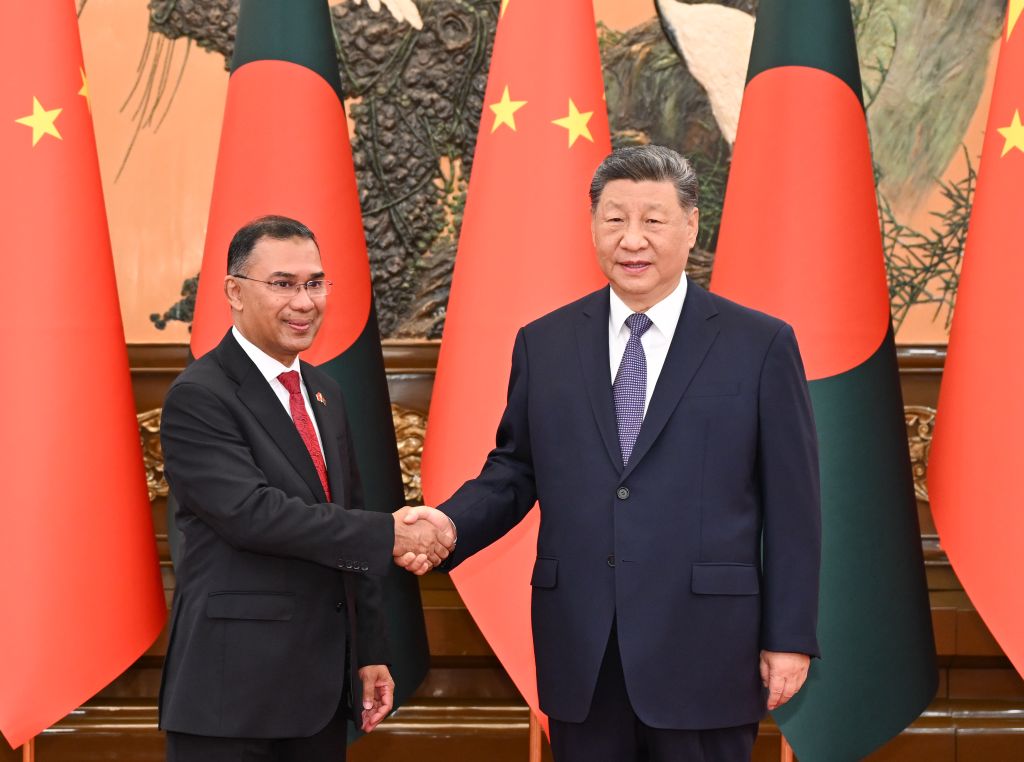
President Xi Jinping and Bangladeshi Prime Minister Tarique Rahman jointly announced the building of a China-Bangladesh community with a shared future in the new era, lifting bilateral relations to a higher level.
The decision came as Xi met with Rahman in Beijing on June 26 during the Bangladeshi leader’s three-day official visit, which was his first overseas trip since taking office in February.
“China has always attached great importance to its relations with Bangladesh, and has followed a good-neighborly and friendly policy toward the Bangladeshi people,” Xi told Rahman.
“No matter how the international situation changes, China will stay firmly committed to the overall direction of China-Bangladesh friendship,” he said, adding that China will remain Bangladesh’s trustworthy good friend, good neighbor, and good partner.
Xi expressed China’s support for Bangladesh in safeguarding its national independence, sovereignty, and territorial integrity, and rejecting external interference.
He called on the two countries to increase exchanges on governance, enhance ties at all levels, deepen strategic communication, strengthen political mutual trust, and continue supporting each other on issues related to their core interests and major concerns.
Xi stressed Beijing’s commitment to the principle of amity, sincerity, mutual benefit, and inclusiveness, saying that China will continue to provide neighboring countries with new opportunities and fresh dynamism as it grows.
He voiced China’s support for the new Bangladeshi administration’s governance efforts and expressed readiness to work with Bangladesh to advance high-quality Belt and Road cooperation, better align development strategies, exchange development experience, and make sound plans for the orderly cooperation in priority areas.
The two sides should tap the cooperation potential in green and low-carbon development, the digital economy, information technology, and artificial intelligence, while conducting exchanges in healthcare, culture, and education, as well as at subnational levels, Xi said.
He also called for efforts to advance the China-Myanmar-Bangladesh Economic Corridor for greater regional connectivity.
Xi said that China is ready to strengthen communication and coordination with Bangladesh within multilateral frameworks, including the United Nations, to jointly promote an equal and orderly multipolar world and a universally beneficial and inclusive economic globalization, and to better uphold the legitimate rights and common interests of the two countries and the interests of the Global South.
Rahman said that China remains the “most valued and trusted partner” of Bangladesh. He said his country is deeply impressed by China’s historic transformation under Xi’s leadership and considers Chinese modernization an example to follow.
He reaffirmed Bangladesh’s commitment to the one-China principle and Dhaka’s opposition to “Taiwan independence” in any form.
Rahman said that Bangladesh fully supports Xi’s vision of building a community with a shared future for humanity and the four global initiatives proposed by Xi, noting that these are of great significance in order to safeguard global peace and development as well as international fairness and justice.
On June 26, Zhao Leji, chairman of the Standing Committee of the National People’s Congress, China’s top legislature, also had a meeting with Rahman.
Observers noted that the Bangladeshi leader’s visit to China came at a time when the two countries are ushering in the next golden 50 years of diplomatic relations, and that this trip will help bilateral ties move forward with stronger political mutual trust, deeper practical cooperation, and closer international collaboration.
M. Humayun Kabir, president of the Bangladesh Enterprise Institute, wrote in an article published by The Daily Star newspaper that the visit reflects Bangladesh’s pressing economic needs, with Chinese investment and infrastructure cooperation remaining high on Dhaka’s agenda.
Yao Wen, Chinese ambassador to Bangladesh, wrote in a signed article in Bangladeshi media that the visit, which has come early in Rahman’s tenure, underscores Bangladesh’s high regard for its relations with China.
Contact the writers at zhaojia@chinadaily.com.cn
