

In 2025, city generated more than 450 billion yuan in core industry output
On the top floor of a converted office building in Wudaokou, a popular neighborhood in Beijing's Haidian district that is famous for its close distances to leading universities, a crowd gathered around a robot trying to pick up tennis balls.
The contestants were not seasoned engineers from China's biggest technology companies. Many were university students. Nearby, founders discussed open-source robotics projects. Investors drifted between tables. Entrepreneurs exchanged business cards over coffee.
Han Yaqi, branding head of the company that operates Beijing AI Genesis Community, one of Beijing's growing networks of artificial intelligence startup hubs, said, "Sometimes you come here for a cup of coffee and end up meeting your next investor."
The scene offers a glimpse into why Beijing has emerged as China's AI capital. The city last year generated more than 450 billion yuan ($66.4 billion) in core AI industry output, hosted more than 2,500 AI companies and nearly 40 AI unicorns, accounting for more than half of China's total. Beijing is also home to 241 registered large language models, more than any other city in the country.
Behind those numbers lies something more difficult to quantify: a dense ecosystem where universities, startups, investors, manufacturers and policymakers increasingly operate within walking distance of one another.
"Beijing AI Genesis Community is not just an incubator," Han said. "It connects the entire chain, from university research to commercial innovation."
That ecosystem is becoming increasingly important as China seeks to transform AI breakthroughs from laboratory achievements into commercially viable products.
While Silicon Valley remains synonymous with software innovation, Beijing is betting that the next phase of AI will be built around deep integration between research, hardware, manufacturing and real-world deployment.
Beijing has also spent years laying the groundwork. Research and development spending accounts for more than 6 percent of Beijing's economic output, a level comparable with leading global innovation centers. Basic research represents roughly 16 percent of total R&D spending, among the highest shares internationally.
The authorities have launched more than 800 major research projects across fields including AI, semiconductors and biotechnology. The results range from the open-source RISC-V processor core to quantum computing cloud platforms and advanced scientific instruments.
Increasingly, however, policymakers want those breakthroughs to leave the laboratory.
Under Beijing's embodied intelligence development plan, the capital city aims to achieve more than 100 key technological breakthroughs in humanoid robotics and embodied AI by 2027, while producing at least 10 globally leading hardware and software products.
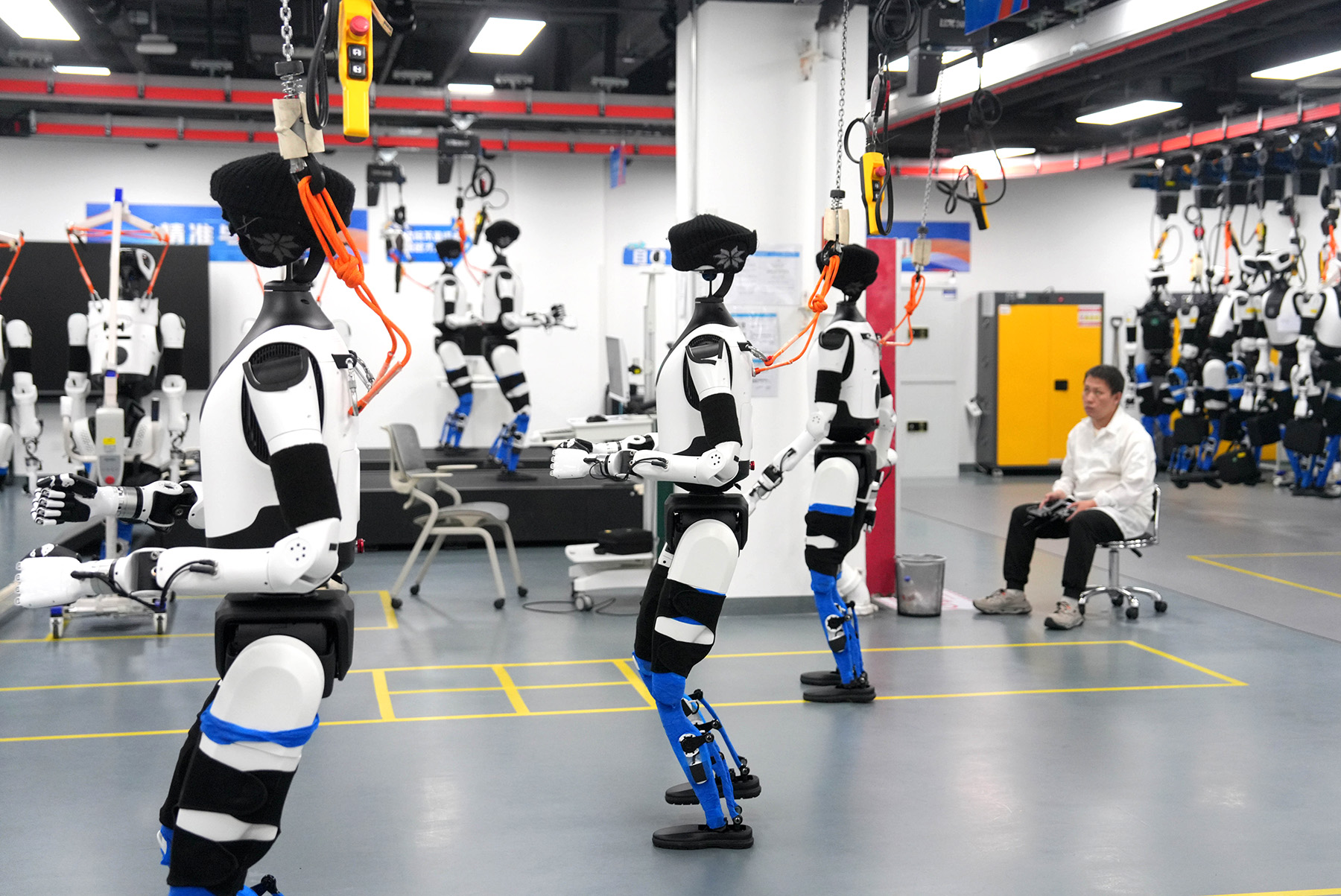
That ambition is already visible inside Beijing's emerging robot industry. Engineers at the Beijing Innovation Center of Humanoid Robotics are building what resembles a miniature automotive factory.
The facility serves as a pilot manufacturing and testing platform where companies can validate designs before committing to mass production. From actuator assembly and joint manufacturing to full robot integration and testing, the center covers the entire production process.
Huang Zhe, head of production at the center, said: "We can build a complete robot here in one to two days."
The pilot platform of the center became operational this year and currently has an annual pilot production capacity for about 5,000 embodied robots, Huang said.
"The goal is not simply manufacturing efficiency. It is shortening the distance between invention and commercialization," he said.
China's robotics industry increasingly faces a challenge familiar to many AI startups worldwide: moving beyond impressive demonstrations.
In another part of the city, robots are practicing tasks that appear deceptively simple. One repeatedly folds clothes. Another assembles cardboard boxes. A third attempts to tie shoelaces.
For humans, these are routine actions. For robots, they represent some of the hardest challenges in embodied intelligence.
"Clothes are deformable objects. They don't have fixed shapes. A robot can't handle them the same way it handles a solid block," said Li Yao, vice-president of Noitom Robotics.
Such exercises are not designed for household chores alone. The same capabilities are needed for future deployment in factories, warehouses and logistics centers, where robots must manipulate objects of varying shapes, textures and physical properties.
Nearby, another robot trains on a replica automotive production line. The machine picks up piston tubes, inserts them with precision, moves empty trays aside and returns for the next task.
The production line mirrors one at an international automotive supplier where the robot is expected to begin commercial operations later this year.
For Beijing's AI industry, the challenge is increasingly practical: not whether robots can perform impressive tricks, but whether they can generate economic value.
That shift is also reshaping how startups are built. At Zhongguancun AI North Latitude Hub, more than 100 AI startups, including one-person companies, are developing products ranging from laboratory automation systems to embodied intelligence applications.
Inside one startup, a robot learns how to grasp test tubes and dispense liquids with precision. The founder, Chen Kai, also teaches at a nearby institution. Half of his employees are his students.
The arrangement reflects another unusual feature of Beijing's AI ecosystem: the increasingly blurred boundary between universities and startups.
A three-minute walk connects the startup incubator to Zhongguancun Academy, a new education and research institution designed specifically to commercialize advanced technologies.
Students come from 31 partner universities and are selected through an unconventional process. Rather than traditional entrance exams, candidates must build AI projects within 12 hours.
The objective is not simply academic excellence.
"We want people who can solve real-world problems," Chen said.
Students work directly with startup founders, chief scientists and entrepreneurs. Many launch companies are still conducting research. The institute currently supports around 120 research and industrial projects.
"Our goal is to help students transform immature ideas into commercial products," said Dong Bin, the academy's executive vice-president.
ALSO READ: Finance sector keen to boost robotics industry
The model reflects a broader effort by Beijing to bridge what policymakers often describe as the "last mile" between scientific discovery and industrial deployment. The strategy is also increasingly aligned with China's broader industrial priorities.
As competition intensifies globally in AI, semiconductors and robotics, Beijing's advantage may not come from any single breakthrough technology.
Instead, it may stem from concentration. Together they form a miniature supply chain covering hardware, data services, open-source frameworks, AI models and downstream applications.
For startups, proximity matters.
Sun Changku, vice-president of Quantaeye, recalled discovering a potential business partner simply by walking upstairs.
"We were working on water utility applications," he said. "Then we found another company in the building focused on the same industry. Collaboration happened naturally."
Contact the writers at chengyu@chinadaily.com.cn
