

TOKYO – The Japanese government plans to rename the Air Self-Defense Force (ASDF) as the "Air and Space Self-Defense Force" within fiscal 2026, further extending Japan's security framework into outer space, a move that has sparked concerns in Japan over military expansion, according to a report by the Nikkei.
The report published on Sunday said relevant legislation is currently under deliberation in parliament. If enacted, it would mark the first change in the names of Japan's Self-Defense Forces since the establishment of the Ground, Maritime and Air Self-Defense Forces in 1954.
The move is intended to formally designate space as one of the operational domains of the Self-Defense Forces, the report said, noting that the renaming would represent "not merely a change in title, but an important milestone in the expansion of Japan's security concept."
Japan has already established and steadily expanded units dedicated to space-related operations. The country's space force originated in 2020 with the launch of the Space Operations Squadron, which initially consisted of around 20 personnel.
ALSO READ: Japan begins shipping missile launcher to easternmost island
The unit was reorganized into the Space Operations Group in 2022 and further expanded into the Space Operations Wing in March 2026, increasing its personnel strength to 670. During fiscal 2026, Japan plans to further upgrade the wing to a space operations command, expanding the force to approximately 880 personnel.
The development has fueled concerns among the Japanese public over the country's expanding security agenda. In comments posted on the news website, many Japanese citizens questioned the government's continued enlargement of the scope of national security and its increases in defense spending, arguing that such policies could place greater pressure on public finances and reduce funding available for social welfare.
During a recent parliamentary debate, Tomoko Tamura, chairperson of the Japanese Communist Party, warned that the government's move would mean that the Self-Defense Forces would formally undertake space combat missions, bringing outer space further into the realm of military competition and potentially intensifying the space arms race.
Large protest in Tokyo
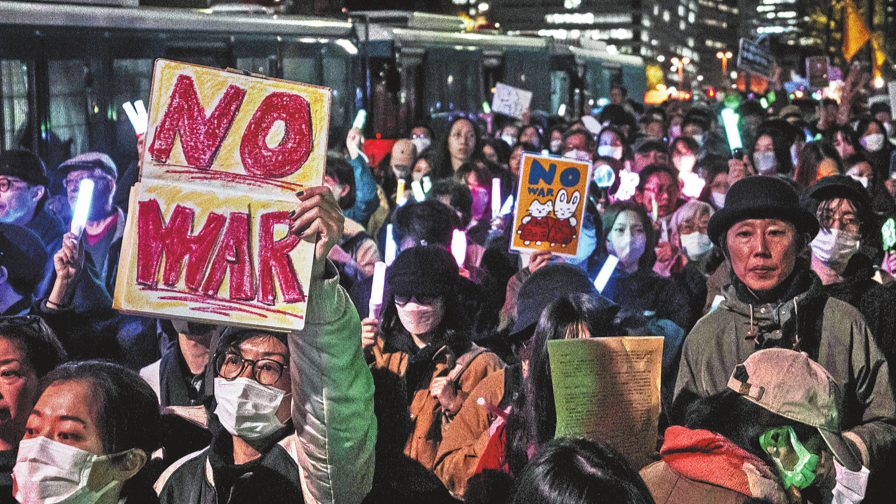
Meanwhile, a large number of Japanese people took to the streets in Tokyo on Sunday afternoon to protest a series of military expansion policies recently pursued by the government of Prime Minister Sanae Takaichi and the ruling Liberal Democratic Party (LDP).
Demonstrators, many wearing helmets bearing the words "Anti-war" and "Peace," chanted slogans such as "No to constitutional revision" and "Stop war."
Organizers said that the Japanese government, while touting the country as a "peace-loving nation," has continued to strengthen the Japan-US security alliance, expand the Self-Defense Forces (SDF), and accelerate its push toward remilitarization, warning that such moves could lead Japan down the path toward war.
One protester, identified as Kashimura, told Xinhua that prices in Japan keep rising, tax burdens continue to increase, and social security spending is growing.
READ MORE: Japan's remilitarization slammed
"At the same time, the government is pushing for legislation that would restrict freedom of expression and suppress anti-war voices. People will lose the space to express themselves freely," Kashimura said.
Another protester, Junko Kaji, said there is little meaningful opposition within the Japanese parliament, with war-related bills being passed one after another.
"Today, large numbers of workers and ordinary citizens have gathered around the Diet (Japan's parliament). Only by bringing down the Takaichi administration through public opposition can war be prevented," she said.
In recent months, Japan has continued to strengthen military deployments in areas including Okinawa, while seeking to bolster its so-called "defense capabilities" through the formulation and revision of relevant policy documents.
On June 9, the LDP approved a draft proposal on revising the country's three key security documents within the year.
The proposal not only called for further increases in defense spending but also urged raising the manning rate of SDF reserve personnel to prepare for contingencies. These developments have sparked widespread public concern.
