

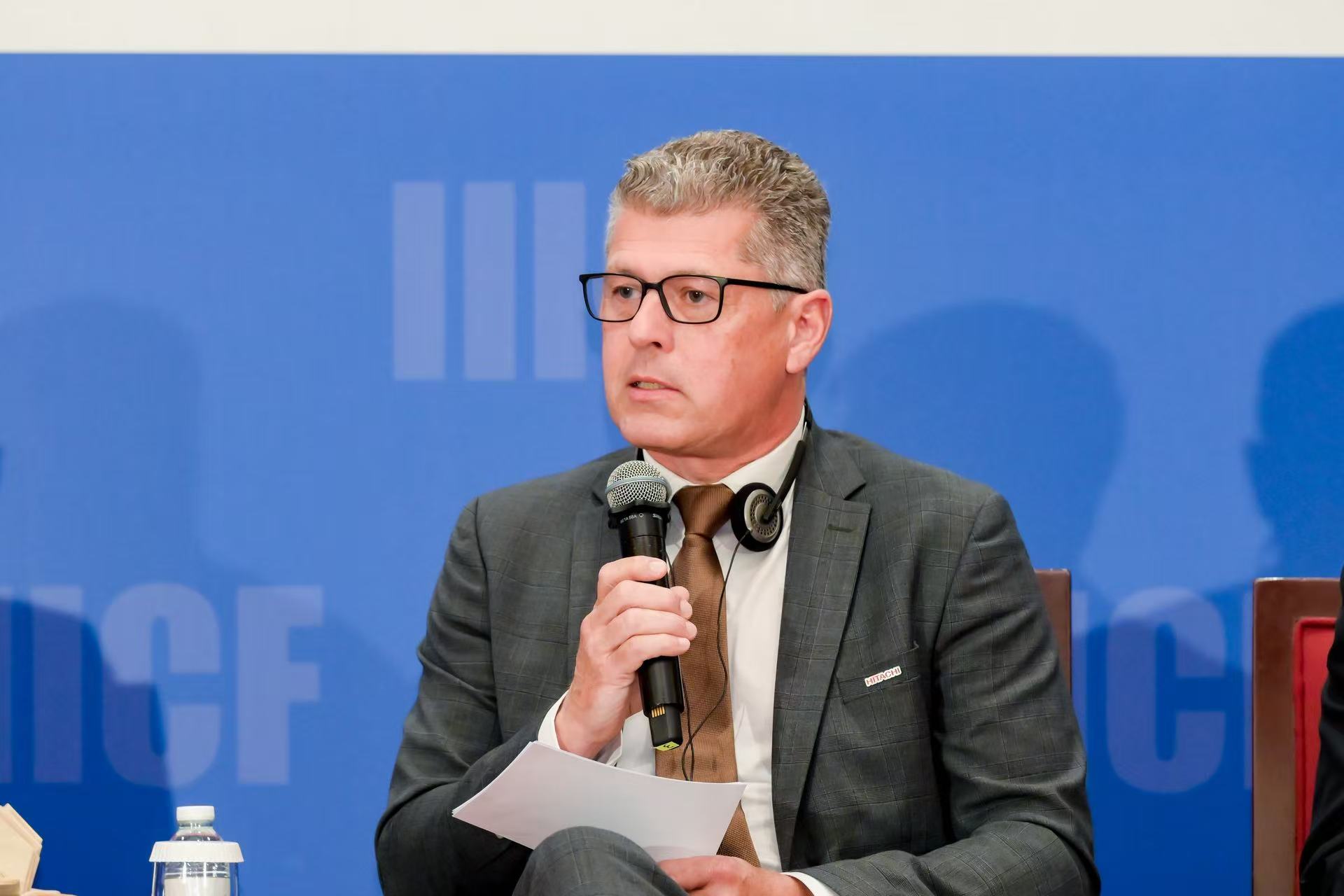
Disruptions to global energy supplies arising from conflict in the Middle East have highlighted the importance for Asia and the world to build a more resilient energy system, according to Wolf Mueller, CEO of the service business unit and executive vice-president of Swiss-based technology company Hitachi Energy.
China has an increasingly important role to play in the global energy transition, Mueller said in an interview with China Daily at the 17th International Infrastructure Investment and Construction Forum and Exhibition being held in Macao from Wednesday through Friday.
“The current oil-induced crisis reinforces the need to accelerate renewables, electrification, and grid investment to reduce exposure to volatile global fossil fuel dependencies.”
Noting that electricity security now underpins national security, Mueller said that countries need to treat power as critical infrastructure.
“In general, China is in a favorable position for energy security,” he added, attributing this to the country’s highly diversified energy mix and its role as the world’s largest renewable energy market, strong hydropower and nuclear growth, and a highly connected grid network.
Themed “Boosting Green Digital Infrastructure Connectivity”, the forum in Macao, the annual highlight of the global infrastructure sector, was jointly organized by the China International Contractors Association and the Macao Commerce and Investment Promotion Institute.
A parallel Hitachi Energy Thematic Forum, “Reshaping the Global Infrastructure Ecosystem through Lifecycle Partnership”, took place on Wednesday, with the aim of building an open, collaborative and sustainable ecosystem supporting high-quality global development.
Noting that China aims to build a new type of energy system during the 15th Five-Year Plan (2026-300) period, Mueller said this presents significant opportunities for the company.
“We see growing demand across the full lifecycle of power equipment – from maintaining and modernizing assets to advancing digitalization and the low-carbon transition of infrastructure,” he said.
In Ningbo, East China’s Zhejiang province, the company delivered the world’s first 550 kilovolt sulfur hexafluoride-free retrofill solution for existing gas-insulated lines at the Zhejiang Beilun power plant.
In addition to energy security, Mueller said there has been a surge in demand for electricity driven by the rapid adoption of artificial intelligence, with the defining challenge of the “electricity era” centering on relatively slow grid expansion.
“The fastest lever we have today is to make better use of what already exists and optimize current energy infrastructure,” said Mueller, noting this is where the convergence of AI and energy becomes critical as energy powers AI, and AI unlocks the energy system.
In China, Mueller said the company has been deeply involved in projects related to new grid technologies and modernization of power systems, and he believes the country has an important role to play in addressing the global energy challenge.
“With experience in building and operating one of the world’s largest and most advanced power grids, China offers a proven model for integrating renewables at scale and meeting rapidly growing electricity demand, including from emerging sectors such as AI,” said Mueller.
For example, leveraging initiatives such as “East Data, West Computing”, China is aligning computing demand with renewable-rich regions, while accelerating the development of high-value “AI + energy” use cases.
The scale and speed of the global energy transition require close global collaboration, and China will have a greater role to play in this, Mueller said.
Contact the writer at kelly@chinadailyapac.com
