

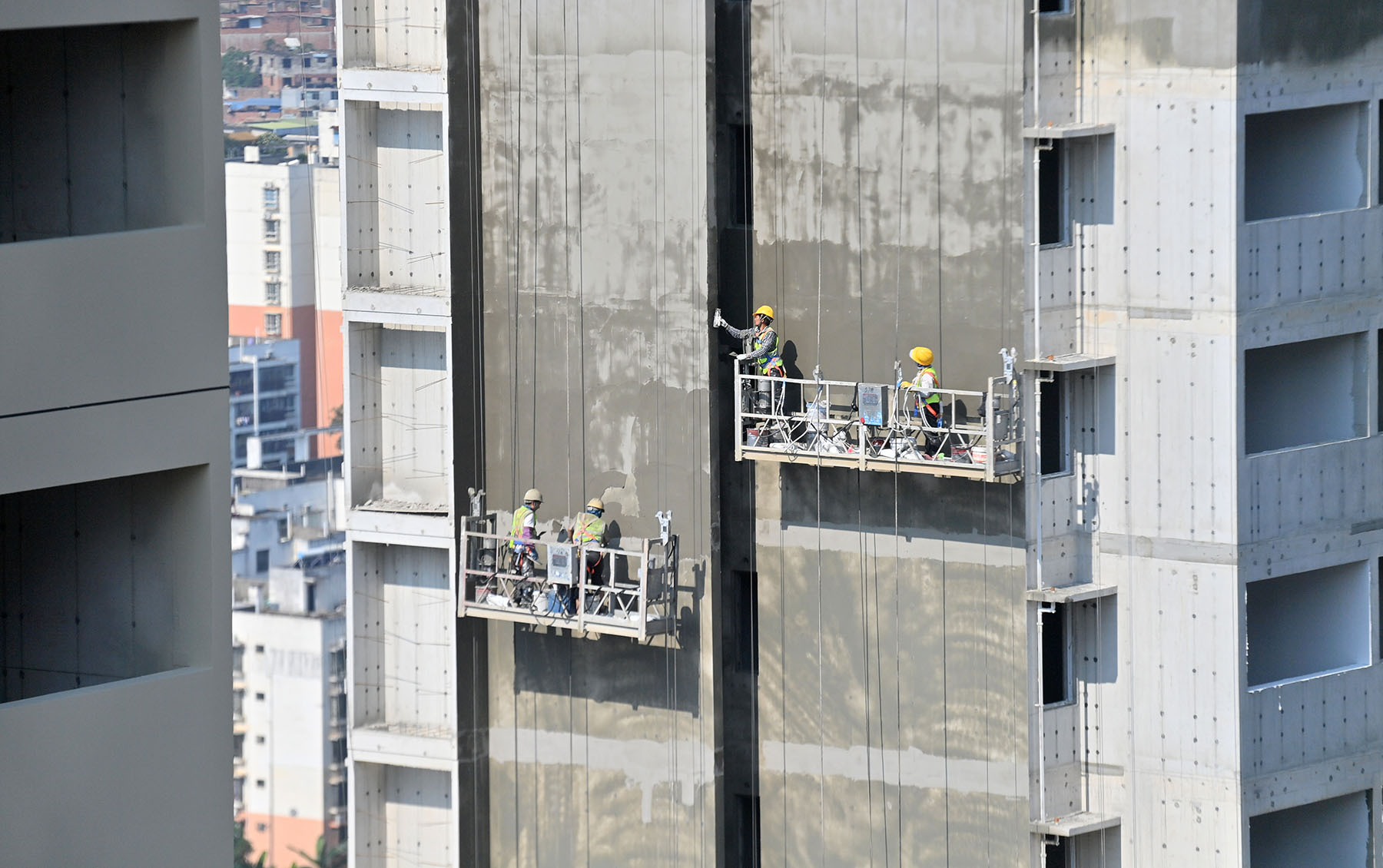
China will make full use of fiscal funds and bank credit while leveraging private capital as part of a broader drive to build a sustainable financing system for the country's urban renewal initiative, officials said on Friday.
The directive, part of China's first national urban renewal plan, seeks to diversify funding sources for a massive infrastructure upgrade that market watchers expect will require about 15 trillion yuan ($2.1 trillion) in investment during the 15th Five-Year Plan period (2026-30).
The plan — released by the State Council in late May — outlines quantitative targets, including the renovation of 500,000 dilapidated urban residential units, 115,000 aging residential communities, 1,500 aging industrial districts and factory zones, 4,000 urban villages, and 365,000 kilometers of underground pipelines by 2030.
READ MORE: Policymakers signal more policy support
In this context, China is expected to invest at least 15 trillion yuan in urban renewal projects during the 15th Five-Year Plan period, averaging 3 trillion yuan annually, said a research note by Huachuang Securities.
Guo Fangming, director of the Finance Ministry's economic construction department, said, "Central fiscal support will remain significant during the 15th Five-Year Plan period, and we will continue to optimize policy design to improve the efficiency of fund utilization."
The central government will allocate subsidy funds to support urban village redevelopment, renovation of aging residential communities and repair of dilapidated urban housing, Guo said.
The ministry will guide local governments in issuing special-purpose bonds to finance eligible urban renewal projects, Guo said, adding that central budget investment and ultra-long-term special treasury bonds will be channeled into underground pipeline networks and aging community renovations.
The National Development and Reform Commission said China has allocated 97 billion yuan from the central budget for urban renewal projects in 2026, focusing on the renovation of aging residential communities and dilapidated urban housing.
Meanwhile, the country's top economic regulator said it had also channeled an additional 160 billion yuan through ultra-long-term special treasury bonds to upgrade underground gas, drainage, water supply and heating pipelines this year.
Beyond direct fiscal support, the ministry will also apply preferential tax policies to eligible urban renewal projects, Guo added.
The fiscal push is part of a larger coordinated drive that began in 2024, when the Finance Ministry launched a pilot program supporting urban renewal in a select group of cities. Over three years, 50 key cities — including Beijing and Shanghai — have received central government block grants.
That pilot phase is being expanded under the new five-year plan. In May, authorities announced a new batch of 15 cities selected for this year's central financial support for urban renewal initiatives.
ALSO READ: Better use of housing fund encouraged
Vice-Minister of Housing and Urban-Rural Development Qin Haixiang said, "On top of using central fiscal funds, local special-purpose bonds and bank credit, we will fully leverage market mechanisms, actively attract private capital and encourage private enterprises to participate in urban infrastructure construction and operation."
This will build a sustainable urban construction, operational investment and financing system, Qin said, adding that the central government is drafting relevant urban renewal regulations at the national level, and localities will be supported to explore their region-specific legislation.
So far, four provincial regions and 20 cities have issued local regulations on urban renewal, providing legal guarantees for the smooth implementation of related projects, Qin said.
Contact the writers at wangkeju@chinadaily.com.cn
