

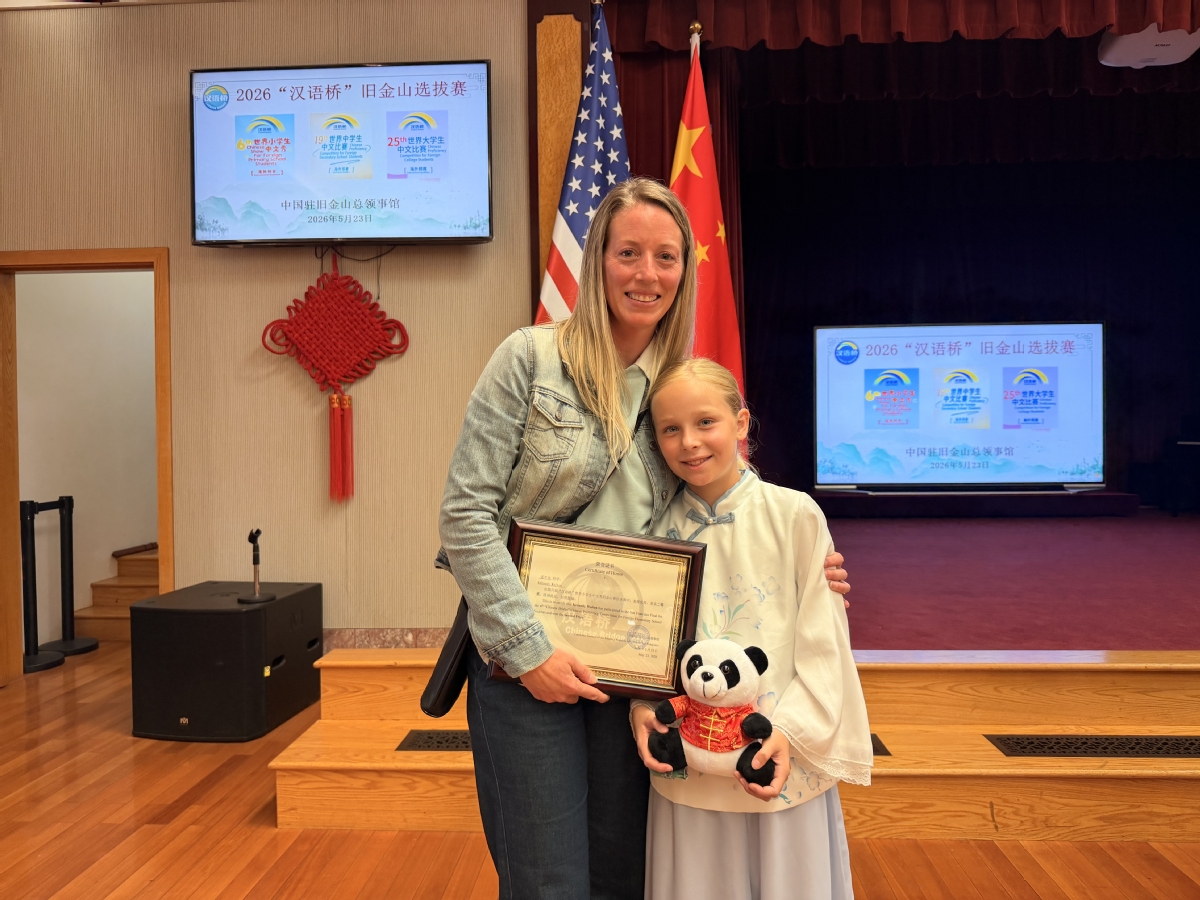
Kennedy Walton, 9, has been learning Chinese in the United States for five years, and her reason for sticking with it is straightforward.
"I think learning another language is powerful," she said, wearing a traditional Chinese outfit her father had bought in China.
The student at Hope Chinese Charter School in the US state of Oregon said that her father works with Nike selling shoes in China, and must rely on translation apps or friends who speak Chinese to get by.
"So I feel like if I ever grow up and go to China or a place that speaks a different language, I could use my language and communicate."
Kennedy placed second in the elementary school division of this year's "Chinese Bridge" preliminary competition, held on Saturday at the Chinese Consulate General in San Francisco.
She was one of 13 elementary, secondary and college students selected through qualifying rounds across several states. They competed before an audience of more than 80 students, teachers, parents and supporters from more than 20 schools.
The Chinese Bridge competition has grown into one of the world's largest Chinese-language contests. Last year, the event drew more than 1.8 million young participants from over 160 countries. Winners of the San Francisco consular district will advance to the global finals in China later this year.
"Chinese Bridge competition is a global stage for Chinese language learners to display their talents and pursue their dreams," Chinese Consul General in San Francisco Zhang Jianmin told competitors at the event. "Many students, in fact, like to refer to this competition as the Olympic Games of Chinese language learning."
Past competitors from the San Francisco consular district had won the global championship and the US regional championship on multiple occasions, Zhang said, adding that many went on to elite universities.
He cited two recent examples: Shiraz Rothschild, who won the 2024 US championship for secondary school students, is headed to Stanford University; Andrew Fowler, who took third place in the 2023 college-level global finals, will this year begin a master's program in archaeology at Peking University.
Journey toward fluency
Tori Howard, a ninth grader at Lakeridge High School in Oregon, won the secondary school division. For her competition speech, she reflected on the Chinese speakers she has met along the way and what they have meant to her journey toward fluency.
"The biggest thing is, it just gives you the opportunity to communicate with so many more people and make new friends," she said.
For Eli Marx, the payoff is now academic. He attended high school in Ohio, where he first picked up Chinese, and is now a sophomore at Stanford University majoring in East Asian studies. Marx won the college division at Saturday's competition.
"My research is focused on social media and interactions between China and the West on social media, so I can read the Chinese comments, watch the Chinese videos, see what Chinese people are thinking about the content they're getting from abroad, and also see what foreigners are thinking about China," he said.
"One thing I love about Chinese — it really does open up another world to me," said Marx, who has traveled to China multiple times. He says what keeps him going is the moment when he is "talking to someone in their native language and seeing them light up and be happy".
Contact the writers at liazhu@chinadailyusa.com
