

Systematic support sends nation's disabled athletes to top of Paralympic table
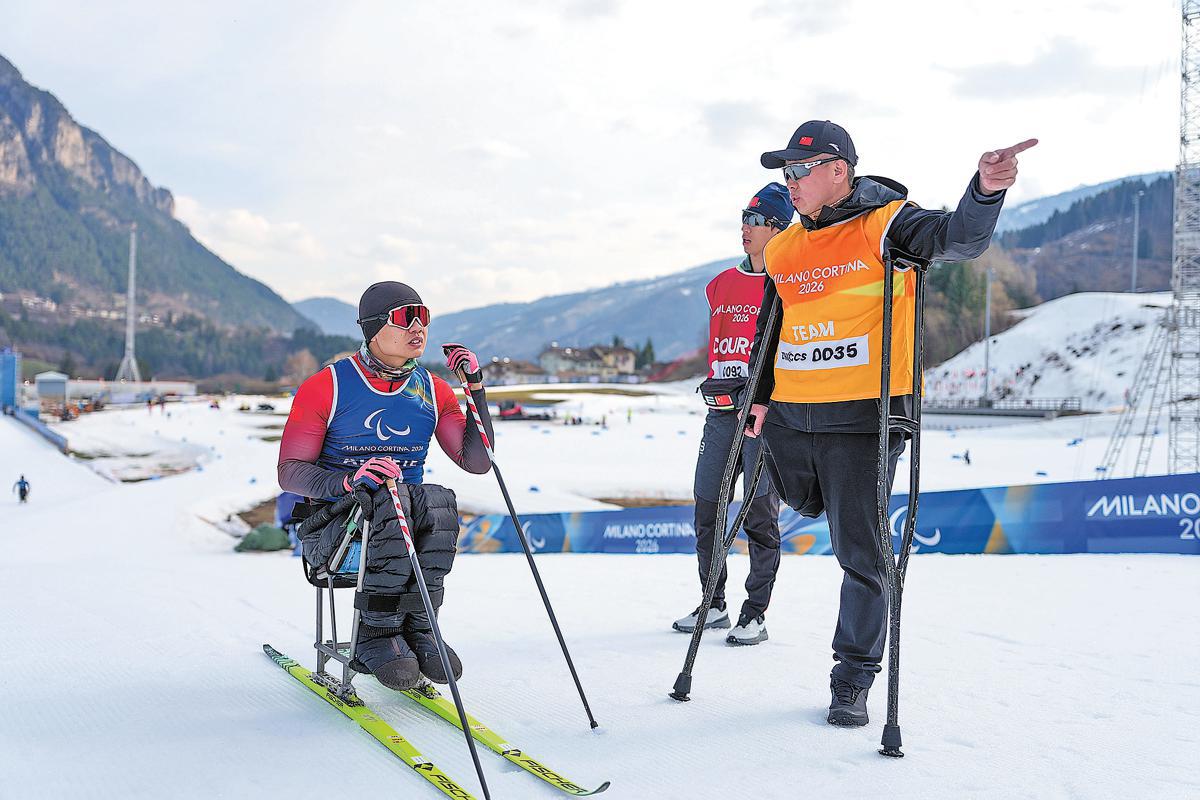
Two decades ago, when Chinese Paralympic athlete Fu Chunshan moved around on his crutches, the national flag on his skiing jacket would often peel at the edges or fall off entirely. With few resources and little funding, his team had no official outfitter and had to stick the flag on with adhesive tape.
"Before each competition, athletes from around the world would gather and gear up together in the preparation tent. We could not help looking on with envy as some European teams arrived with a full army of wax technicians, coaches, guides, team doctors and equipment managers," Fu said.
That memory, from the Turin 2006 Winter Paralympic Games in Italy, has stuck with him for 20 years. In that time, he has transitioned from a para cross-country skiing athlete to a coach, and has witnessed his nation's steady progress in bringing more people with disabilities into winter sports and achieving athletic excellence on the international stage.
At the Milan-Cortina 2026 Winter Paralympics, held from March 6 to 15 in Italy, the Chinese delegation topped the medal table with 15 gold, 13 silver and 16 bronze medals. It was China's best performance at an overseas Winter Paralympics since its debut in Salt Lake City in the United States in 2002.
Chang Zheng, vice-president of the China Disabled Persons' Federation and deputy head of the Chinese delegation, said China sent 70 para athletes to compete in 73 of the 79 events across six sports. "The extensive participation reflects a boom in engagement in ice and snow sports among people with disabilities," he said.
"Behind the team's sporting excellence lies the indomitable spirit of our para athletes, as well as a large group of skilled coaches, support staff, guides, technicians, medical and rehabilitation personnel, and scientific researchers," Chang added.
Of the 15 gold medals, the para cross-country and biathlon team that Fu coaches contributed 11.
"Foreign athletes now acknowledge our arrival with remarks like 'Here comes China'. During races, rival coaches will push their own athletes by pointing out that a Chinese competitor is ahead of them," Fu said. "The team's sporting success this year is beyond my dreams."
Fu, 42, lost his right leg in a childhood accident. He began training as a cross-country skier in the early 2000s and was one of eight athletes on China's delegation at Turin 2006. His best performance as an athlete came at the Vancouver 2010 Winter Paralympics, where he finished ninth.
"At that time, I was shy, intimidated and tended to crouch in a little corner to prepare for the race quietly," he said. "The mere arrival of some foreign teams, slick and well-equipped, was a formidable sight in itself."
What Chinese para athletes relied on, Fu said, was primarily mental toughness. "Regardless of inclement weather or poor snow conditions, we just went out, gave it everything and hoped to demonstrate what we had trained for," he said.
"At the same time, our early experiences overseas enabled us to observe and learn the drills of the world's best athletes firsthand — what equipment they used, how they waxed and how they maneuvered on the snow," he added.
Sometimes, Fu questioned himself: "Is it that we Asian athletes are somehow inherently incapable of rivalling Western athletes?" "But I soon waved off my doubts and concluded that the gap came down to inadequate training and support," he said.
A turning point came in 2015, when Beijing and the neighboring city of Zhangjiakou in Hebei province won the bid to host the 2022 Winter Olympics and Paralympics. "At the time, I set a goal of drafting a batch of athletes and helping them stand on the Paralympic podium," Fu said.
According to the China Disabled Persons' Federation, China's para snow sports entered a rapid development phase in 2016, bolstered by systematic support covering talent cultivation, venue construction, upgrades to training systems and hosting of competitions.
Since then, the number of winter Paralympic athletes nationwide has grown from fewer than 50 to over 1,000, and the number of technical officials has increased from zero to more than 100. The number of categories the delegation participates in has grown from just two to all six major Winter Paralympics events.
A key milestone was the opening of the National Ice Sports Arena for People with Impairments in late 2020, "which ends the longtime embarrassment of training in borrowed facilities during empty time slots".
Training has also become more diverse, integrating summer and winter sessions with both domestic and overseas programs, while a number of domestic para winter sports competitions are now held regularly, according to the federation.
The effort also includes greater public engagement. For instance, a winter sports season for people with disabilities, launched by the federation in 2016, attracts more than 300,000 visits annually.
For para cross-country and biathlon skiers, Fu said that they now have access to two year-round ski centers in the provinces of Jilin and Hebei, as well as overseas venues in Chile and Argentina for out-of-season training.
"My coach used to be in charge of everything — waxing the skis, driving us around, managing recovery and psychological therapy. And as an athlete, my mind wasn't just on the race. I was also preoccupied with tiny details, like whether a screw on my sit-ski might be loose," Fu said.
At the 2026 Winter Paralympics, Fu said China's para cross-country and biathlon team arrived with a support team of more than 40.
"Each athlete wears a heart rate watch or chest strap. Through a monitoring system, we calculate the optimal training heart rate and communicate with them in real time to ensure they can ski within a scientific heart rate zone," he said. "We also conduct blood lactate and morning urine tests regularly and adjust training plans based on their physical condition."
In winter para sports, equipment is essential. It determines whether athletes can navigate rough terrain at high speed, protect themselves in high-impact events, and push their limits.
Fu said the rapid development of China's manufacturing industry and long-term cooperation with a domestic company have turned his vision of equipping athletes with quality, homegrown pieces into reality.
"Taking sit-skis for example, we used to rely on equipment imported from Norway or Russia," he said. "Over the years, we have gradually switched to domestically made ones — first made with stainless steel, then later more advanced materials like aluminum and titanium."
At para biathlon competitions, athletes race different distances around a looped course and stop between laps to shoot. In preparation, Fu said the team trained six days a week. "In the evening, we also arranged for them to handle the rifle to maintain a feel for shooting," he said.
Athletes with visual disabilities use an electronic rifle guided by acoustic signals. To experience what it feels like to aim and shoot based on the pitch of the sound transmitted into their headphones, Fu and other coaches practiced the same way.
"The headphones give off a very noisy sound. After practicing for a long time, my ears will start ringing. This made me truly understand how difficult it is for athletes with visual disabilities," Fu said.
This system of people and programs, combined with the grit and adaptability of the athletes, has removed critical barriers for para athletes and helped them achieve high performances on the international stage.
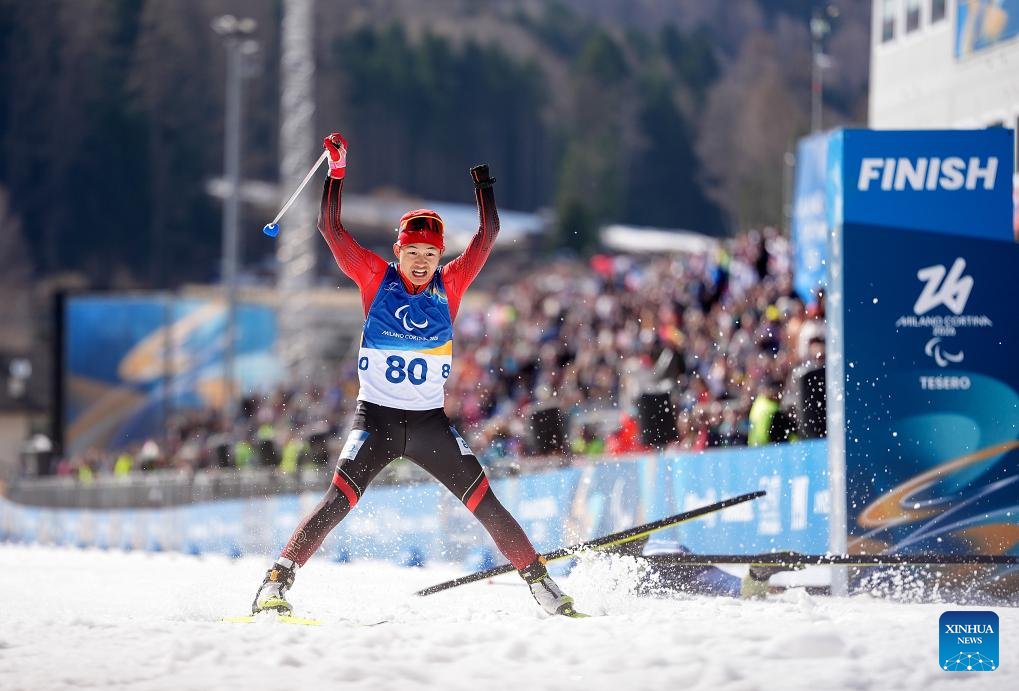
Cai Jiayun, who won three gold medals in the standing class at the 2026 Winter Paralympics, was trailing in the final stretch of the men's sprint pursuit event but overtook the leading Ukrainian skier to win by 0.2 seconds.
"There seemed to be no way I could catch up given the distance between us and the short time left," Cai said. "But at that moment, I relied on my willpower. I just kept following, kept chasing and did my best."
Beyond willpower, Fu said that the Chinese athletes' explosive sprints at the end of races were partly due to a weekly training session dedicated to improving this specific capability — incorporating lunges for standing-class athletes and hyperextensions for sitting athletes.
Yu Shuang, who finished third in the qualification round of the men's sprint pursuit for the blind and partially sighted, asked the team's wax technician to adjust the wax on his skis according to the snow conditions.
"After getting a feel for the course during the qualification round, I believed that a deficit of over 10 seconds could be made up by changing the wax," he said. He later won the gold medal in the event.
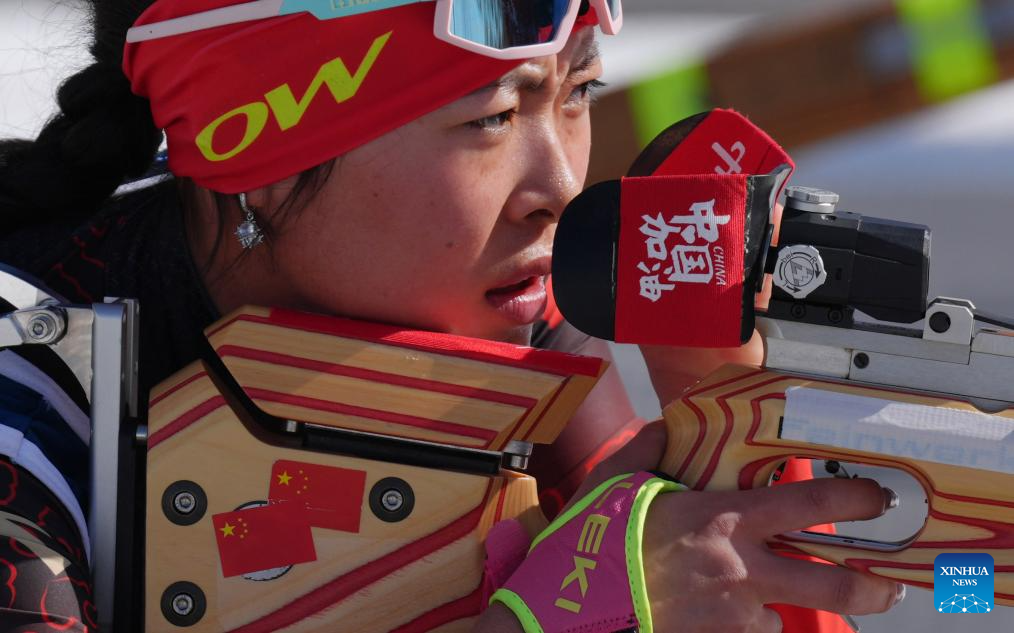
Guo Yujie, 22, left this year's Paralympics with regrets, missing the podium in all her events. Still, she said she learned a valuable lesson in self-confidence and tenacity.
"We Chinese athletes train nearly 11 months each year, and our training is scientifically formulated and supported by high-performance equipment. Despite the relatively warm temperatures and the slushy, grabby snow here in Italy, we have adapted well," she said.
On a personal level, Guo said she has overcome injuries, as well as the frustrations and doubts raised by lackluster results ahead of the Paralympics, just to stand at the starting line.
"The silver lining is that I feel my shooting has become more stable," she said. "More importantly, going through setbacks this time has toughened me up. If I can rise from disappointment on a stage like the Paralympics, then there is no difficulty in life that I cannot overcome."
