

Sino-US summit in Beijing an important moment in top-level diplomacy, analysts say
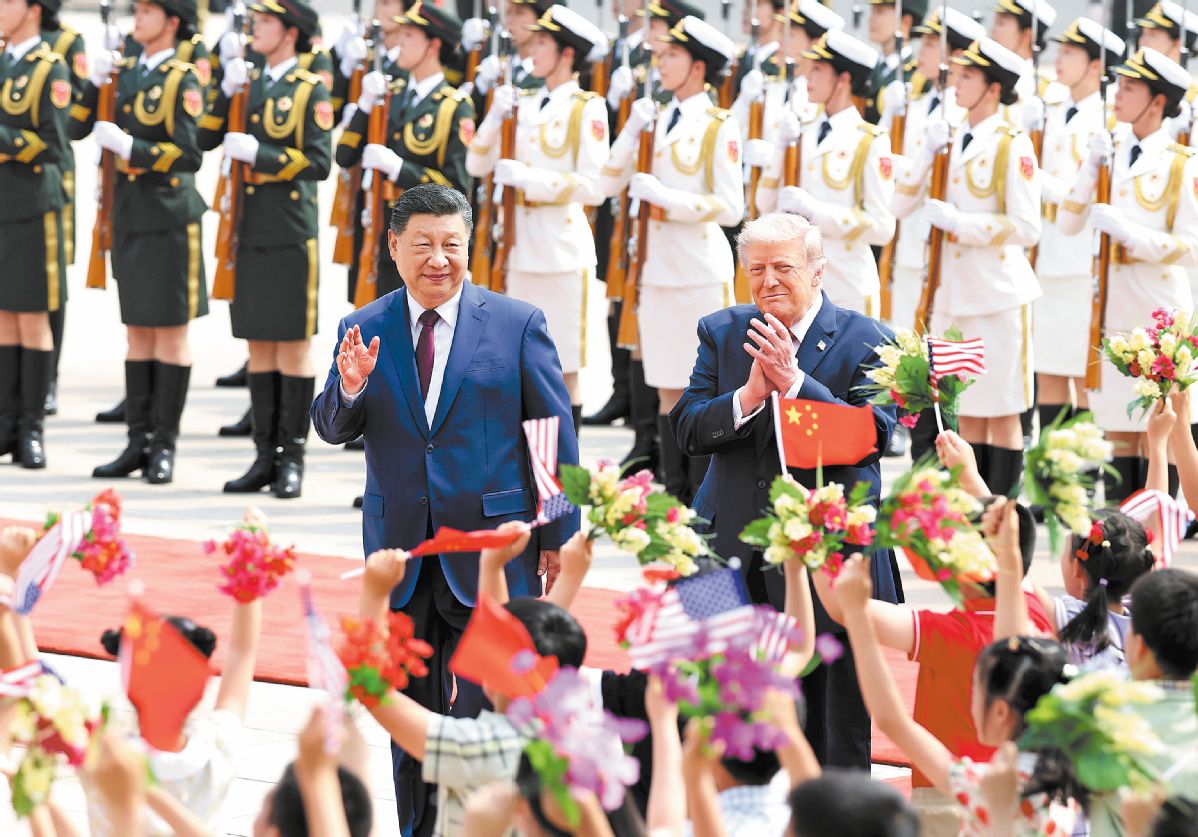
China and the United States should find the right way for major countries to get along well with each other in the new era, President Xi Jinping said on May 14.
Xi made the remarks during his talks with visiting US President Donald Trump at the Great Hall of the People in Beijing.
Xi stressed that the two countries have more common interests than differences, success in one is an opportunity for the other, and a stable bilateral relationship is good for the world.
“China and the United States both stand to gain from cooperation and lose from confrontation. We should be partners, not rivals. We should help each other succeed and prosper together,” he said.
Noting that transformation not seen in a century is accelerating across the globe and the international situation is fluid and turbulent, Xi said that the world has come to another crossroads.
“Can China and the United States overcome the Thucydides Trap and create a new paradigm of major-country relations? Can we meet global challenges together and provide greater stability for the world? Can we build a bright future together for our bilateral relations in the interests of the well-being of the two peoples and the future of humanity? These are the questions vital to history, to the world and to the people. They are the questions of our times that the leaders of major countries need to answer together,” Xi said.
He expressed the hope that 2026 will be a historic and landmark year for China-US relations.
The US president arrived in Beijing on May 13 evening to a red-carpet welcome, as the world looks to the two largest economies for greater stability. Vice-President Han Zheng greeted him at the airport.
Trump’s three-day trip marks the first state visit to China by a sitting president of the US in nearly nine years and follows Xi and Trump’s meeting in Busan, Republic of Korea, last October, which helped to set the tone for efforts to stabilize and improve China-US relations.
The Xi-Trump summit is seen as another important moment in head-of-state diplomacy, which has played a strategic guiding role in China-US relations.
Over the years, Xi has repeatedly stressed that the China-US relationship is among the most important bilateral relationships in the world, and that the two countries must find the right way to get along.
His message has been consistent: While China-US cooperation can enable the two countries to achieve major undertakings serving their own interests and those of the world, confrontation would spell disaster for both countries and the wider world.
Analysts said the high-level engagement between Xi and Trump will be closely watched as to whether the two sides can keep the “giant ship” of China-US relations on a steady course, manage differences through dialogue, and expand practical cooperation, thereby injecting greater certainty into a turbulent world.
For a relationship as significant and complex as that between China and the US, direction matters as much as momentum.
During the meeting with Trump in Busan, Xi said, “You and I are at the helm of China-US relations. In the face of winds, waves and challenges, we should stay the right course, navigate through the complex landscape, and ensure the steady sailing forward of the giant ship of China-US relations.”
In their phone conversation last year, Xi said that recalibrating the direction of the giant ship of China-US relations requires the two sides to take the helm and set the right course, adding that it is particularly important to steer clear of various disturbances and disruptions.
Zhiqun Zhu, a professor of political science and international relations and director of the China Institute at US-based Bucknell University, said the “giant ship” metaphor highlights both the complexity of the relationship and the importance of guiding it in the right direction.
“It’s a top-down approach, with leaders on both sides playing a pivotal role,” Zhu said. “Only when the general direction is set can the relationship move forward.”
But setting the course also requires a clear understanding of the nature of the relationship.
At a welcome dinner in San Francisco in November 2023, Xi said that he had long been thinking about “how to steer the giant ship of China-US relations clear of hidden rocks and shoals, navigate it through storms and waves without getting disoriented, losing speed or even having a collision”.
“In this respect, the number one question for us is: Are we adversaries, or partners? This is the fundamental and overarching issue. The logic is quite simple. If one sees the other side as a primary competitor, the most consequential geopolitical challenge and a pacing threat, it will only lead to misinformed policymaking, misguided actions and unwanted results,” Xi told participants from across US society.
Sun Chenghao, a fellow at Tsing-hua University’s Center for International Security and Strategy, said the “giant ship” metaphor speaks to the extraordinary weight of the relationship.
“China-US relations are too large and too consequential to be allowed to drift off course, or even capsize due to temporary storms,” Sun said.
China and the US are the world’s two largest economies and permanent members of the United Nations Security Council, and both play major roles in regional and global affairs.
Despite the twists and turns in bilateral ties, China-US economic relations remain deeply intertwined. Chinese customs data showed that bilateral trade in goods reached 4.01 trillion yuan ($590 billion) in 2025, accounting for 8.8 percent of China’s total foreign trade.
“China’s view that the relationship concerns not only the well-being of the two peoples but also the future of humanity is not merely diplomatic rhetoric,” Sun said. “Rather, it is a judgment based on real interests and the stability of the international system.”
That judgment has run through Xi’s remarks on China-US relations over the years.
When meeting with Trump during his first term as US president in 2017 at the latter’s Florida resort, Xi said there are a thousand reasons to make China-US relations a success, and not a single reason to break them.
In March 2024, when meeting in Beijing with representatives from the US business, strategic and academic communities, Xi said that whether the two countries can find the right way to get along bears on the well-being of the two peoples and the future of humanity.
Beyond the bilateral level, China-US cooperation is also closely watched in terms of its implications for global governance at a time when the world faces sluggish growth, geopolitical tensions and mounting challenges requiring international coordination.
In Busan last year, Xi told Trump: “The world today is confronted with many tough problems. China and the US can jointly shoulder our responsibility as major countries, and work together to accomplish more great and concrete things for the good of our two countries and the whole world.”
According to Sun, many global challenges cannot be effectively addressed without sustained communication between the two countries.
Zhu, of Bucknell University, echoed that view, saying that if the two most powerful nations cannot get along well, the global economy will suffer and international cooperation on critical issues such as climate change and artificial intelligence governance will become difficult.
David Chong, founder and president of the US-China Youth and Student Exchange Association, said that he has become increasingly aware that keeping the giant ship of China-US relations moving steadily requires joint efforts from both countries at all levels.
Since 2015, Chong’s association has helped bring more than 2,000 US youths to China for exchange programs.
“People-to-people organizations may not be in the ‘cockpit’ of the giant ship,” Chong said, “but they can serve as ‘connectors’ and ‘road builders’ by strengthening the cultural and social foundation for the steady development of China-US relations”.
Sun, the researcher, said that cooperation remains the most realistic and responsible choice.
“The reason is simple: Competition cannot erase interdependence, and differences cannot eliminate shared risks,” Sun said. “China and the US cannot expect a voyage without winds and waves, but they must not allow the storms to decide the course.”
Contact the writers at caodesheng@chinadaily.com.cn
