

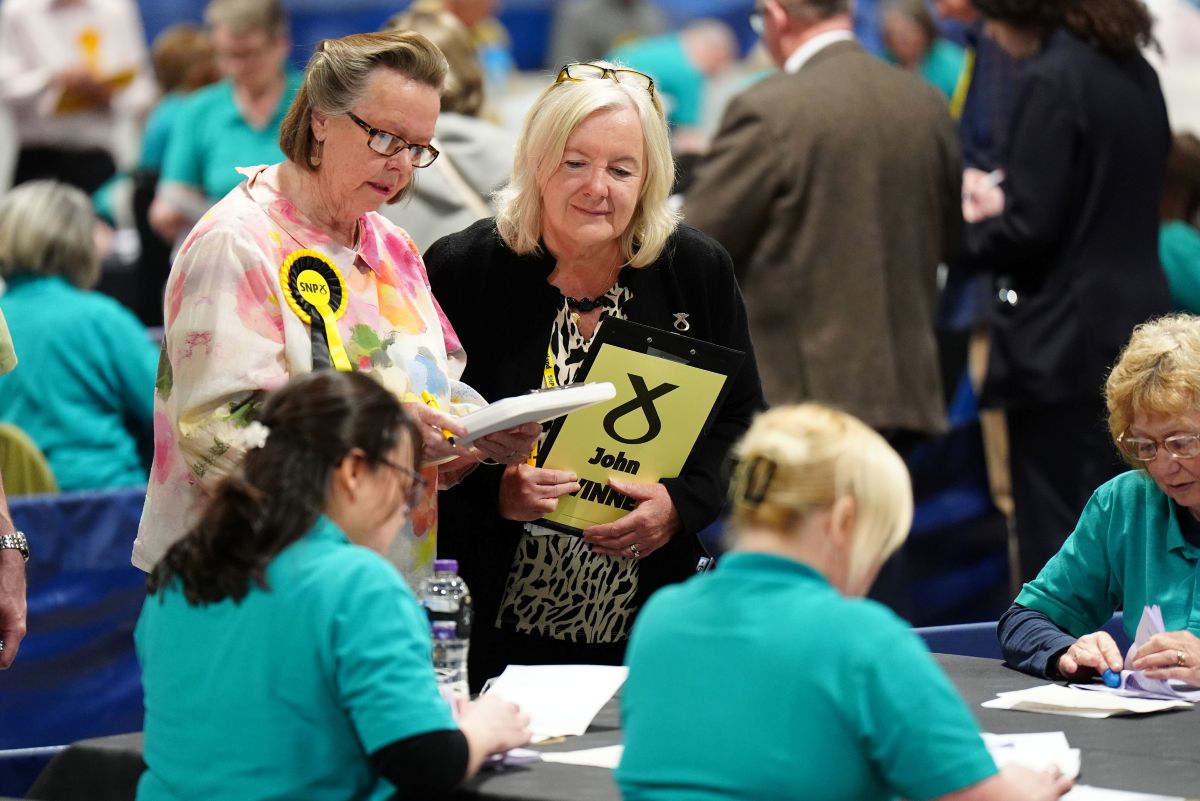
The Scottish National Party secured a record fifth straight term in government but fell short of the majority that leader John Swinney said would have given him a mandate for a new referendum on Scotland leaving the United Kingdom.
The SNP won 58 seats, seven short of a majority. Labour, which after the 2024 UK general election had high hopes of mounting a serious challenge, was tied at 17 seats with Reform UK, for whom support surged north and south of the English border. The Greens won a record 15 seats and could form a powerful pro-independence bloc with the SNP.
Swinney, so far, has evaded questions as to whether he would partner with another party to ask Westminster for the right to hold a referendum about quitting the UK union.
“We have won emphatically,” said Swinney, who took over the party leadership in 2024 after a series of scandals and missteps led to the resignation of long-time leader Nicola Sturgeon and her successor Humza Yousaf.
“Living in a democracy is something that all of us should cherish and I would like thank everyone who voted in this election,” he said Friday. “However you voted today, I promise that I will be a First Minister for all of Scotland.”
Completing the 129-seat setup in Holyrood, the Conservatives had their worst-ever result to finish with 12 MSPs, and the Liberal Democrats got 10.
Largely expected by a series of polls, the result extends the SNP’s term in power to more than two decades and heaps further pressure on UK Prime Minister Keir Starmer. His Labour party suffered a string of losses in English local elections, ceding ground to Nigel Farage’s populist Reform UK. Labour’s leader in Scotland said the party had lost the argument.
The SNP has only achieved a majority once before — in 2011, under former leader Alex Salmond. That outcome forced then Prime Minister David Cameron to concede to demands for a vote on independence in 2014. Scots rejected the idea of secession by 55% to 45%, but some recent polls suggest the nationalists would win another referendum.
As in the rest of the UK, the Scottish results emphasized just how deeply British politics has splintered. Reform and the Greens made up ground on the right and left, splitting apart a Tory-Labour duopoly that dominated for more than a century. Scotland’s labour leader, Anas Sarwar, was early to concede defeat.
“We made an argument for change and, ultimately, it’s an argument we lost,” Sarwar told reporters in Glasgow. The elections — supposedly based on local and devolved issues — “became about a national mood, and a national dissatisfaction,” he said. Sarwar has previously called for Starmer to stand down. “I stand by that,” he said.
Scotland’s mixed voting system, which includes an element of proportional representation, means smaller parties gain seats on the list vote as the counting continues. The Highland and Islands list, containing seven seats, completed the Holyrood lineup shortly aftter 1 am on Saturday.
The electoral maths in Scotland this time around was complicated by the emergence of Reform UK, a party that had only one of Scotland’s lawmakers in the previous parliament, a defection from the Conservatives.
