

The tomb of a 9-year-old girl, deeply cherished, leaves an imprint far beyond its years, Lin Qi reports.
In the summer of AD 608,9-year-old Li Jingxun set out with her grandmother, Yang Lihua, for a seasonal retreat at Fenyang Palace in present-day Shanxi province. What should have been a fun escape ended in tragedy: the young girl fell suddenly ill and died, her condition unrecorded in historical accounts.
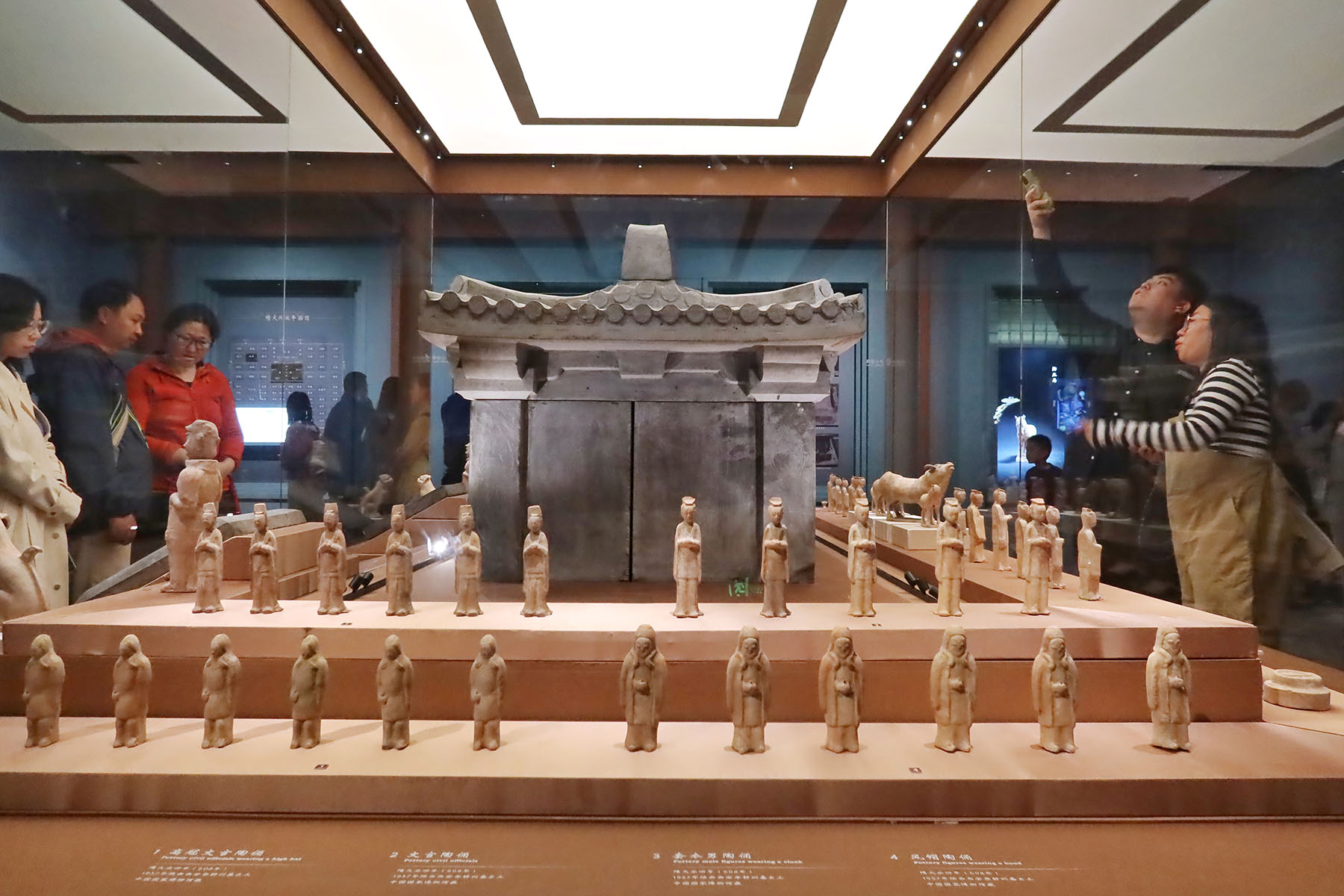
Her body was returned to Daxing, the Sui capital — now Xi'an — where she was laid to rest. Overwhelmed by grief, Yang, a prominent member of the Sui Dynasty (581-618) royal family, resolved to care for her granddaughter in death as she had in life. She assembled an extraordinary burial: ceramics, jewelry, glassware, gold and silver ornaments, and an array of pottery figurines arranged within and around a finely constructed stone coffin.
READ MORE: Chinese ancient treasures spark new pursuit of beauty
Yang went further. Defying burial protocols, she had the tomb built within the Wanshan Monastery, close to the imperial palace complex. She also ordered the construction of a multi-storied pagoda in traditional Chinese style at the site, reflecting the prominence of Buddhism during the Sui era. On the sarcophagus lid, she had four characters engraved — kai zhe ji si, meaning "whoever opens this shall die" — a warning meant to protect the grave from disturbance.
Yang died a year later. Over time, the pagoda vanished, its existence preserved only in the tomb's epitaph. For more than 1,300 years, the grave remained sealed and undisturbed, until 1957, when archaeologists from the Institute of Archaeology at the Chinese Academy of Social Sciences rediscovered it by chance.
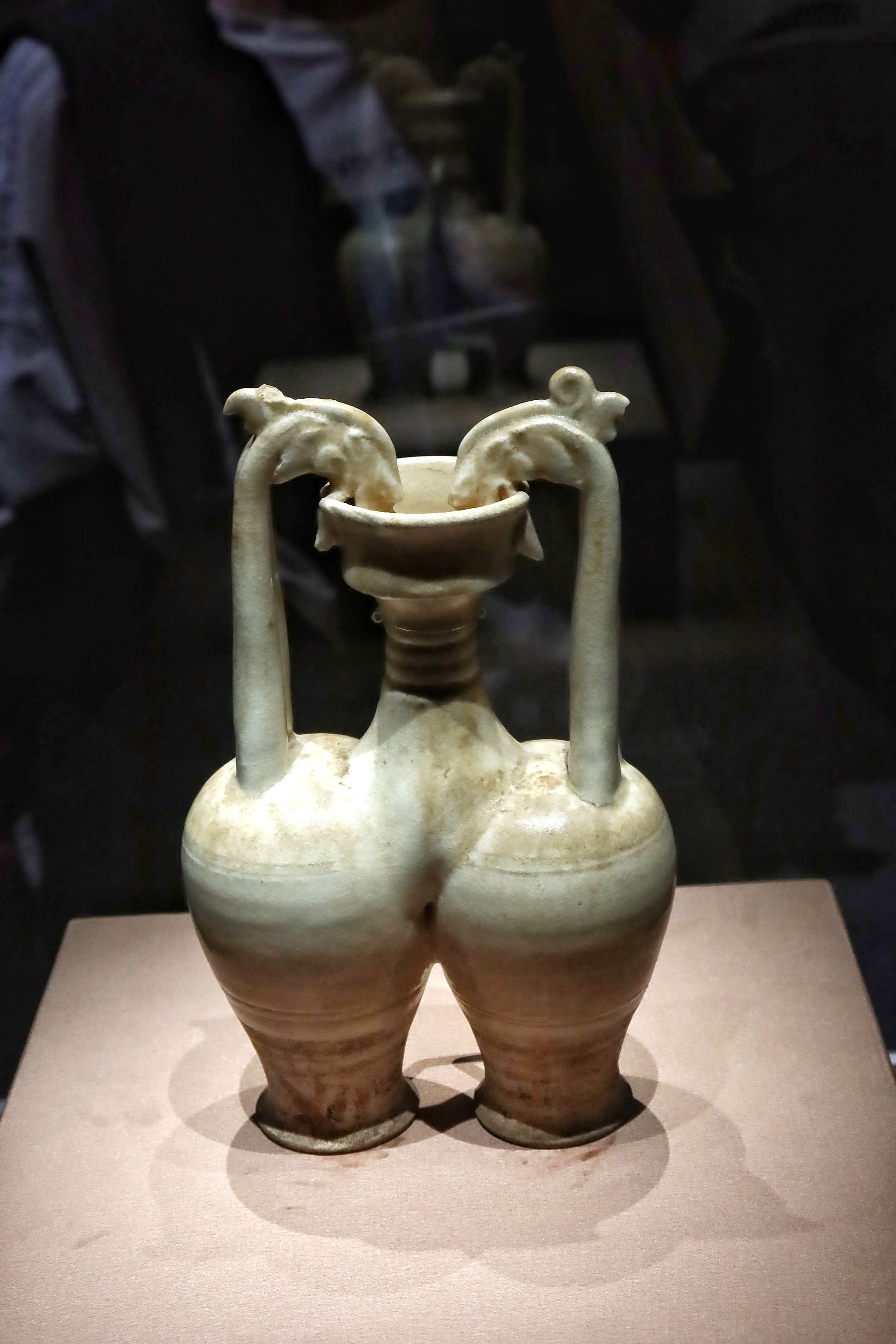
What they found was remarkable: a tomb intact, its treasures undisturbed, and unusually well-documented. The burial's scale and layout suggested a status higher than many Sui tombs known at the time. Crucially, the identity of its occupant and the date of burial were clearly recorded — a rarity that offered scholars a precise window into the period.
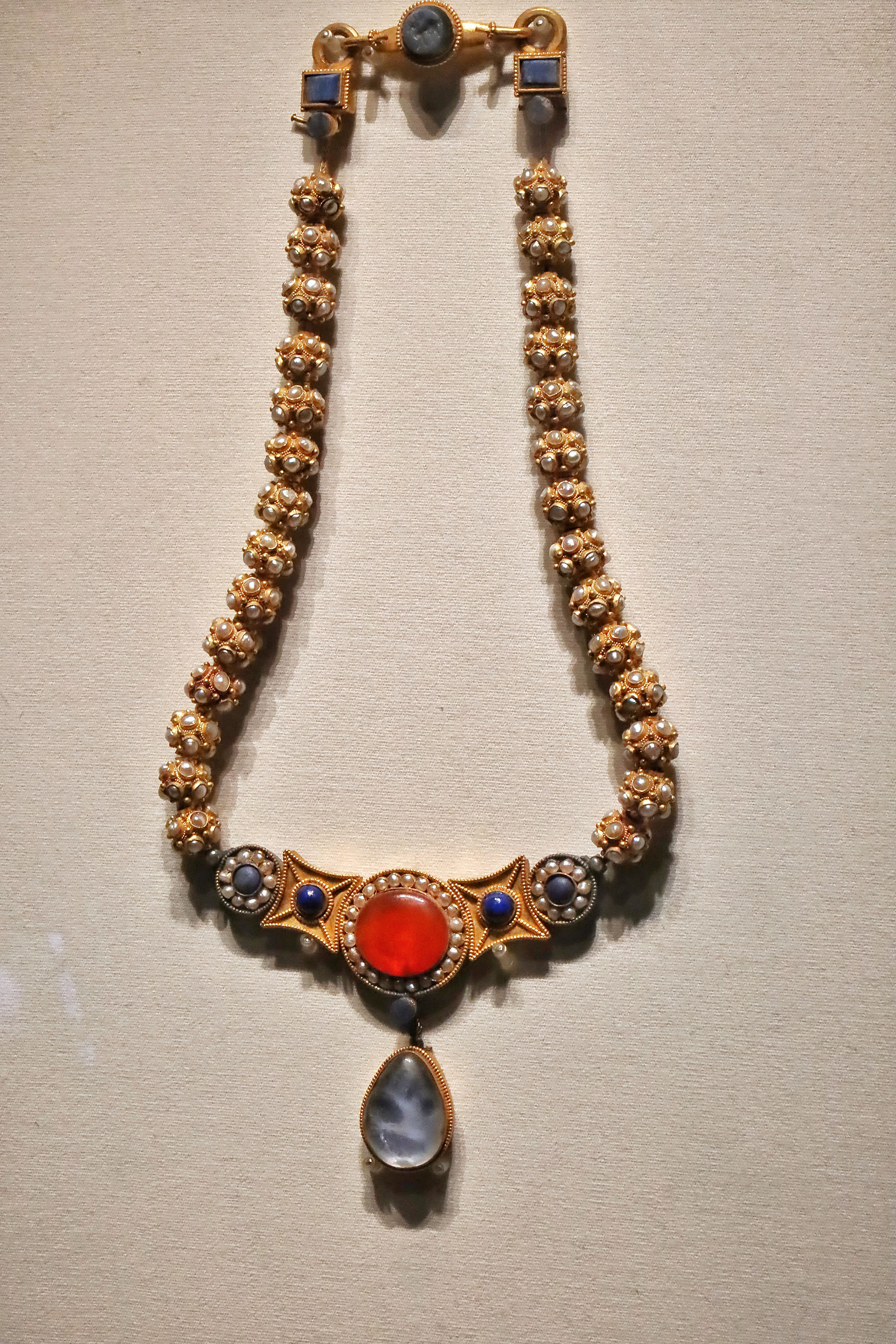
More than 240 sets of artifacts were excavated. Many are held by the National Museum of China in Beijing, where some feature in long-term displays. Among them is a striking gold necklace set with pearls, rubies and blue gemstones which was once worn by Li and has been on display at the Ancient China exhibition hall.
For the first time, objects from the same tomb have been brought together in a special exhibition, Discoveries at Li Jingxun's Tomb, running through Oct 8.
Zhao Yuliang, the exhibition's curator, says "more than 50 objects on show have been restored" and along with dozens of artifacts loaned from other museums, will provide information on Li "as comprehensively as possible".
The exhibition is layered and wide-ranging. Jewelry enthusiasts will be drawn to the intricacy of Li's personal ornaments; others may linger over celadon and white porcelain, or the inscriptions carved into stone tablets. Some visitors may even find connections to popular culture — the story of the Chinese martial arts manhua (graphic story) biaoren (Blades of the Guardians) by Xu Xianzhe unfolding around the same historical moment.
For Qi Dongfang, a professor at the School of Archaeology and Museology at Peking University, the tomb's importance lies in its completeness. The objects, he says, are "representative in every social, economic, and cultural aspect" of the Sui Dynasty, a pivotal period bridging the fractured Northern Dynasties (439-581) and the rise of the Tang Dynasty (618-907).
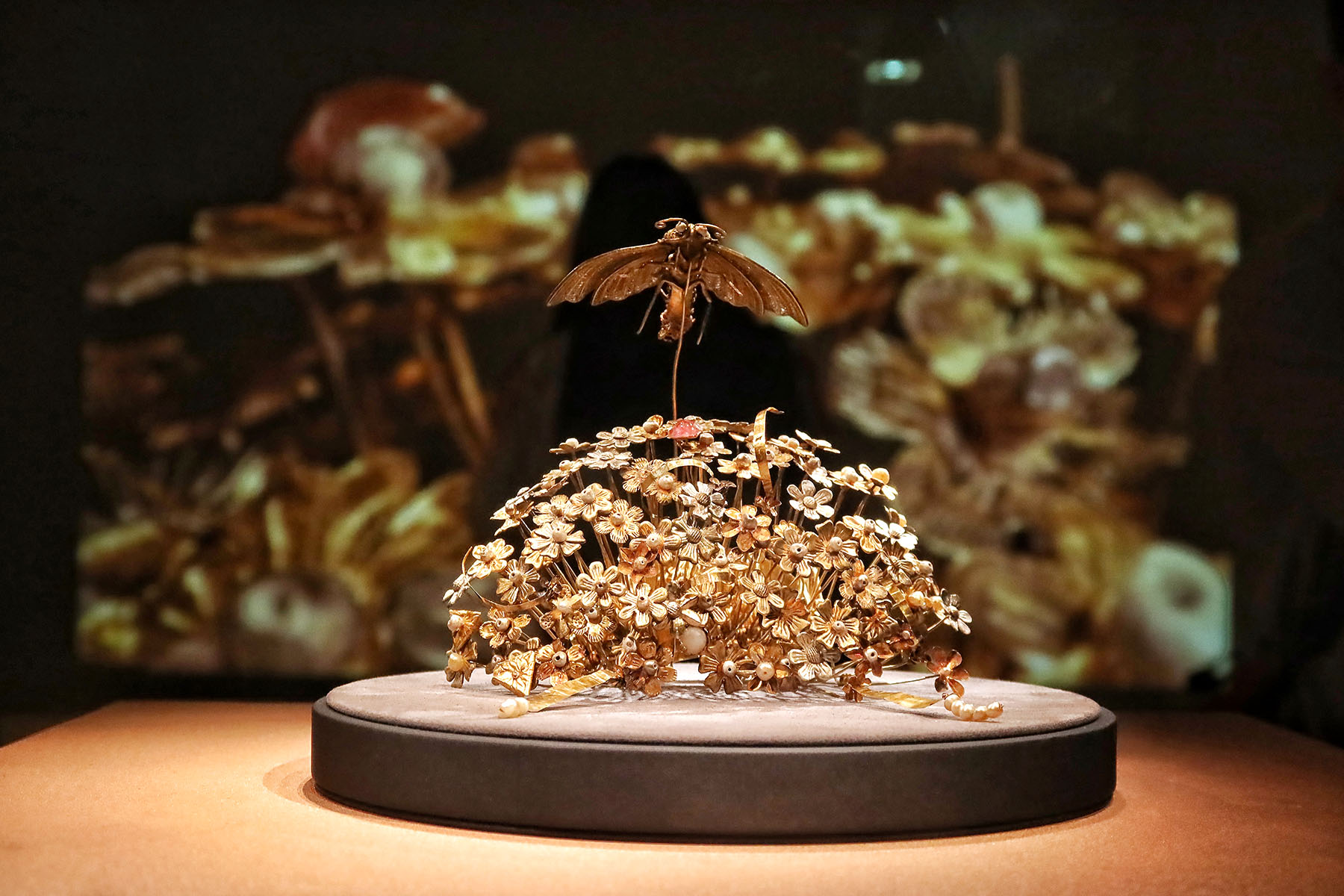
Qi, with expertise in Sui and Tang archaeology, specializes in the study of ancient wares of glass, gold and silver. He cites Li's gold hairpin with a moth, the first object on display at the exhibition, as an example of Sui's superb workmanship and artistry.
The hairpin, made of gold plates, pearls and colorful gemstones, was badly deformed, its structure distorted by time. Through ultraviolet imaging and scanning electron microscopy, researchers were able to reconstruct its intricate design and understand the techniques behind it.
The restored accessory assumes a vibrant scene: a moth flying over a blooming flower. "It looks vivid and real. Its magnificent look makes the hairpin truly one of a kind," Qi says.
"It could be called nao'e (bustling moth), a type of hairpin that women wore on festivals and other significant occasions."
Glassware found in the tomb offers another layer of insight. Qi says that among the 24 vessels are examples of both Chinese lead-barium glass and Western soda-lime glass. "Their coexistence suggests not only technological diversity but also cultural exchange, likely facilitated through networks such as the Silk Road. Techniques and materials traveled alongside goods, shaping local production in ways that are still being studied today."
Regular communication between the East and West back then left traces on two objects on display: a silver coin of the Sasanian Empire, cast between 457 and 483, was discovered at Li's grave, in a copper bowl with silver nail guards; while a Byzantine gold coin was buried in another aristocratic Sui tomb, dated 600, located in Xianyang, Shaanxi.
Despite the richness of her burial, Li Jingxun herself was never granted the title of princess. The tomb's opulence and location reflect not rank but affection. She was the only child of Yang Lihua's daughter, and the object of deep personal devotion.
The exhibition also shows artifacts from the graves of the people Li was related to through bloodlines, both close and distant, as well as other high-ranking members of Sui.
Family trees are illustrated on the wall to reveal a complicated network of the four well-connected houses Li was born into, which also fought for power, secretly and openly — one may call it a Sui version of Game of Thrones.
Yang Lihua used to be an empress of the Northern Zhou Dynasty (557-581) while her father Yang Jian served as a prominent minister at the court. Northern Zhou was the last of the Northern Dynasties.
Yang Jian later forced the ruling Yuwen family to abdicate and seized the throne himself to found Sui. Lihua saw her status altered to a princess.
This may explain why Lihua buried her granddaughter at the Wanshan Monastery. The institution was built as a shelter for the concubines of the overthrown Northern Zhou to live out the rest of their lives as Buddhist nuns.
Before her death, Lihua entrusted the future of her daughter, the mother of Li Jingxun, and her husband Li Min who also came from an influential family, to Yang Guang (Emperor Yang of Sui). That trust proved misplaced. In 615, he ordered the execution of Li Jingxun's father on suspicion of rebellion. Months later, her mother was forced to take her own life.
The family's fate underscores a stark truth of imperial politics: proximity to power offered no guarantee of safety. Kinship could turn fragile, even fatal, in times of suspicion and control, particularly given that Lihua and Emperor Yang were of the same mother, Dugu Qieluo, from the celebrated Dugu family. Qieluo's father, Dugu Xin, was also a high-ranking Northern Zhou minister and general.
Besides Qieluo, he had a second daughter who also married into the Yuwen family as an empress.
His third daughter gave birth to Li Yuan, from a different Li family, who was the founder and first emperor of Tang.
Zhao, the curator, says what began as a private act of mourning has become a lasting archive of a world in transition.
Contact the writer at linqi@chinadaily.com.cn
