

First "2+2" meeting in Phnom Penh marks institutional upgrade, experts say
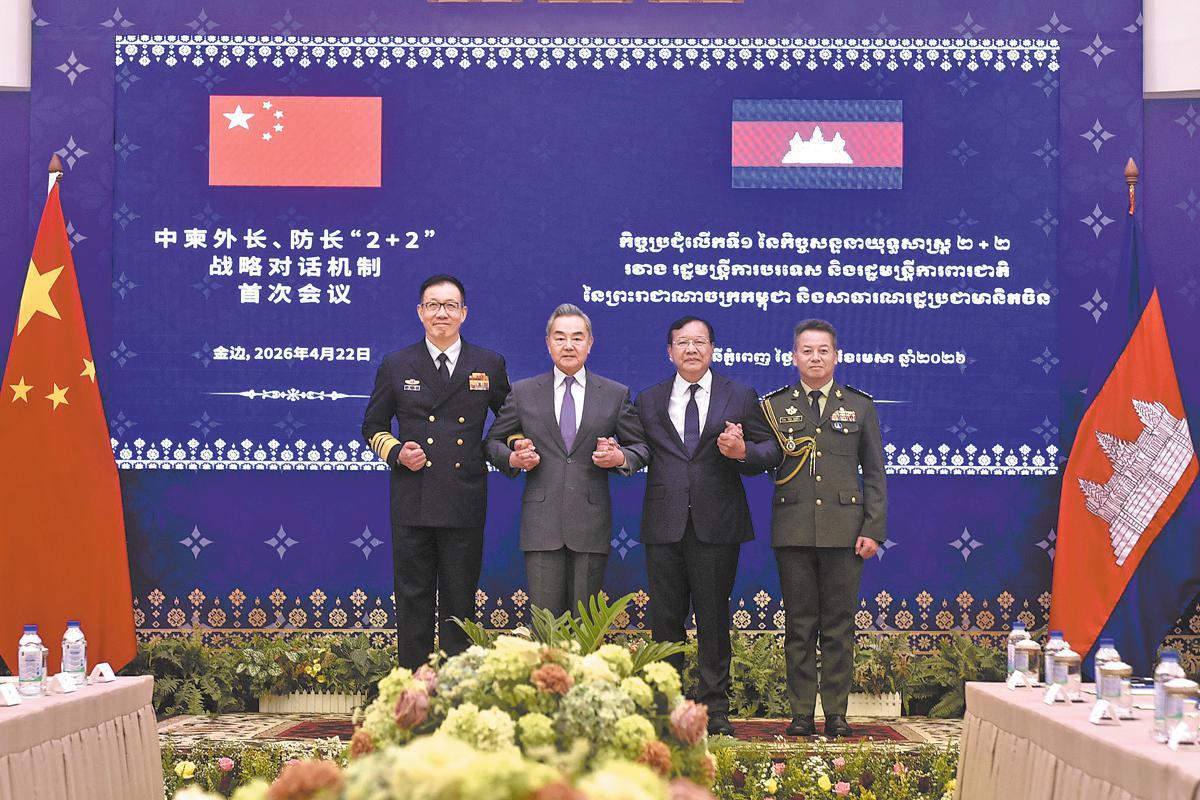
China and Cambodia have enhanced bilateral strategic coordination with the first meeting between their foreign ministers and defense ministers under the "2+2" strategic dialogue mechanism, which officials and experts said marks a significant institutional upgrade in bilateral ties.
Foreign Minister Wang Yi and Defense Minister Dong Jun cochaired the meeting on Wednesday in Phnom Penh, the capital of Cambodia, with Cambodian Deputy Prime Minister and Minister of Foreign Affairs and International Cooperation Prak Sokhonn, and Deputy Prime Minister and Defense Minister Tea Seiha.
Lauding the convening of the inaugural meeting, Wang said it has fully demonstrated the time-tested ironclad friendship between China and Cambodia, and underscored the high priority both sides place on deepening strategic cooperation.
ALSO READ: Cambodia to trial visa-free policy for Chinese citizens from mid-2026
He said China is willing to work with Cambodia to develop the mechanism into a strategic platform for enhancing political and defense security cooperation, and to make new contributions to building a China-Cambodia community with a shared future.
He also highlighted China's role as a peace facilitator, noting China's support for Cambodia and Thailand in implementing the five-point consensus reached at the trilateral meeting by the Fuxian Lake in China's Yunnan province.
China is willing to provide platforms for more comprehensive and effective communication between Cambodia and Thailand, he added.
He said China is willing to deepen cooperation with Cambodia within the framework of the four major global initiatives proposed by China, and promote the development of the global governance system in a more just and equitable direction.
On defense cooperation, Dong said China is willing to work with Cambodia to deepen and strengthen mutual trust in military security.
The Cambodian side reiterated its steadfast partnership with China. Sokhonn said that China is Cambodia's most trusted friend and expressed gratitude for Beijing's comprehensive support. Meanwhile, Seiha said that Cambodia is willing to actively explore new avenues for cooperation and promote greater development of bilateral ties.
Practical outcomes
The meeting yielded concrete agreements on several fronts. Both sides agreed to deepen law enforcement and defense cooperation, jointly combat online gambling and telecom fraud, and safeguard their respective cybersecurity.
They also underscored support for resolving regional disputes through dialogue and negotiation, jointly opposing unilateral bullying and power politics, and upholding global free trade and international fairness and justice.
As a key outcome of the first meeting, the two sides further agreed to upgrade the "2+2" mechanism to a "3+3" format with the participation of China's Ministry of Public Security and Cambodia's Ministry of Interior, according to a press release by Cambodia's Ministry of Foreign Affairs and International Cooperation. The "3+3" strategic dialogue on diplomacy, defense and public security was first initiated globally by China and Vietnam, with its inaugural ministerial meeting held in March.
Experts said the high-level engagement demonstrates a shared commitment to addressing complex regional dynamics through closer coordination.
Gu Jiayun, director of the Center for Cambodian Studies at Beijing Foreign Studies University, said the upgrade of the mechanism reflects high-level coordination between the two countries in areas such as security cooperation and state governance, serving as telling proof of the continuous deepening of China-Cambodia relations.
It is essential for the two sides to align their steps in diplomatic and defense collaboration, jointly advance high-quality development and high-level security, and enrich the all-weather China-Cambodia community with a shared future in the new era, Gu said.
ALSO READ: Cambodia expects high growth of Chinese tourists in 2026
Geopolitical analyst Kin Phea, director of the International Relations Institute at the Royal Academy of Cambodia, said he viewed the engagement as very important, particularly as part of resolving the Cambodia-Thailand border dispute.
"What we are particularly interested in is the implementation of the consensus agreement, the five-point Fuxian consensus," he said in a Phnom Penh Post article.
"What Cambodia desires is the normalization of diplomatic relations. We want peace, stability, development and friendship that respects the sovereignty, independence and territorial integrity of the Kingdom of Cambodia," Phea said.
Contact the writers at jihaisheng@chinadaily.com.cn
