

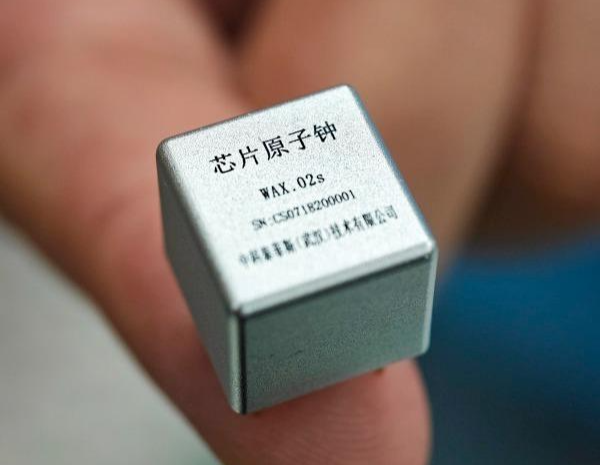
China has taken a critical step forward in high-precision timekeeping by mass-producing a fingernail-sized chip-scale atomic clock that maintains an accuracy with an error of just one second every 30,000 years. The advancement lays a high-precision time foundation for national strategic fields such as low-Earth-orbit satellites and underwater Beidou navigation systems.
The device, developed by Wuhan University's Satellite Navigation and Positioning Technology Research Center in Hubei province, measures only 2.3 cubic centimeters — about one-seventh the size of comparable products made in the United States — while delivering equivalent performance.
"Time is a strategic resource, and those who achieve the highest precision in timekeeping gain an advantage in technology, economy and even national defense," Chen Jiehua, a professor at the center and legal representative of Zhongke Taifeisi (Wuhan) Technology Co, told Hubei's local newspaper Changjiang Daily.
"Time is distance in navigation and positioning — a time error of just one nanosecond (one billionth of a second) leads to a positioning deviation of 0.3 meters. However, even the most accurate daily timepieces can drift by more than 10 seconds per year," Chen said, explaining why his research team has dedicated decades to developing chip-scale atomic clocks — by firmly holding the "power of time" in China's own hands.
In addition, while time calibration typically relies on satellites, atomic clocks can provide an independent and stable time reference in special conditions, such as underwater, underground, in deep space or on a GPS-jammed battlefield.
Traditional atomic clocks work by "counting" the stable frequency signals generated through the interaction of microwave fields with atoms. However, the long wavelength of microwaves limits how small these devices can be made. Chip-scale atomic clocks, on the other hand, use lasers modulated by microwaves. Because lasers can be guided into a very small space, these clocks achieve ultra-high precision while reducing both size and power consumption by dozens of times.
ALSO READ: China's BeiDou Navigation Satellite System to undergo in-orbit upgrade
Chen emphasized the broad market potential of chip-scale atomic clocks, noting their compact size of just a few cubic centimeters and low power consumption of less than 200 milliwatts. These features make them well suited for applications such as underwater systems. On the seabed, where satellite signals are inaccessible and devices cannot rely on solar energy, autonomous synchronization systems require precise time references and low-power operation over extended periods. This makes chip-scale atomic clocks an ideal frequency source component for such environments.
Notably, Zhongke Taifeisi (Wuhan) Technology Co has achieved large-scale production of the chip-scale atomic clocks, which have been successfully applied in time synchronization systems for underwater Beidou, low-Earth-orbit satellites and drone swarms.
Gou Fei, an official from the Yangtze River Industry Group, which holds more than 20 percent of the company's shares, said in an interview with Changjiang Daily that quantum technology has been designated as a top priority among China's future industries. It encompasses the field of quantum precision measurement, where chip-scale atomic clocks serve as a core device.
"The world's smallest chip-scale atomic clock, developed by Professor Chen Jiehua's team, has completely broken the foreign technology monopoly. It achieves a comprehensive leap forward with smaller size, better performance and scalable production, positioning China at the forefront of the global quantum industry," Gou said.
The product, which is the first and currently the only chip-scale atomic clock in China to achieve commercial sales at scale, reached sales of several hundred units in 2024, with sales continuing to grow in 2025, according to Gou.
However, mass production is still constrained by the performance and high cost of lasers. Gou said the group will leverage its capital and resources to help the company tackle key component technologies and advance automated production to reduce costs, further expanding its applications in both military and civilian communications and solidifying Hubei's competitive edge in the quantum precision measurement sector.
The outline of the 15th Five-Year Plan (2026-30) for national economic and social development emphasizes the need to achieve breakthroughs in key technologies related to quantum precision measurement and to promote quantum technology as a new driver for economic growth.
READ MORE: China's homegrown quantum computer gains AI capabilities
The field is also of strategic importance globally and is experiencing rapid development. According to QYResearch, a global industrial market research institute with dual headquarters in Beijing and Los Angeles, the global market sales of chip-scale atomic clocks reached 405 million yuan ($60 million) last year and are expected to reach 737 million yuan by 2032.
