

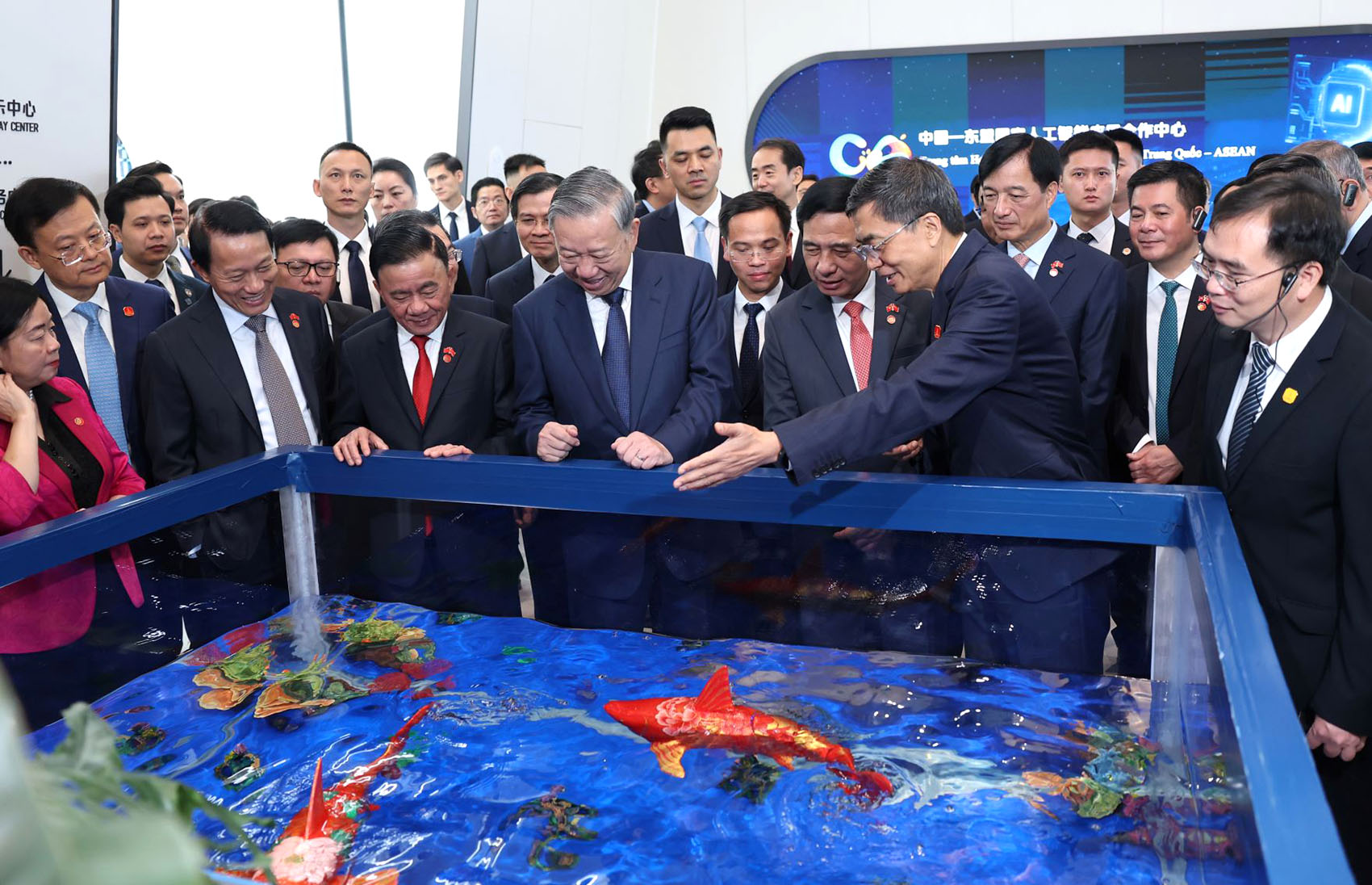
The visit of Vietnam's top leader to China confirms that Beijing remains a priority of Hanoi's foreign policy, with the leadership showing strong interest in China's governance and innovation model, experts say.
"The visit underlines the continuity and priority Vietnam places on relations with China, showing that Vietnam considers China a cornerstone in its foreign policy," Le Hong Hiep, senior fellow and coordinator of the Vietnam Studies Programme at the ISEAS-Yusof Ishak Institute in Singapore, told China Daily.
To Lam, general secretary of the Communist Party of Vietnam Central Committee and president of Vietnam, paid an official visit to China on April 14-17.
READ MORE: Beijing, Hanoi vow to boost ties
It marked his first foreign visit following his recent election as Vietnamese president and came one year after Chinese President Xi Jinping's state visit to Vietnam in 2025.
Hiep said the visit also reflects To Lam's interest in selectively adopting elements of China's governance and development models, aiming to adapt Chinese successes in infrastructure and technology to Vietnam's local context as the country aims to become a high-income country by 2045.
To Lam's visit comes as Vietnam embarks on a new development era following the 14th National Party Congress of the Communist Party of Vietnam, while China has begun to implement its 15th Five-Year Plan (2026-30).
During his four-day visit to China, To Lam boarded a high-speed train, traveling for around 10 hours from Beijing to Nanning in South China's Guangxi Zhuang autonomous region, which borders Vietnam.
Ian Seow Cheng Wei, a senior analyst at the S. Rajaratnam School of International Studies at Nanyang Technological University in Singapore, told China Daily that the Guangxi trip was a key highlight, carrying profound symbolic and economic weight.
While the trip highlighted the shared revolutionary history and strong ties between the Communist Party of Vietnam and the Communist Party of China, Seow said it also underscores the importance of Guangxi, one of the largest trading partners of Vietnam in China, to Vietnam's economic development.
Seow said this can be exemplified by the two countries' agreements to improve cooperation on artificial intelligence, semiconductors, and transport connectivity.
China and Vietnam agreed to accelerate infrastructure connectivity, according to a joint statement issued on Friday.
Both sides highly commended the early completion of the feasibility study for the Lao Cai-Hanoi-Haiphong railway, the first phase of which began construction in December to connect with China's Yunnan province, and welcomed the signing of implementation agreements for the Dong Dang-Hanoi and Mong Cai-Ha Long-Haiphong standard-gauge railway planning projects connecting Guangxi.
"China is one of Vietnam's many comprehensive strategic partners, but the timing of To Lam's visit shows that China is Vietnam's first-among-equals partner," said Khang Vu, a visiting scholar in the Political Science Department at Boston College in the United States.
ALSO READ: Xi highlights 'red gene' of friendship
He told China Daily that cooperation in railway infrastructure will be mutually beneficial. It can not only improve China's connectivity with Vietnam and Southeast Asia but also help Vietnam reduce transportation costs for goods reaching Europe via rail, Khang said.
The recent oil crisis triggered by the war in Iran also highlighted the risks in Vietnam's energy dependency, said Khang, noting Vietnam can learn from China's experience in developing electric vehicles and clean energy.
"Infrastructure connectivity and clean energy will be the key sectors of cooperation," said Khang.
As To Lam's visit took place amid global turbulence, Hiep from ISEAS said both Vietnam and China emphasized stabilizing relations and building a community with a shared future.
This, he said, aligns with Vietnam's wish to maintain a stable and peaceful external environment to facilitate its domestic development. "The visit further underscores China's indispensable role as a neighbor and a development partner of Vietnam," said Hiep.
Contact the writers at kelly@chinadailyapac.com
