

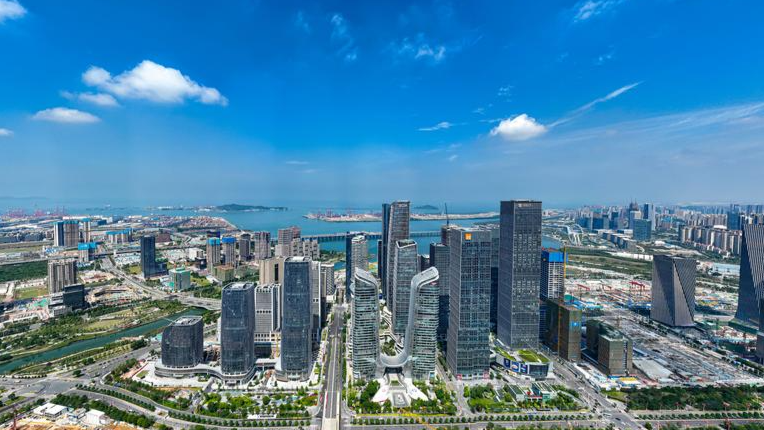
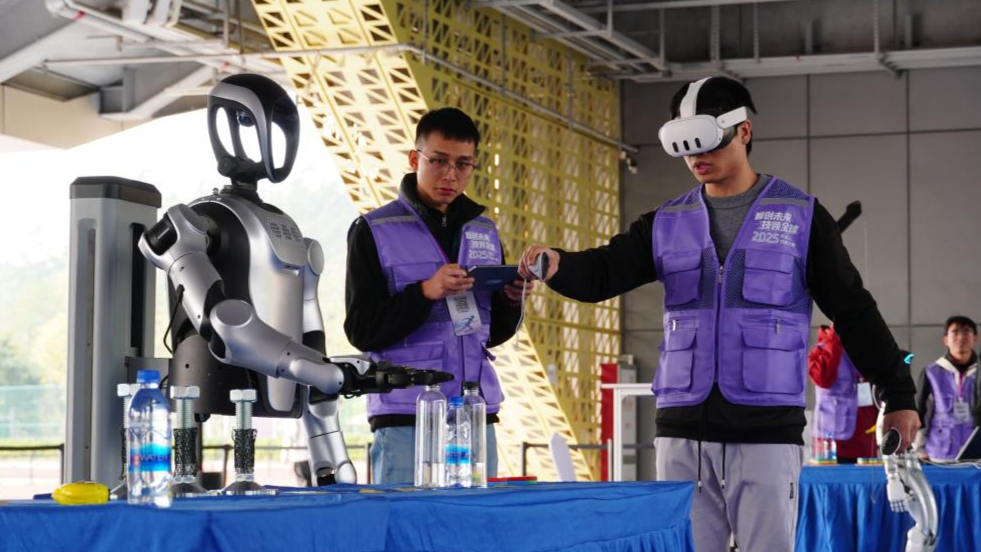
SHENZHEN - At this year's Spring Festival Gala, a martial arts performance titled "Wu BOT" amazed audiences. Dozens of humanoid robots took the stage alongside martial artists, executing precise kung fu moves -- squatting, leg sweeping, and side flipping -- in perfect sync. Their seamless coordination and stunning moves quickly made waves on social media.
Behind this breathtaking display was a Shenzhen-based tech company: Manifold Tech. The company's self-developed spatial memory module Odin 1 gave the robots "spatial memory," enabling them to operate autonomously with centimeter-level precision.
"Addressing the industry's pain point -- the lack of autonomous spatial perception in robots and drones -- we have introduced a high-performance hardware module integrated with multiple sensors and built-in algorithms," Xu Wei, co-founder of Manifold Tech, told Xinhua. "It has already achieved commercial application and large-scale deployment."
ALSO READ: China's home-cleaning robot service grabs overseas attention
The company has secured over 100 intellectual property rights both in China and abroad, holds more than 70 percent of the market share for its core products, and has seen its annual revenue more than triple year after year.
Xu and his co-founder met while pursuing doctoral degrees at the University of Hong Kong. They founded Manifold Tech in Hong Kong in 2021. A year later, drawn by Qianhai's industrial clusters, supply chain advantages, and lower costs, they decided to move the company to the Qianhai Shenzhen-Hong Kong Youth Innovation and Entrepreneur Hub.
A launchpad for dreamers
The rapid growth of Manifold Tech is a clear example of how Qianhai in Shenzhen, which plays a leading role in developing the Guangdong-Hong Kong-Macao Greater Bay Area (GBA) and expanding Hong Kong's development opportunities, supports and nurtures startups.
The GBA consists of the Hong Kong Special Administrative Region (SAR), Macao SAR, and nine cities in Guangdong with a total area of 56,000 square kilometers. Featuring regional advantages, strong economy, innovation power and advanced engagement with international businesses, the GBA will become a dynamic world-class city cluster and a global technology and innovation hub.
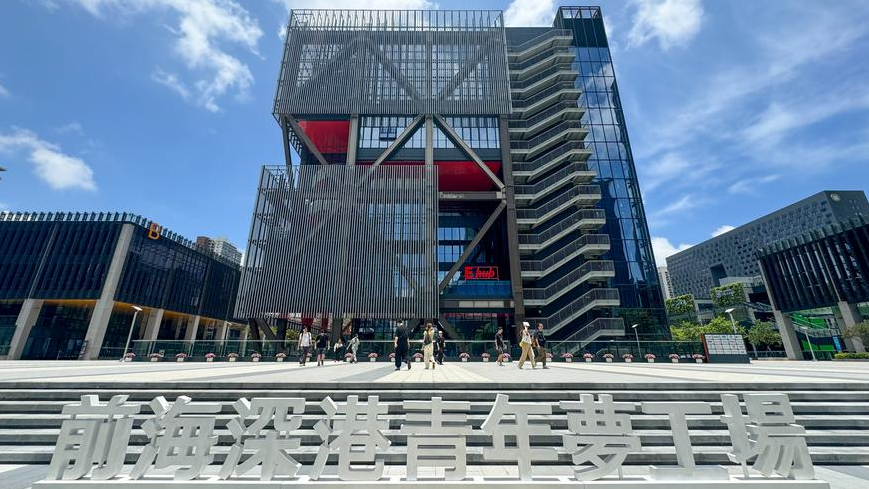
In August 2010, the Qianhai Shenzhen-Hong Kong Modern Service Industry Cooperation Zone was officially established. In December 2014, the Qianhai Shenzhen-Hong Kong Youth Innovation and Entrepreneur Hub was launched with a mission to help young people from Hong Kong and Macao start businesses on the mainland, serving as a "first stop" for those looking north to pursue their careers.
Over the past decade, the hub has expanded from space just for about 200 teams to three areas with a planned floor area of approximately 190,000 square meters.
ALSO READ: CUHK launches Qianhai innovation center to foster cross-border tech transfer
In 2025, the hub attracted more than 700 applications, and 187 high-growth potential enterprises settled in. Among the companies, one-quarter secured financing of over 5 million yuan (about $728,548) and more than half had prior incubation experience in Hong Kong. So far, the hub has nurtured a total of 91 national high-tech enterprises, with incubatee teams raising a total of 8.4 billion yuan in funding.
Today, Qianhai is not only fertile ground for tech startups but also a magnet for cutting-edge innovation resources. Technology transfer platforms from several Hong Kong universities, including the University of Hong Kong, the Hong Kong Polytechnic University, and the Chinese University of Hong Kong, have all set up operations in Qianhai.
A taste of Hong Kong
If tech companies shape Qianhai's future, then time-honored brands preserve the GBA's memory. Strolling through the streets of Qianhai, visitors come across a replica of the Tsim Sha Tsui clock tower and familiar sights that evoke the atmosphere of Hong Kong.
One example is Wing Nin, a time-honored brand founded in Yuen Long, Hong Kong, in 1962. In late 2024, Wing Nin opened a cafe at the hub, bringing together office space, training, exhibitions, research and development.
"Before, we ran a traditional shop in Hong Kong serving local customers," said Hin Lau, chairman of Wing Nin Catering Development Co (HK) Ltd. "Now in Qianhai, we're keeping our flavors authentic while reaching the entire GBA, serving more Hong Kong youth and mainland friends alike. Our horizons have completely opened up."
Wing Nin regularly holds entrepreneurship sharing sessions, Shenzhen-Hong Kong youth exchange events and feasts -- all free for young people to network and explore collaborations, turning the space into a shared community.
At the same time, the hub is strengthening its links to global innovation resources. It has established partnerships with more than 100 overseas institutions across more than a dozen international innovation hubs. An emerging global incubation network is now taking shape, positioning Qianhai as an important bridge between Chinese and international innovation ecosystems.
The year 2026 marks the first year of China's 15th Five-Year Plan period (2026-2030). Early this year, Qianhai issued an action plan for building a pilot zone for Shenzhen-Hong Kong integrated development, systematically promoting breakthroughs in three key areas: rule alignment, industrial coordination, and people-to-people connectivity.
READ MORE: Shenzhen debuts on-demand domestic robots with hourly bookings
Today, more than 11,000 Hong Kong-funded enterprises operate in Qianhai, and over 10,000 Hong Kong residents work there.
From Manifold Tech's show-stopping performance, to research results from Hong Kong universities taking root here, to the familiar aroma of Hong Kong-style milk tea drifting from a time-honored cafe -- in Qianhai, technology and humanity, innovation and tradition are deeply intertwined.
For young people in the GBA pursuing their ambitions, this is more than just a place to launch a business. It is a place to build a future and a place to call home.
