

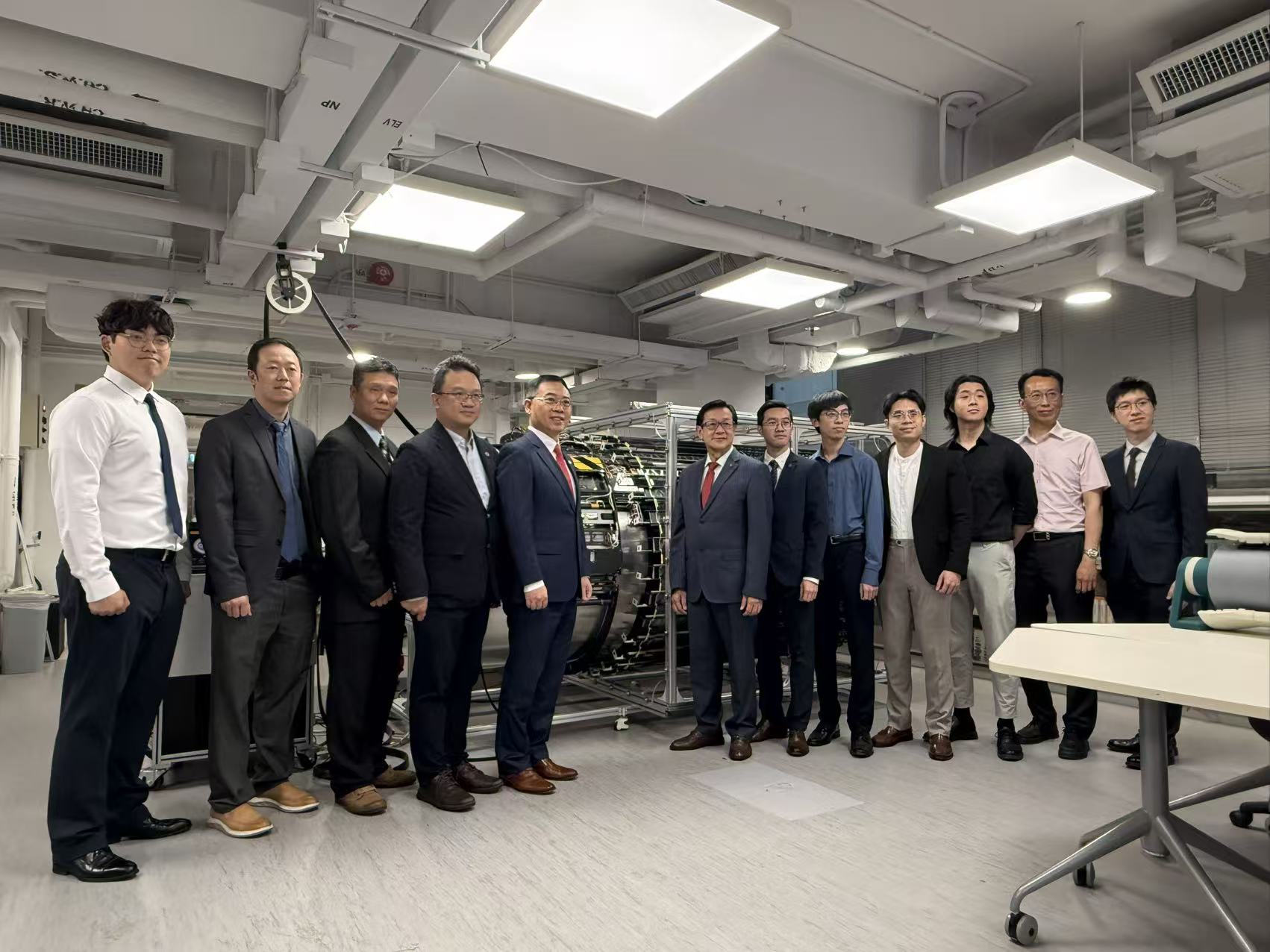
A 36-millimeter-thick robot that crawls inside power generators to hunt for faults — the brainchild of a university-industry tie-up in the Hong Kong Special Administrative Region, and which has already received a premier international invention award — has piqued the interest of major electricity providers on the Chinese mainland and beyond, developers disclosed on Thursday.
The interest — from China Southern Power Grid Co Ltd and power providers in Canada and Vietnam — came after real-world deployment of the robot at a local power plant had demonstrated that the technology is able to cut generator inspection time from over 40 days to around 30 days — by about 10 to 20 percent — while offering a safer and easier approach.
The industry partner of the project team — CLP Power Hong Kong Ltd — said in a media briefing on the invention that, with the help of the robotic inspector, it would be willing to increase its annual inspection frequency from roughly once every four years now to possibly once a year.
The robot — a five-year joint development between Hong Kong Polytechnic University and CLP Power — was purpose-built for the structural characteristics of certain gas-fired generators at CLP Power’s Black Point Power Station in Lung Kwu Tan, Tuen Mun, New Territories, Hong Kong, for which no suitable robotic inspection solutions were commercially available.
ALSO READ: Hong Kong tech expos spotlight cutting-edge innovation, forge partnerships
Conventional inspections without the robot are intricate, high-stakes operations that are logistics-intensive and take over 40 days to complete, according to Kevin Lau, CLP Power’s senior director of generation. Part of the procedure involves extracting a 50-ton cylindrical component called the “rotor” from inside the hollow generator.
However, because of its 36-mm-thinness, the robot can instead slip into the narrow air gap between the rotor and surrounding “stator” cross ventilation baffles (the generator’s outer component), and automatically carry out key inspections, all without the rotor’s removal.
Power generators, which Lau described as “the heart of the power system”, are typically bespoke, with each unit differing slightly from the others in structural characteristics and — by extension — unique inspection and maintenance procedures, he explained; but he said he believes the technology is “scalable”.
The current version “has established a model” that others can tweak through design revisions to suit their needs, Lau said, adding that there’s already interest from power stations in Vietnam.
READ MORE: HKUST study looks into ‘healthy longevity’ of Chinese people
Research team leader Tam Hwa-yaw, who is also chair professor of photonics at PolyU’s Department of Electrical and Electronic Engineering, also said that after a recent viewing of the robot in operation, China Southern Power Grid was “very interested” in using it in the mainland’s power system, and that some Canadian power providers have also taken an interest.
The university-industry co-development mechanism was applauded by both sides. Tam said his team appreciated the collaboration, above all for what it offered students. “Plant tours, up-close observation of the generator and the opportunities to study intimate mechanical details through photographs — such access is exceptionally rare anywhere in the world,” he said.
Many team members belong to an engineering entrepreneurship club Tam founded to let undergraduates help design industry solutions. “Some have been involved since their freshman year,” he said. “And that’s a full demonstration of the fruits of industry-academia-research collaboration.”
Lau, meanwhile, said that the close involvement of CLP Power’s engineers, who offered their input from an operational perspective, not only ensured the solution aligned with the power plant’s demands, but also provided the engineers with a front-row seat onto technological frontiers — key to sharpening their technical expertise.
At the 51st International Exhibition of Inventions Geneva — among the world’s most prestigious invention showcases — the robot won a gold medal and a special prize for being the Best International Invention and Innovation, from the National Research Council of Thailand.
Contact the writer at wanqing@chinadailyhk.com
