

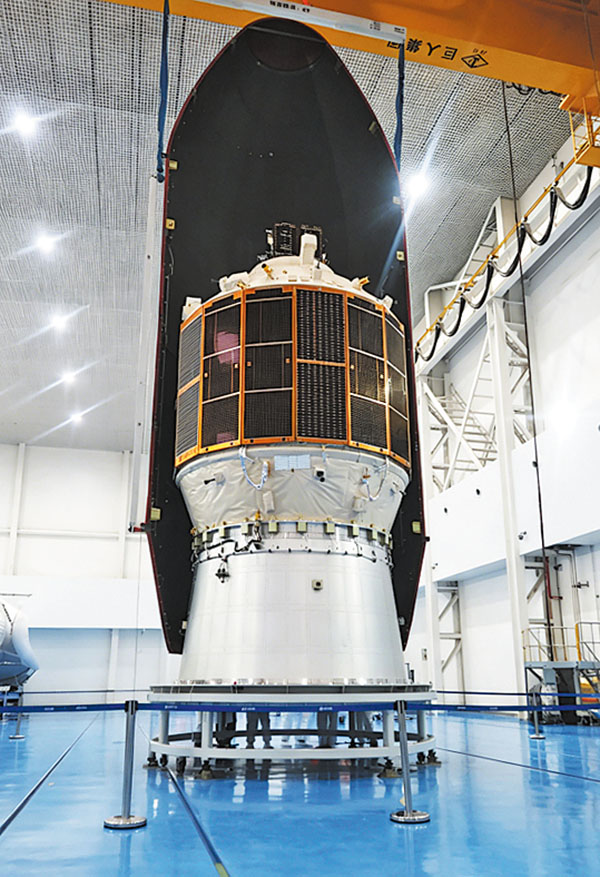
A prototype of China's Qingzhou, or "Light Ship", robotic cargo spacecraft has completed a host of assignments and will continue to carry out technology verification and tests in orbit, according to its developer.
The Shanghai-based Innovation Academy for Microsatellites of the Chinese Academy of Sciences said in a news release on Wednesday that so far the Qingzhou prototype has successfully completed flight control tests, and has moved to a higher orbit at an altitude of 600 kilometers. The vessel has entered the long-term operation phase to verify key technologies used on the craft, and examine its operational stability and perform other extended tests.
The single-section cargo vessel, weighing 4.2 metric tons, was carried into space on March 30 by the Kinetica 2 rocket from the Jiuquan Satellite Launch Center in northwestern China.
The prototype spacecraft has achieved satisfactory results, the academy said.
Its foldable ultra-thin flexible monocrystalline silicon solar cells have worked well, at a cost only one-tenth that of traditional spaceship cells. The new air-to-air communication module has delivered an excellent performance, enabling data transmission over 450 km. Components made through 3D printing technology or made of new materials have worked stably in orbit.
Its standardized payload platform features a payload "plug-and-play" function, and has so far facilitated six new technology tests, including active vibration isolation and on-orbit metal manufacturing.
On April 2 and 3, the spacecraft successfully deployed two small satellites, and conducted long-distance approach and departure tests with the New March 01 satellite, according to the release.
ALSO READ: Commercial rocket makes maiden flight
The prototype's operation is not only providing key data support for the research and development of the Qingzhou cargo spacecraft, but also exploring a feasible path for low-cost, commercial space operation and cooperation, according to the academy.
Specs from the academy show that the Qingzhou's cargo module has a total stowage volume of 9 cubic meters and a four-tier rack system with 40 standard slots, which can flexibly accommodate payloads ranging from crew supplies to scientific equipment. This design effectively meets the diverse logistical demands of China's Tiangong space station.
An intelligent onboard cargo management system enables the smart identification, tracing and management of goods. Astronauts can locate items quickly through voice commands, significantly improving retrieval efficiency and reducing their in-orbit workload.
Previously, the only cargo spaceship used by China was the Tianzhou, a larger model made by the China Academy of Space Technology. To date, nine Tianzhou vessels have been launched and eight of them have transported fuel and supplies to the Tiangong space station.
Contact the writers at zhaolei@chinadaily.com.cn
