

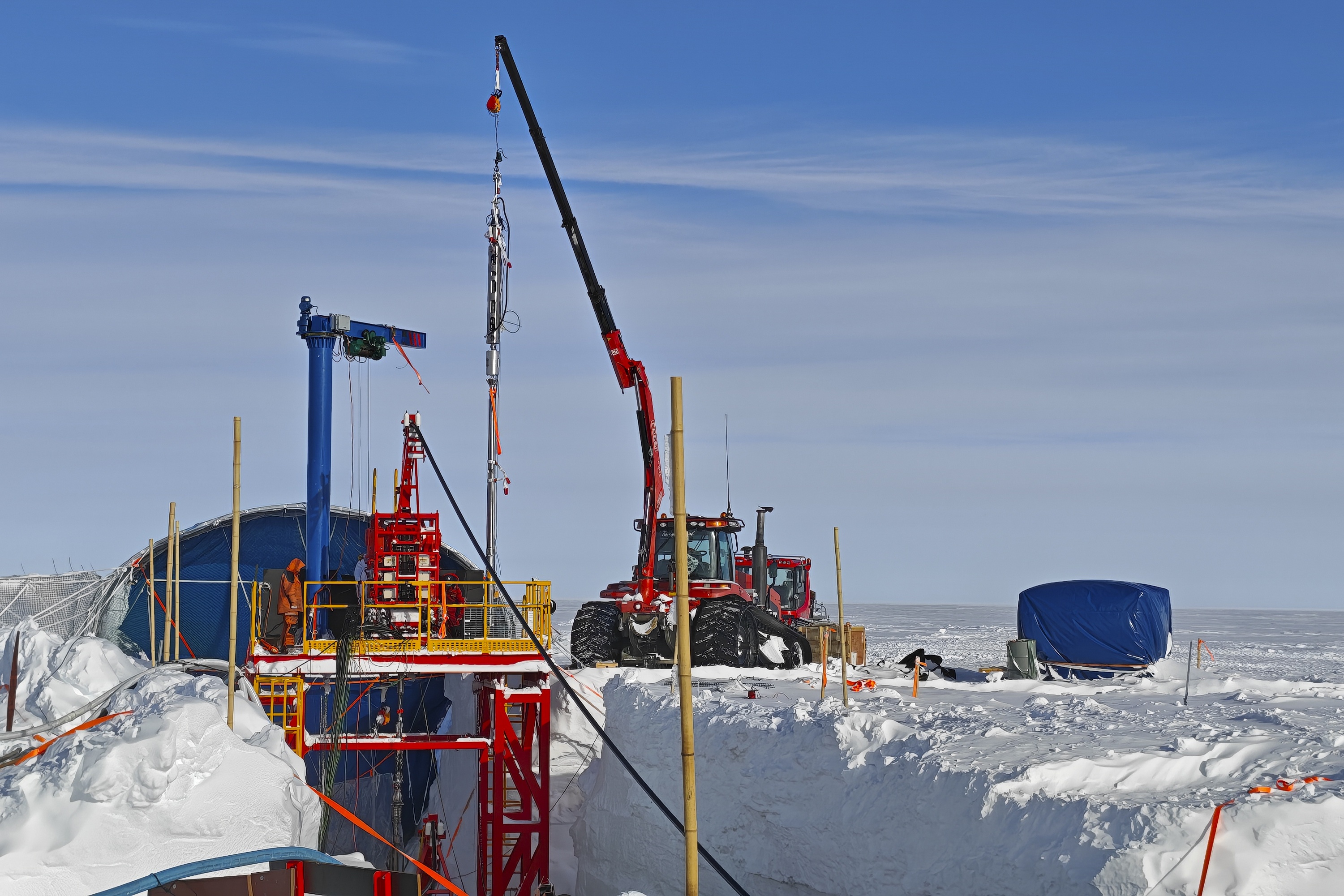
China's 42nd Antarctic expedition team has successfully completed the country's first-ever hot-water drilling test in Antarctica, reaching a depth of 3,413 meters, the Ministry of Natural Resources said on Tuesday.
The achievement breaks the previous international record of 2,540 meters for polar hot-water drilling and marks a major technological leap.
Conducted at the Qilin Subglacial Lake on Feb 5, the test demonstrates China's ability to carry out drilling research across more than 90 percent of the Antarctic ice sheet and the entire Arctic ice sheet.
The Qilin Subglacial Lake, named by China in 2022, is the second-largest buried lake in Antarctica. It is located in Princess Elizabeth Land in the East Antarctic ice sheet, about 120 kilometers from China's Taishan Station.
Polar ice sheet hot-water drilling is a frontier field in international research that studies paleoenvironmental changes, helps predict global climate change and explores the boundaries of life in extreme environments.
READ MORE: China's new polar research expedition starts journey
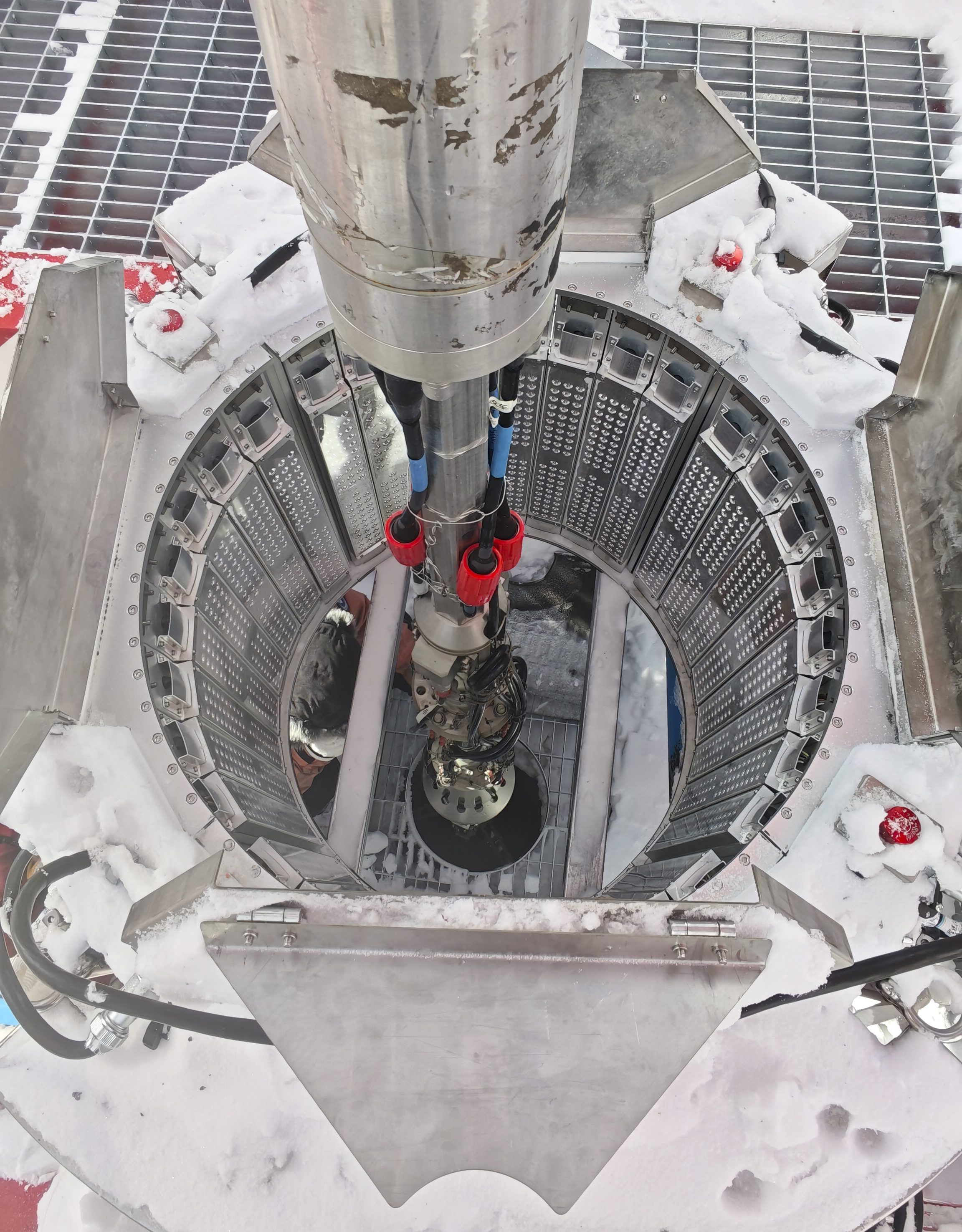
The drilling technique is used primarily in glaciology and polar research to create boreholes through thick ice sheets or glaciers. Instead of using a traditional rotating metal drill, this method uses a high-pressure stream of near-boiling water to melt a path through the ice.
Compared with mechanical ice drills, hot-water drilling ensures stronger penetration, higher efficiency, less disturbance to the ice, easier access to large boreholes and clean operations. It has become a mainstream technology for investigating deep environments in polar ice sheets and ice shelves.
'Pioneering' achievement
Li Yuansheng, a visiting professor at East China Normal University's School of Geographic Sciences in Shanghai, described the achievement as "groundbreaking and pioneering, positioning China as a leader in polar hot-water drilling".
"The successful experiment of deep and fast hot-water drilling has laid the foundation for in situ detection and sampling of deep subglacial lakes in Antarctica, achieving world-leading progress," Li said.
He added that the system integrates multiple pieces of equipment designed for polar conditions and addresses key technical challenges to meet the requirements for high-precision, large-borehole and clean drilling in Antarctica.
Li said that the hot-water drilling system can rapidly reach designated depths exceeding 3,000 meters and create clean boreholes to support the subsequent exploration and sampling of subglacial lakes.
He emphasized that the system complies with the Antarctic Treaty's requirements of peaceful use and environmental protection. Measures taken include using locally sourced snow to control external pollutants, employing anti-contamination materials and implementing strict sterilization procedures to prevent biological contamination.
According to the Ministry of Natural Resources, the operation has achieved efficient, stable and clean deep polar hot-water drilling, filling a technological gap in China's polar research capabilities and reflecting its commitment to green and environmentally friendly exploration.
ALSO READ: China says to promote cooperation in polar regions with all parties
The ministry said that China will actively share relevant technologies and data with other countries to support the international community in better understanding, protecting and utilizing the polar regions.
Lu Kai, a postdoctoral researcher at the Chinese Academy of Sciences' Institute of Geology and Geophysics, highlighted the significance of the breakthrough in advancing polar research.
"Polar ice cores preserve high-resolution records of water, hydrogen and oxygen isotopes, documenting past changes in temperature, atmospheric circulation and global ice volume. These unique archives are fundamental for reconstructing global climate dynamics," Lu said.
He added that the drilling breakthrough is crucial for extracting kilometer-thick polar ice cores that represent extended time periods, and for studying long-term paleoenvironmental changes.
He also noted that open data sharing is essential for driving global progress in the field.
Contact the writers at limenghan@chinadaily.com.cn
