

Experts call attention to long-standing impact of conflict between the US, Israel and Iran in region and beyond
In between Israeli bombardments of Lebanon and the fallout from Washington and Tel Aviv's joint strikes on Iran across the Middle East, Najib Saab and his team at the Arab Forum for Environment and Development, drastically reduced their operations until the shift to work online became inevitable.
Though the setup may feel like the COVID-19 pandemic all over again, the secretary-general of AFED, a not-for-profit NGO promoting environmental policies and programs across the Arab region, said that their office in downtown Beirut, Lebanon, suffered damage twice recently because of nearby explosions.
"We live between one disaster and another," he said. "We depend 90 percent on private generator for electricity, at very high cost now due to increasing fuel prices."
READ MORE: Iran threatens retaliation amid fresh wave of Israeli strikes
The United States and Israel began their attacks on Iran on Feb 28, including a strike hitting the Shajareh Tayyebeh Primary School in Minab in the southern Iranian province of Hormozgan, killing 175 including dozens of schoolgirls, according to the Time Magazine. Since then, Tehran has responded with retaliatory action.
As both sides engaged in tit-for-tat strikes across the region with civilian and energy infrastructure bearing the brunt of the damages, concerns are growing over the ecological harm and public health risks.
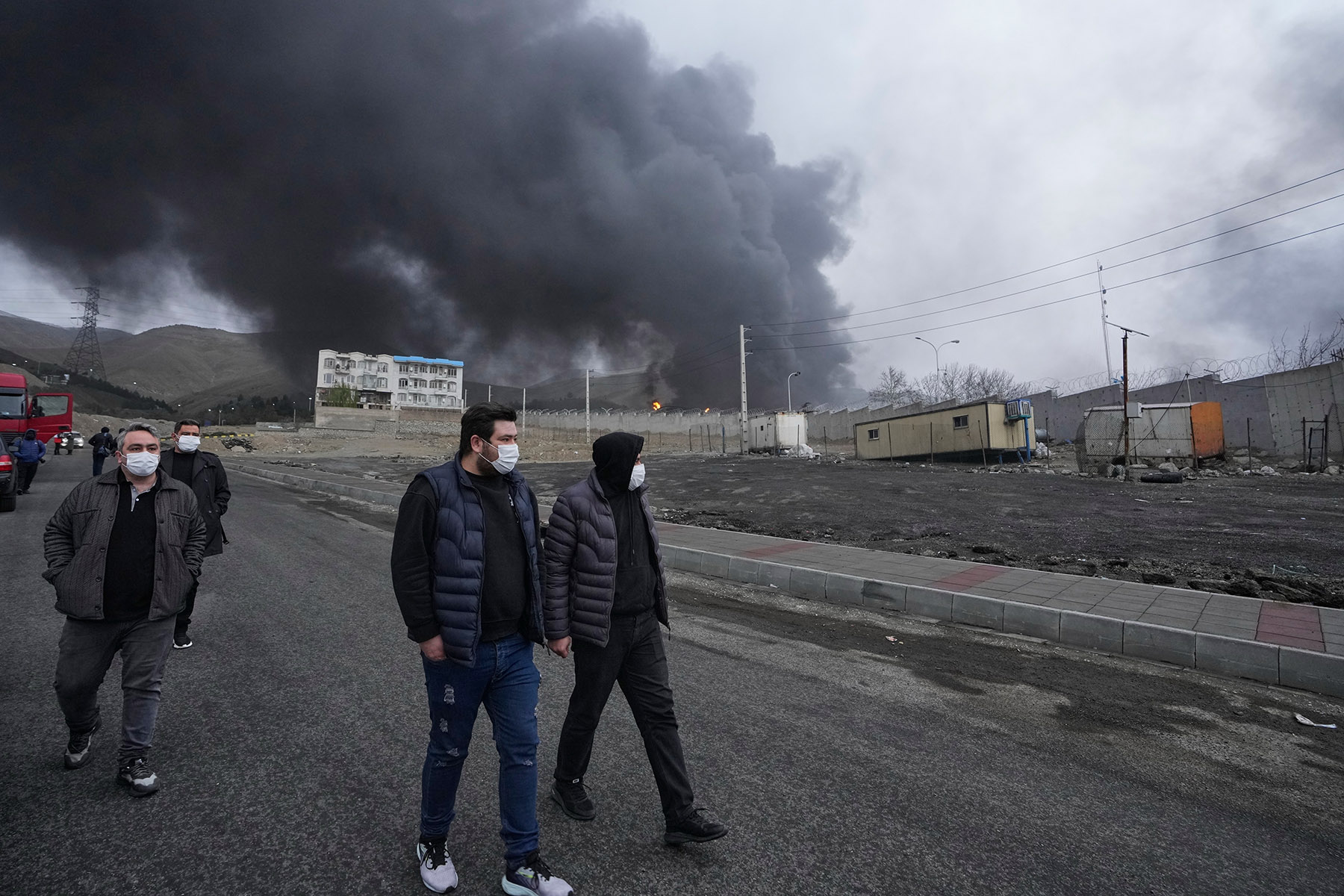
On March 7, thick smoke covered Tehran's skies after Israeli air strikes hit oil facilities and killed at least four people. World Health Organization spokesperson Christian Lindmeier warned on March 10 that the "black rain" that fell on Tehran after the strikes "is indeed a danger" for Iranians and advised people to stay indoors.
Lindmeier also said Iranian strikes on oil infrastructure in Bahrain and Saudi Arabia raised concerns of "wider regional pollution exposure", highlighting the long-term effects of pollutants, which affect respiratory health and contaminate water.
On March 16, Iranian Foreign Minister Abbas Araghchi called Israel's bombings of fuel depots in Tehran "ecocide" and demanded that Israel be "punished for its war crimes".
Saab, from AFED, said he believes people's exposure to toxic substances amid the conflict would have effects "continuing for decades after the war ends", which currently shows no signs of abating.
"The ultimate goal is to control natural resources, not to free people from dictatorships, as promoted by the US and Israel," he said.
What makes it more dangerous, he said, is that the main players on all sides "rely on fundamentalist ideologies to muster support among their fanatic popular base from extreme Zionists and their evangelical disciples in Israel and the US, to the theocratic regimes on the opposite side, turning the conflict into a sort of holy war".
"This leads warring parties in this conflict to grossly disregard all traditional rules governing wars and international humanitarian laws,"Saab said.
"What complicates matters further is the US administration's view of the world as pure real estate opportunities, regardless of national and human rights of people.
"This is precisely demonstrated in the attacks on energy and power facilities initiated on Iran, which triggered counterattacks on energy installations in Arab countries hosting US military presence."
He said the situation may become more dangerous if seawater desalination plants in the Gulf Arab countries are targeted by bombing or their operations disrupted by massive oil pollution.
"This threatens the very survival of millions, as some countries do not have alternative sources of fresh water other than desalination."
Rumaitha Al Busaidi, vice-president of the Environment Society of Oman, said that the environmental cost of this conflict operates on two timescales.
Immediate damage
The immediate damage is visible, she said, citing refinery fires releasing toxic hydrocarbons and sulfur compounds into the air, the risk of oil entering the marine environment through the Strait of Hormuz, and the ongoing threat to ecosystems already operating under extreme stress from warming seas and chronic pollution.
"The Gulf and the Sea of Oman support over 1,600 fish species and the second-most important dugong population in the world after Australia. Military activity in these waters compounds pressures that were already approaching critical thresholds."
She said the less visible dimension may prove more consequential. A new analysis suggests the first 14 days of the conflict released more than 5 million metric tons of carbon dioxide, equivalent to the combined annual output of 84 small nations.
The largest share of immediate atmospheric emissions comes from fuel consumption by military aircraft and naval vessels, which generate up to 30 times the carbon output of infrastructure destruction.
"Rerouted civilian aviation across the region adds further emissions. The targeting of gas storage facilities risks releasing uncombusted methane, a far more potent greenhouse gas in the short term," Al Busaidi said. "These invisible contributions feed directly into the atmospheric imbalance driving more extreme weather patterns across the region and beyond."
From energy to food, the ongoing conflict has sent global markets into a frenzy, with the International Energy Agency saying the situation was worse than the 1970s energy crisis and the Ukraine-Russia conflict combined.
The uncertainty has prompted the Philippines, which holds the Association of Southeast Asian Nations chair this year, to be the first country to declare a national energy emergency.
"From my perspective as a corporate lawyer in Jakarta, the war in Iran may feel far away, but its environmental impact is not," said Glenn Wijaya, a senior associate at the Christian Teo & Partners law firm.
War "is inherently carbon-intensive", he said, and over time, this feeds into climate change and rising sea levels. This "is a very real and immediate concern for Indonesia", the largest economy in ASEAN, accounting for nearly 40 percent of the bloc's GDP.
"At the same time, higher oil prices are creating a tricky balance. On one hand, they push countries — including Indonesia — toward cleaner energy," Wijaya said.
"On the other, they can also lead to greater short-term reliance on fossil fuels to keep energy affordable and stable. Recent discussions about increasing coal production quota reflect that reality."
Policy push
However, there is a clear policy push in the other direction, Wijaya said, noting Indonesian President Prabowo Subianto making energy transition a priority, with Minister of Energy and Mineral Resources Bahlil Lahadalia driving efforts such as expanding solar power, reducing diesel use, and accelerating two-wheeler electric vehicle adoption.
"So while the war is distant, its effects are not. It is shaping how Indonesia consumes energy, with mixed environmental outcomes," Wijaya said.
Saab, from AFED, said the conflict in the Middle East, as well as in Ukraine, "will have long-standing consequences on the environment for many decades".
However, the major impact might be on the energy sector, with vulnerabilities exposed, both for producing and consuming countries.
"Producers have to expedite diversifying their economies, to minimize dependence on oil and gas for income, and redraw supply routes.
"The wars will certainly delay achieving development targets across the region, putting reconstruction ahead of any other goals. This will also have a great stress on resources, from water to energy to building materials, with huge environmental impact," Saab said.
Nabeela Siddiqui, assistant professor at Vinayaka Mission's Law School, a constituent unit of Vinayaka Mission's Research Foundation in Chennai, India, said that the relationship between environmental health and national security "is not incidental in the Middle East, but it is foundational".
ALSO READ: Optimism renewed as Trump signals war end
She said scarce water resources, fragile ecosystems, and climate vulnerability mean that environmental degradation directly threatens state stability, civilian welfare, and regional peace.
"The challenge, then, is not simply recognizing this link, but enforcing accountability for environmental harm even when conflict is ongoing. International humanitarian law provides one of the most powerful entry points,"Siddiqui said.
"Embedding environmental restoration targets directly within ceasefire and peace frameworks — specifying, for instance, the supervised reopening of water treatment facilities — elevates environmental concerns from diplomatic afterthoughts to concrete, monitored obligations," Siddiqui said.
"Ultimately, the most durable strategy combines rigorous real-time evidence collection with financial conditionality — ensuring that whoever signs a peace agreement also accepts responsibility for the land, water, and air that their populations depend upon," Siddiqui said.
Contact the writers at jan@chinadailyapac.com
