

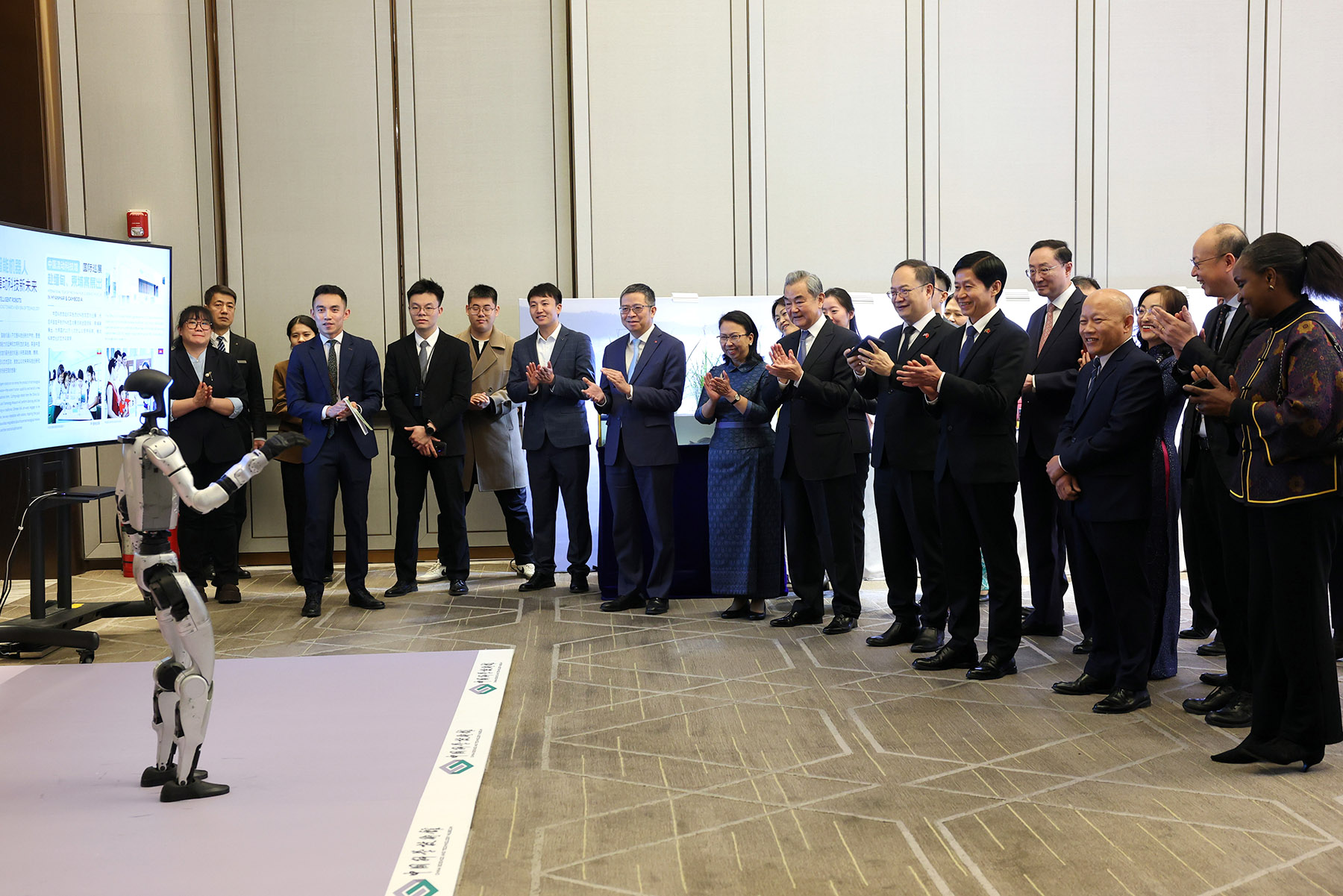
Foreign Minister Wang Yi called on Monday for building an upgraded version of the Lancang-Mekong Cooperation mechanism focused on solidarity, openness, green innovation and peace, in order to usher in a new "golden decade" of regional cooperation.
Wang, who is also a member of the Political Bureau of the Communist Party of China Central Committee, made the remarks at a reception held in Beijing on Monday to commemorate the 10th anniversary of the first Lancang-Mekong Cooperation Leaders' Meeting.
He said the robust growth of the LMC over the past decade has been driven by three key principles: upholding good-neighborliness, friendship and a shared future, staying focused on development to serve the people, and pursuing innovation and breaking new ground.
READ MORE: Cross-border rail rallies regional connectivity
Official data shows that over the past 10 years, China has established communities of a shared future with all five Mekong countries: Cambodia, Laos, Myanmar, Thailand and Vietnam. Trade between China and the Mekong nations has surpassed $500 billion, up 150 percent from a decade ago.
More than 1,000 "small and beautiful" livelihood projects have been carried out across the region, while joint Mekong River patrol and law enforcement operations involving China, Laos, Myanmar and Thailand have been conducted 162 times.
Noting that the world is entering a period of turbulence marked by hegemonism and power politics, which are severely affecting the existing international order, Wang said the six member countries should strengthen strategic coordination to promote long-term peace, stability and prosperity in the region, offering a "Lancang-Mekong model" for global governance.
He called for advancing comprehensive infrastructure connectivity in the Lancang-Mekong region and for jointly building an economic development belt for the river basin.
Wang urged deeper cooperation in fields such as the digital economy, artificial intelligence, scientific and technological innovation, and ecological governance. He called for greater investment in new energy, stronger regional green value chains, and the development of green industrial clusters.
He emphasized the need for stronger basin-wide governance, greater sharing of hydrologic information and closer joint action against cross-border crimes, such as online gambling and telecom fraud, to help create a secure environment for deeper regional cooperation.
Chatchai Viriyavejakul, Thai ambassador to China, described the LMC mechanism as "one of the most dynamic and effective platforms for regional cooperation", saying that it has played a pivotal role in boosting socioeconomic development, improving livelihoods, narrowing development gaps and supporting ASEAN community building. He credited China's support through the LMC Special Fund for driving project implementation across the region.
ALSO READ: Lancang-Mekong nations pledge unity
As the current co-chair of the mechanism, Thailand looks forward to the fifth LMC leaders' meeting scheduled later this year, as well as to building a safer, cleaner and more sustainable Lancang-Mekong community with a shared future, he added.
This week marks the 2026 Lancang-Mekong Cooperation Week. At a regular news briefing on Monday in Beijing, Foreign Ministry spokesman Lin Jian said that China will host more than 170 celebratory events to mark the occasion.
Du Lan, secretary-general of the Global Center for Mekong Studies China Center, said the move to build a more mature and resilient Lancang-Mekong Cooperation 2.0 reflects the six countries' shared need to respond to a changing global landscape, strengthen regional resilience and pursue common development through closer coordination. She added that the success of the LMC mechanism shows that developing countries can achieve common development through equal cooperation.
Contact the writers at zhaojia@chinadaily.com.cn
