

Photographs reveal the forgotten Ming-era story carved into two neglected stone monuments in Beijing and their links to a vanished temple
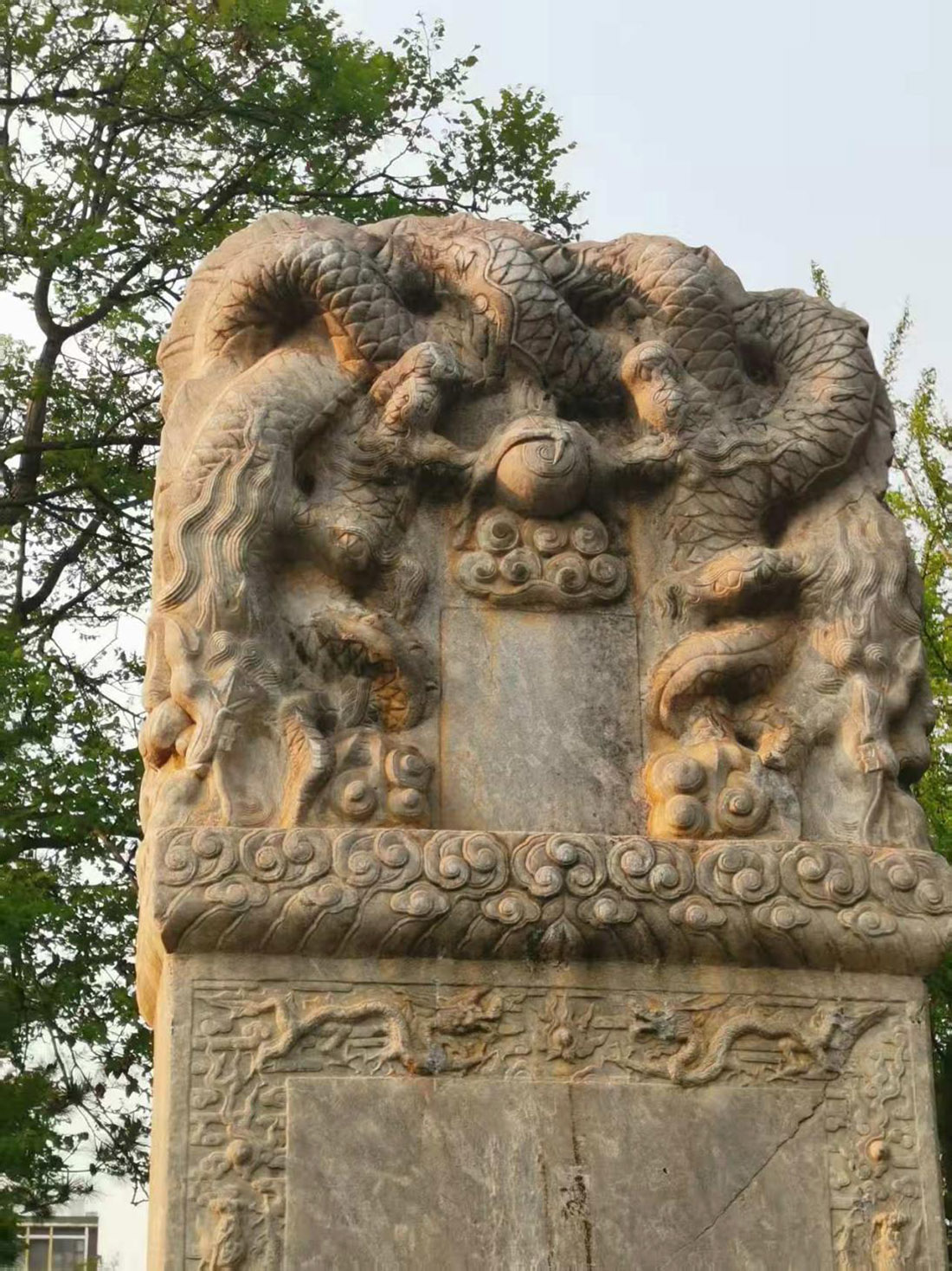
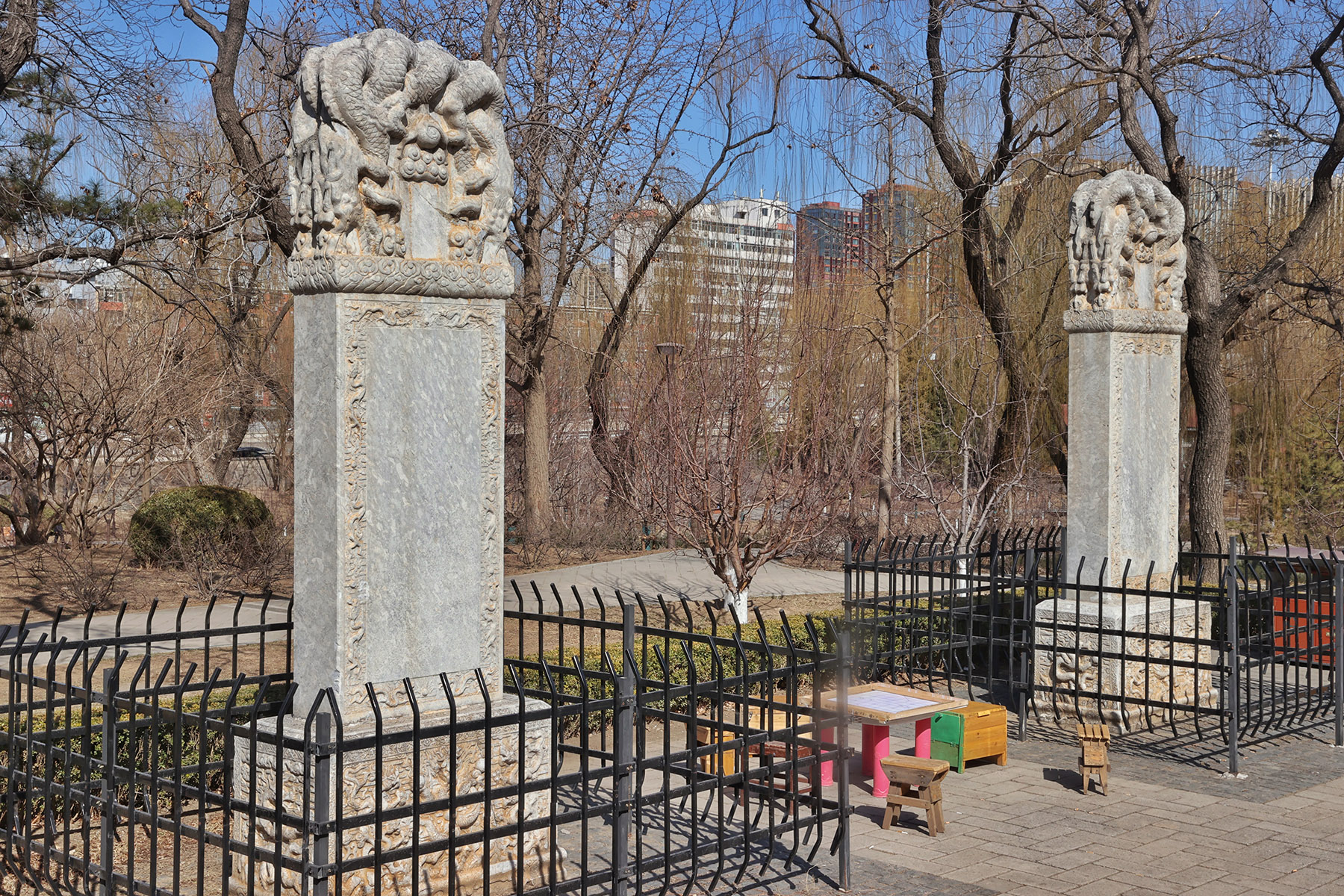
Two exquisitely carved ancient stone steles stand alone at the easternmost end of Tucheng (Earth City Wall) Park. The park, officially named the Yuan Dadu (Khanbaliq)City Wall Relics Park, is located north of the North Third Ring Road in Beijing.
Stretching over nine kilometers from east to west and only 200 to 300 meters wide from north to south, the park was built along the remains of the northern city wall and a section of the western city wall of the Great Capital of the Yuan Dynasty (1271-1368).
The stone steles, with lifelike coiled dragons on them, have a strong style of royalty. However, the inscriptions have become blurred with the passage of time.
My family moved to the new site of China Daily, near the park, in the late 1980s, and the steles have stood there ever since. No one knows the exact time when they were moved there. Though protected by iron railings, there is no explanatory plaque beside them, leaving their age, purpose of construction and value a mystery.
In the autumn of 2024, a strong gale blew down a large tree behind the steles, which crashed onto them. The eastern stele was knocked flat onto the brick-paved ground. Miraculously, the entire stele remained intact except for scratches on its surface from the iron railings. Park management immediately used a crane to reerect the stele and installed new protective barriers.
About a decade ago, I wrote a letter to the park administration, suggesting that an information board be placed next to the steles to explain their origin and value — so that these cultural relics could come alive, rather than merely serving as decorations. A staff member called me back: first to express thanks, then to say the matter was quite complex, and that only with the participation of cultural relic authorities could the steles' origin be clarified. Nothing more was heard of it after that.
Last year, many signs reading Park Director's Mailbox with QR codes were installed in the park. I scanned the code, sent some comments, and repeated my suggestion for an information board for the steles, citing the example of Beihai Park, which is a famous royal garden near the Forbidden City.
I hoped the park director would have an information board installed for the steles as soon as possible.
A few weeks ago, I saw two unidentified young men at the steles — one holding a spotlight, the other photographing them with a camera. This gave me an idea: I could also take photos of the inscriptions with my mobile phone.
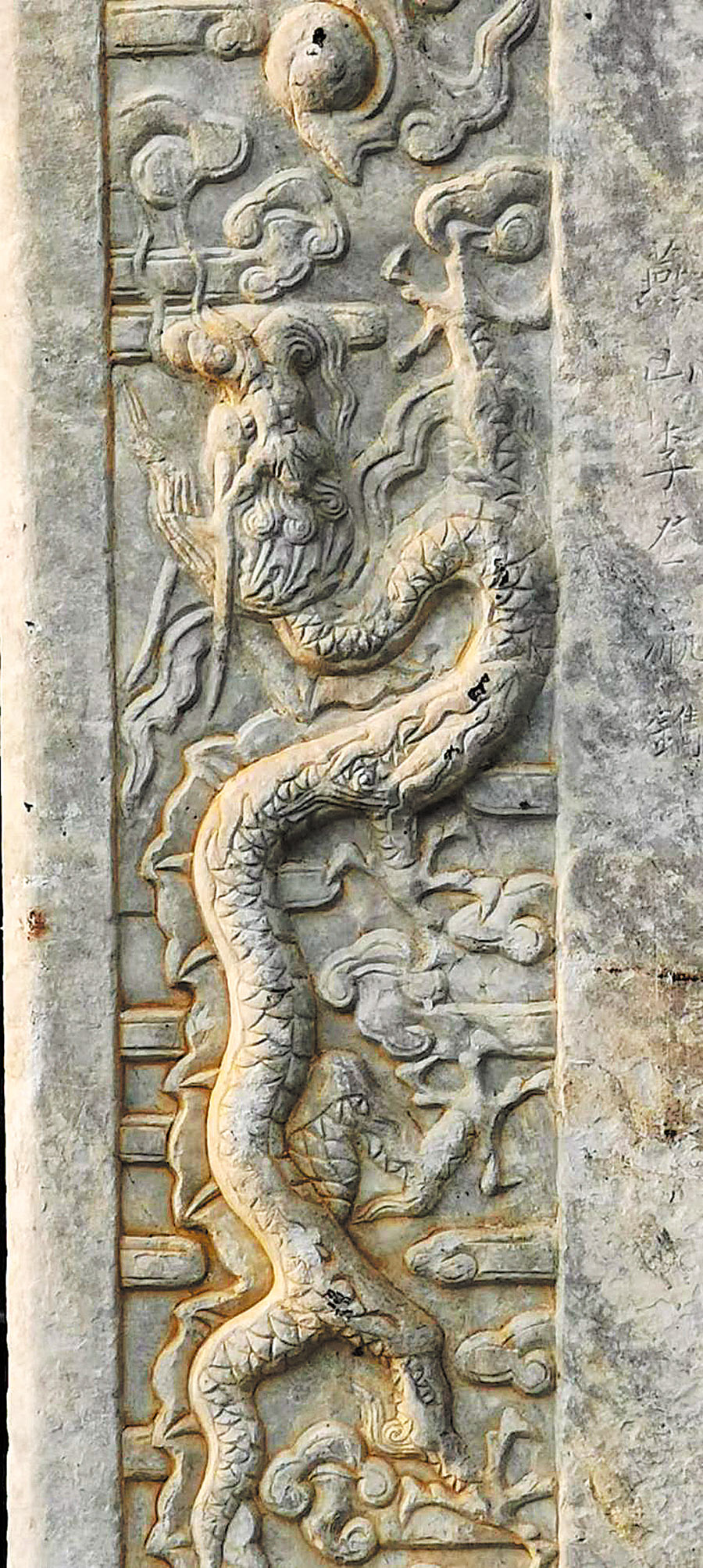
When I zoomed in on the inscriptions, I was astonished! Many faint characters that were invisible from a distance became clear. It turns out the steles are relics of the Ming Dynasty (1368-1644), recording the renovation of a temple.
The inscriptions clearly state:"Record of the Renovation Project for the 'Tianxian (Celestial Beauty)Palace for Protecting the State, Blessing the Sage and Prolonging Life'." The palace was an imperial-bestowed temple, which was granted by the emperor. It had a long name, commonly abbreviated as Tianxian Palace or Tianxian Temple. It is recorded in both Ming and Qing (1644-1911) historical documents but fell into disrepair and disappeared by the early 20th century. These two steles are undoubtedly relics of this temple.
The first sentence of the inscription on the right stele reads, "It is said Shenlu (the way of the deities) is boundless", and there are phrases such as "outside Chaoyang Gate of the capital", indicating the original temple was situated at Shenlu Street near Chaoyangmenwai Dajie (the avenue outside Chaoyang Gate). This aligns with the belief that the steles were moved to Tucheng Park from outside Chaoyang Gate in the 1960s or 1970s.
The inscription is signed, "Written by Wu Ruyin of Yongliang". Yongliang was the ancient name for the Wuwei area in Gansu province. Wu Ruyin, who was a high-ranking official of Mongolian ethnicity, was the sixth Marquis of Gongshun in the Ming era.
He was the son of Wu Jijue, the fifth Marquis of Gongshun, and inherited the title in the 27th year of the Wanli reign (1573-1620). He held important military positions in the imperial court and died in the 4th year of the Chongzhen reign (1628-1644).
As the sixth Marquis of Gongshun, Wu Ruyin witnessed the political and military changes in the mid-to-late Ming Dynasty. His family held a special position in Ming history: they were both representatives of Mongolian aristocrats who surrendered to the Ming and were important members of the dynasty's meritorious minister system.
The fact that the steles were inscribed by Wu Ruyin, the Marquis of Gongshun, attests to the great importance of the Tianxian Palace.
The temple enshrined the Goddess of Mount Tai (Bixia Yuanjun), widely known in folklore as the "Lady of Mount Tai". This belief was extremely popular in the Ming Dynasty, and the goddess is revered as the protector of childbirth, children's health, farming and women's well-being.
The inscription on the other stele is even more blurred. It is presumed to be a list of donors for the renovation project, with the highest-ranked being Zhu Changying — Prince Gui of Ming. It also records the names of officials and eunuchs who oversaw the project. Zhu Changying was an unremarkable feudal prince of the Ming Dynasty, but his son Zhu Youlang became the Yongli Emperor (1646-1662) of the Southern Ming Dynasty, who led the resistance against the Qing Dynasty for 16 years and became a symbol of the anti-Qing struggle.
The inscription at the end of the second stele reads: "Erected on the auspicious 15th day of the first month of winter in the Guihai year of the Tianqi reign of the Great Ming Dynasty". Tianqi was the reign title of Emperor Xizong (Zhu Youxiao), ruling from 1621 to 1627. The Guihai year in his reign is 1623.
ALSO READ: Sacred beasts of ancient Yinxu
According to historical documents such as Beijing Local Chronicles and Studies of Ancient Accounts of the Imperial Capital, the temple was named "Tianxian Palace for Protecting the State, Blessed by the Sage and Prolonging Life", which differs from the inscription by the order of two characters: "Shengyou (Blessed by the Sage)" in the documents versus "Yousheng (Blessing the Sage)" in the inscription. Which one is correct?
Naturally, the inscription prevails. As original physical historical materials, stone steles are more credible than written records. Furthermore, "Yousheng" is linguistically logical: "Tianxian (Celestial Immortal)" is the subject, "Huguo" means safeguarding the nation,"Yousheng" means blessing wise men, and "Yanshou" means extending people's lifespan — whereas "Shengyou" would be grammatically incoherent in this context. The error in the documents was caused by the carelessness of copyists.
The document management system became lax in the middle to late Ming Dynasty. The Collected Regulations of the Great Ming Dynasty compiled during the Jiajing reign (1522-1566) recorded that "four or five out of 10 local documents submitted contain character errors or mistakes". My research on these steles has corrected errors in historical documents, which is indeed of great significance.
At present, the faint characters on the steles are still visible when zoomed in on, but they will fade away in the years to come. If no photographic records are made, the origin of the steles will be lost forever, a loss that can never be recovered. I am greatly heartened to have made a small contribution to the protection of cultural relics.
The author is a freelancer for China Daily.
