

Hong Kong is more than merely a launchpad for mainland enterprises going global. The city is having more than its fair share in the thrust through its unique strengths, traditional financial finesse and superconnector role, augmented by increased cooperation across the Guangdong-Hong Kong-Macao Greater Bay Area. Jessica Chen reports.

It’s history — Chinese enterprises, technology-driven or manufacturing-heavy, aren’t venturing abroad on their own any longer. A growing symbiotic partnership between Hong Kong and mainland industrial capital is powering their global thrust.
Scholars, rather than bankers or entrepreneurs, have stood at the forefront of Hong Kong’s global symbiosis. During the pandemic, Chris Lo Kwan-yu, a professor at Hong Kong Polytechnic University (PolyU), surprisingly found himself as an “avant-garde” figure in the wave of Chinese enterprises’ global expansion.
Lo, a resourceful innovator who developed self-disinfecting materials technology (Gold Medal, Geneva Inventions Expo) and an expert in global supply chain management, is now targeting international markets from Southeast Asia to North America for his startup, Immune Materials Ltd (IML). He is tapping manufacturers from Fujian province, a southeastern coastal hub on the mainland with ready-made market access.
“Fujian is home to manufacturers for world brands like Adidas, who are now exploring anti-virus apparel for global markets,” Lo said.
As one of PolyU’s standout spinoffs, IML exemplifies Hong Kong’s strengths. “We’ve made it PolyU’s strategy to incubate and support campus startups,” said Christopher Chao Yu-hang, the university’s senior vice-president.
READ MORE: Hong Kong to redefine its super-connector role
Startups like IML have gained footholds northward, as mainland partners rapidly scaled up production — building robust portfolios in product competitiveness and technological know-how for a greater global presence. Chao adds that PolyU’s ties with Fujian have become “a cornerstone of sustained innovation.” PolyU alone spun out 450 startups, many of which secured mainland investment, with about 60 preparing for mass production across the boundary. With Fujian provincial funding, IML shifted manufacturing partners in Malaysia, Vietnam and Thailand to leverage lower labor costs and tariff advantages. Hong Kong-based distributor Kin Sang Chemical then took over, marketing IML products globally via its own channels and Fujian’s extensive trade network — a seamless partnership driven by policy and pragmatism.
“China is now exporting its technology. They need strategic partners to become true global champions, which requires international expansion,” said Daniel van Scheltinga, founder and managing partner at Polarwide, with 24 years of experience facilitating Chinese firms’ global expedition.
Policy and pragmatism
IML’s story mirrors a larger trend. By late last year, major mainland provinces and cities had built regional coordination centers in Hong Kong, with some of them operating as incubators for innovation projects born at local universities. One of the earliest to set foot in the special administrative region — Wuxi Hong Kong Science and Technology Innovation Center, run by Surrich International from Jiangsu province’s city of Wuxi, which is known for its semiconductor industry — opened in 2023. The facility overlooking Victoria Harbour symbolizes the city-to-city tech connections rippling across the region.
Such partnerships have matured over the years, and gained momentum after the COVID-19 pandemic waned under the Guangdong-Hong Kong-Macao Greater Bay Area blueprint. With a population of 86 million, comparable to that of the New York and Tokyo bays, the Greater Bay Area now hosts over 570 Hong Kong-affiliated firms.
In his 2026 Government Work Report, Premier Li Qiang called the Greater Bay Area a “world-class innovation engine”, with Hong Kong as a linchpin of the nation’s push for technological self-reliance. The 15th Five-Year Plan (2026-30) further positions Hong Kong as a research powerhouse, financial bridge, and global-talent magnet.
It has been “common sense” among the business circles that Hong Kong is far more than a fitting launchpad or adaptive middleman — it offers the connectivity, financing and legal sophistication complementing the mainland’s manufacturing scale and global trade reach. Together, they form a pragmatic ecosystem for “going global” — one that channels resources with precision to navigate an ever-more complex geopolitical landscape.
In this emerging cross-boundary mechanism, the city’s universities conceive new technologies, while mainland municipal and provincial funds bankroll overseas production. The SAR handles what it knows best — trade facilitation, financing and regulatory alignment.
ALSO READ: HKSAR urged to play greater role in Chinese firms ‘going global 2.0’
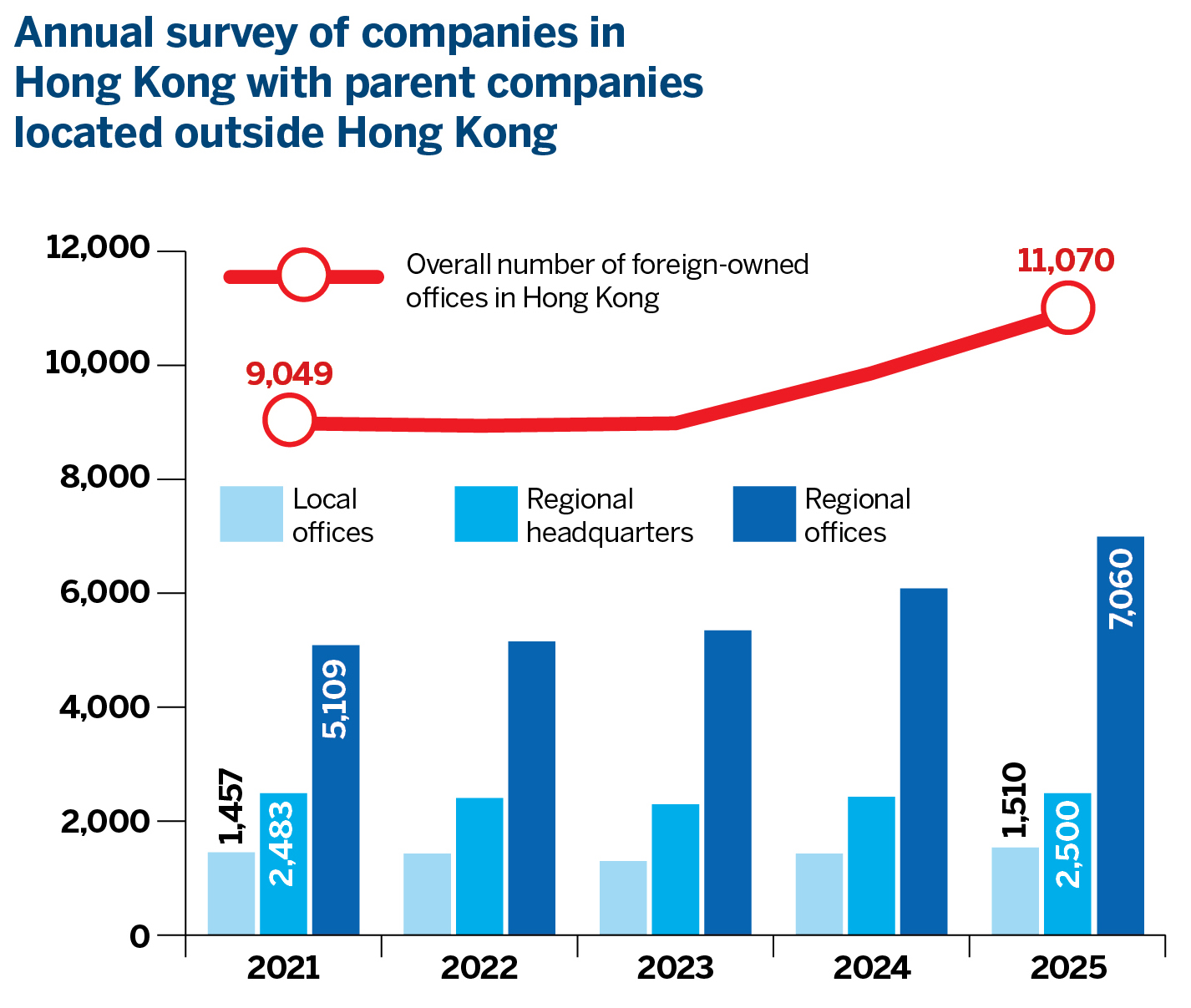
According to official data, overseas sales by mainland-listed enterprises hit 9.44 trillion yuan ($1.37 trillion) in 2024, while direct outbound investment was $192 billion, up 8 percent year-on-year — the highest level since 2018. Three months earlier, FDi Intelligence — a division of the Financial Times — surveyed 101 foreign investment leaders on the top three sources of global foreign direct investment. China was the most favored, with 74 respondents selecting Chinese companies “making inroads as global corporations.” (See chart)
Hong Kong remains a central pivot of the momentum. Hong Kong Chief Executive John Lee Ka-chiu has moved swiftly to align local initiatives with national priorities, setting up a cross-bureau task force in October to accelerate the internationalization of mainland enterprises.
The southern tech boomtown of Shenzhen has forked out more than 6 percent of its GDP for research and development, embracing artificial intelligence, biotechnology, and advanced materials, while Hong Kong channels its financial and legal clout to commercialize breakthroughs. At Qianhai — dubbed the “special zone in the special zone” — more than 10,577 Hong Kong firms have set up shop, while the Hetao zone boasts over 200 high-end research projects. Ports integrate, rules converge and renminbi liquidity flows more freely.
Veteran investment adviser Scheltinga, who has been coaching Chinese dealmakers since 2002, agrees that Hong Kong is the superconnector and universal adaptor — a city built on bilingual dexterity and bicultural fluency that continually reshapes international perceptions of China.

Gears in motion
The results speak for themselves. Shenzhen’s high-tech BYD reportedly met its 2025 sales target and is likely to have surpassed Austin, Texas-based Tesla in global deliveries. Hong Kong-listed Miniso, which runs 3,300 overseas stores, tapped fresh investor enthusiasm with a secondary listing in the city.
Chinese outbound investment increasingly anchors factories across the 11-member Association of Southeast Asian Nations, cementing China’s role as the region’s manufacturing powerhouse. Intra-Asia trade, which already accounts for 60 percent of the continent’s total, is projected to pick up a further 8 percent this year, buoyed by renminbi settlements and rising consumer spending.
Geopolitical turbulence may scrape occasionally against the machinery. Yet Hong Kong’s engine continues to hum. Anchored by the Greater Bay Area’s energy and its own flexibility, the city has refined “going global” into a disciplined playbook — one that leverages cross-boundary synergies and agile supply-chain realignments. Mainland companies tap the SAR for capital and compliance, while local startups like IML access mainland networks to scale up globally.
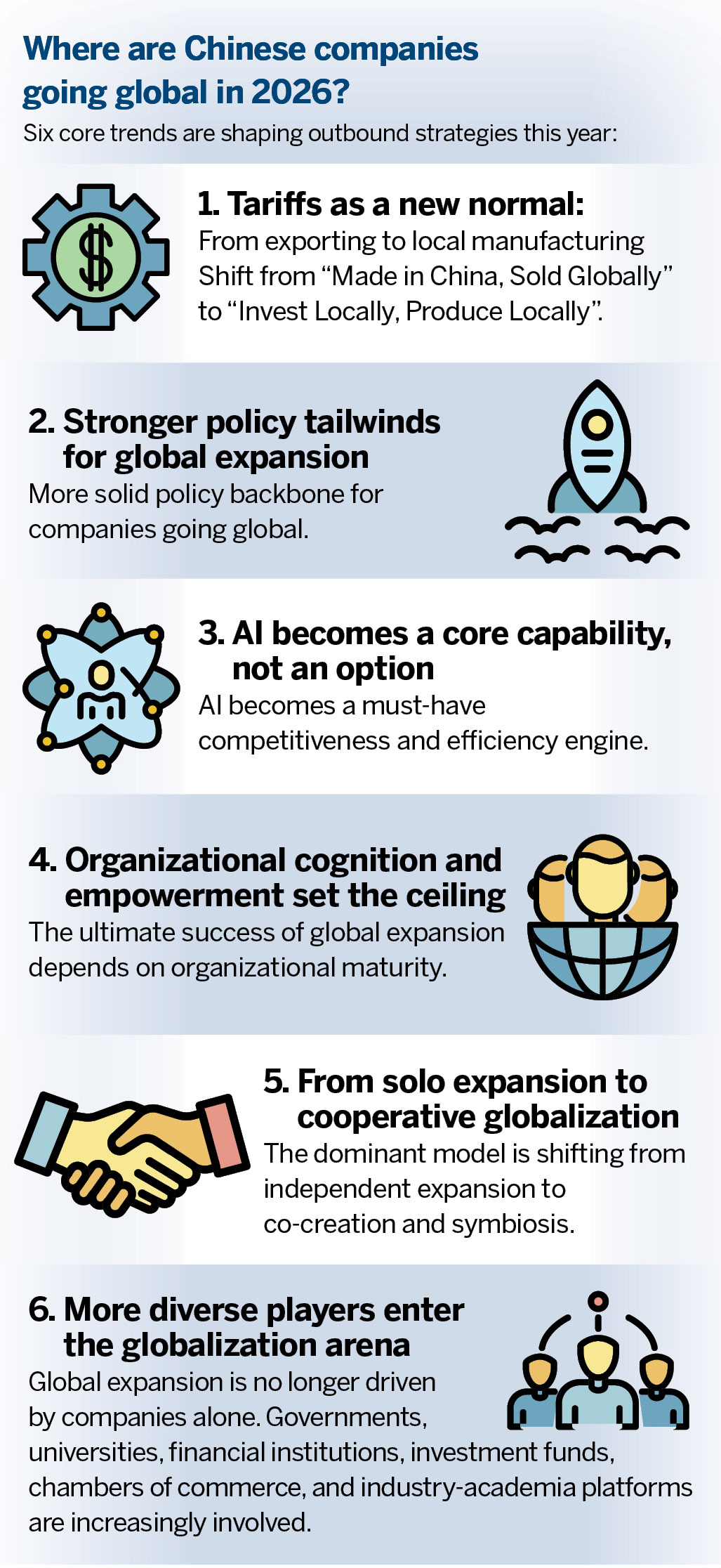
Smarter global blueprint
As PwC notes in its report China: Going Overseas, the question for 2026 and beyond is no longer whether China’s trade dominance can endure, but how it can evolve into higher quality, stronger resilience and greater trust. Hong Kong will sit at the center of that transformation.
“The center of gravity in global trade is shifting decisively southward,” says Robin van Puyenbroeck, executive director of the World Trade Centers Association. “Hong Kong’s role as a hub for digital trade, supply chain finance and regulatory coordination will only grow more critical.”
As Scheltinga perceives: Hong Kong doesn’t advance by force — it advances by finesse.
Contact the writer at Jessica@chinadailyhk.com
