

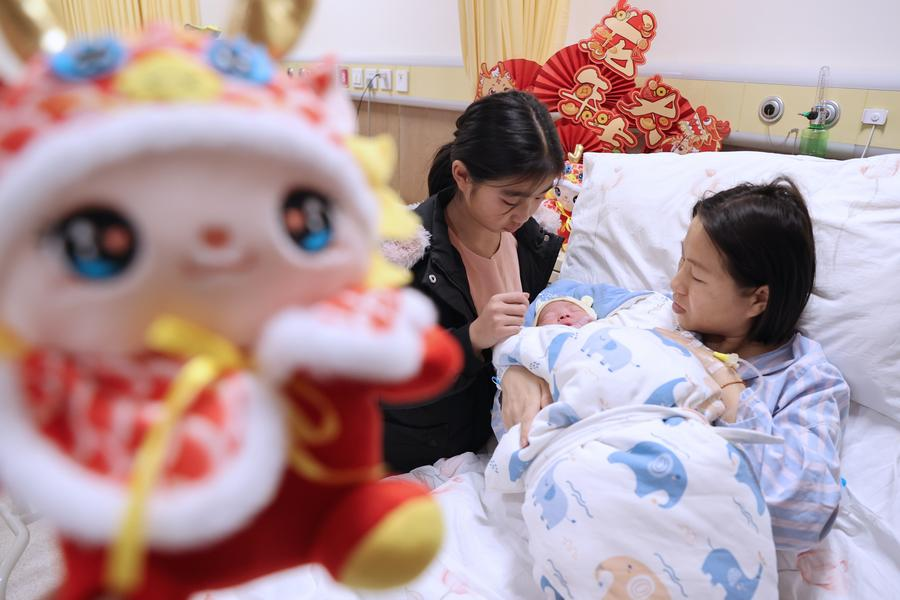
BEIJING -- China has earmarked more than 100 billion yuan (about $14.5 billion) for childcare subsidies, the country's top health official said on Saturday, as part of its efforts to build a more birth-friendly society.
The nationwide subsidy program, which was introduced in 2025, provides 300 yuan per month for each child under the age of three.
Fiscal authorities at all levels nationwide have allocated the funds for the subsidies, including more than 90 billion yuan from the central government, Lei Haichao, head of the National Health Commission, said at a press conference held on the sidelines of the annual session of the top legislature.
More than 33 million eligible children have been covered by the program so far, Lei said, adding that the payments help families raise their children and support their healthy development.
READ MORE: China launches new round of applications for nationwide childcare subsidies
"A birth-friendly society" is a key aspect of the draft outline of the 15th Five-Year Plan (2026-2030), which is currently under review at the ongoing legislative session.
It requires refining the policies and incentives for boosting birth rates; effectively reducing the costs of childbirth, parenting and education; striving to stabilize the number of newborns; and promoting long-term balanced population development.
"The 15th Five-Year Plan period is a critical stage for China's population development," said He Dan, head of the China Population and Development Research Center under the National Health Commission, adding that the country will take systematic measures, from planning and funding to policy formulation, to effectively boost people's willingness to have children.
Beyond direct subsidies, multiple measures are underway to promote the country's population development.
READ MORE: China exempts childcare subsidies from individual income tax
"In the past year alone, 890,000 slots of public-interest nurseries were added, bringing the total to 6.6 million," Lei said, citing the expansion as an important policy support.
Meanwhile, maternity leave in China has been generally extended to over 158 days, along with spousal paternity leave and parental leave, making new mothers feel increasingly supported.
The draft outline calls for expanding the coverage of maternity insurance, fully implementing maternity leave policies and strengthening childcare services, according to Liu Dechun, an official with the National Development and Reform Commission.
It also aims to raise the enrollment rate of children under three by six percentage points, supporting the integration of childcare and kindergarten services as well as diversified public-interest childcare programs, Liu said at another press conference on Saturday.
"Building a fertility-friendly society is a systematic task," said Yang Fan, associate dean at the School of Population and Health, Renmin University of China, noting that the key during the 15th Five-Year Plan period is to turn fragmented policies into an integrated system, creating support that covers the full life cycle.
