

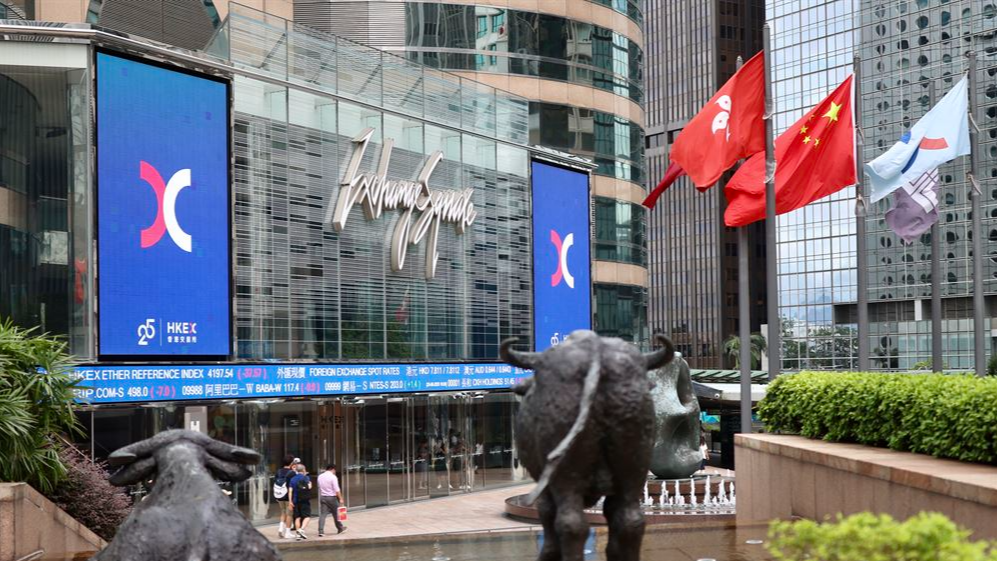
A risk-averse sentiment was seen across major Asia-Pacific markets on Wednesday, as geopolitical tensions in the Middle East continue to keep investors on edge.
But experts said elevated uncertainty argues for diversification and a long-term mindset, and over the long run, Middle East investors are expected to ramp up investments in Asia, with the Chinese mainland and Hong Kong being the key go-to destinations.
The benchmark Hang Seng Index extended its losses on Wednesday, dropping 2.01 percent to close at a nearly three-month low of 25,249.48 points. The gauge tracks broader weakness across Asian markets, once falling below the 25,000-point threshold in intraday trading.
On the mainland, the Shanghai Composite Index closed about 1 percent lower at 4,082.47 points, while the Shenzhen Component Index edged down 0.75 percent at 13,917.75 points.
The South Korea and Thailand stock markets were forced to temporarily halt trading after plunging more than 8 percent and triggering “circuit breakers” — market rules that stop trading after a sharp intraday fall.
ALSO READ: Oil surges, stocks slide, dollar rallies as conflict grips Middle East
Adam Hetts, global head of multiasset at asset management company Janus Henderson, said that the immediate aftermath of US-led strikes in Iran typically brings “a jarring set of headlines” and what could amount to peak uncertainty.
“As always, diversification and a long-term perspective matter most when uncertainty peaks,” Hetts said.
Miao Yanliang, senior managing director and chief strategist at China International Capital Corp, said, “In any market, assets are priced on fundamentals, while liquidity drives short-term swings. Hong Kong equities are influenced by both.”
“Amid escalating conflicts, liquidity conditions have tightened as investors are quick to exit risk assets, including stocks and move into safer alternatives.”
Onshore A-shares, however, have shown relative resilience at the index level. That suggests mainland assets are ultimately priced domestically, with valuation power largely in China’s own hands, Miao said. Hong Kong stocks, by contrast, are widely viewed as reflecting a combination of Chinese fundamentals and global liquidity conditions, he added.
Miao said that the dynamic may be evolving at the margin. Over the past two years, southbound flows from the mainland have expanded markedly, increasing their share of market participation, he said.
READ MORE: Budget reasserts SAR’s reputation as world city
“The H-share discount to A shares has narrowed, and in some cases reversed, suggesting growing investor appetite for Chinese assets. This trend could enhance the Hong Kong market’s ability to withstand external liquidity shocks,” he said.
Citing his previous talks with sovereign wealth funds in the Middle East, Miao said China has long been an intended destination for diversification, though lingering questions over economic fundamentals has slowed their commitments.
“There is no crystal ball to determine how long the latest bout of geopolitical tensions will persist. But diversification efforts are expected to accelerate,” Miao said. “Portfolios that were once heavily weighted toward dollar-denominated assets and domestic holdings may increasingly pivot toward Asia, particularly the Chinese mainland and Hong Kong.”
Contact the writer at sophialuo@chinadailyhk.com
