

Consumption jumps during long holiday
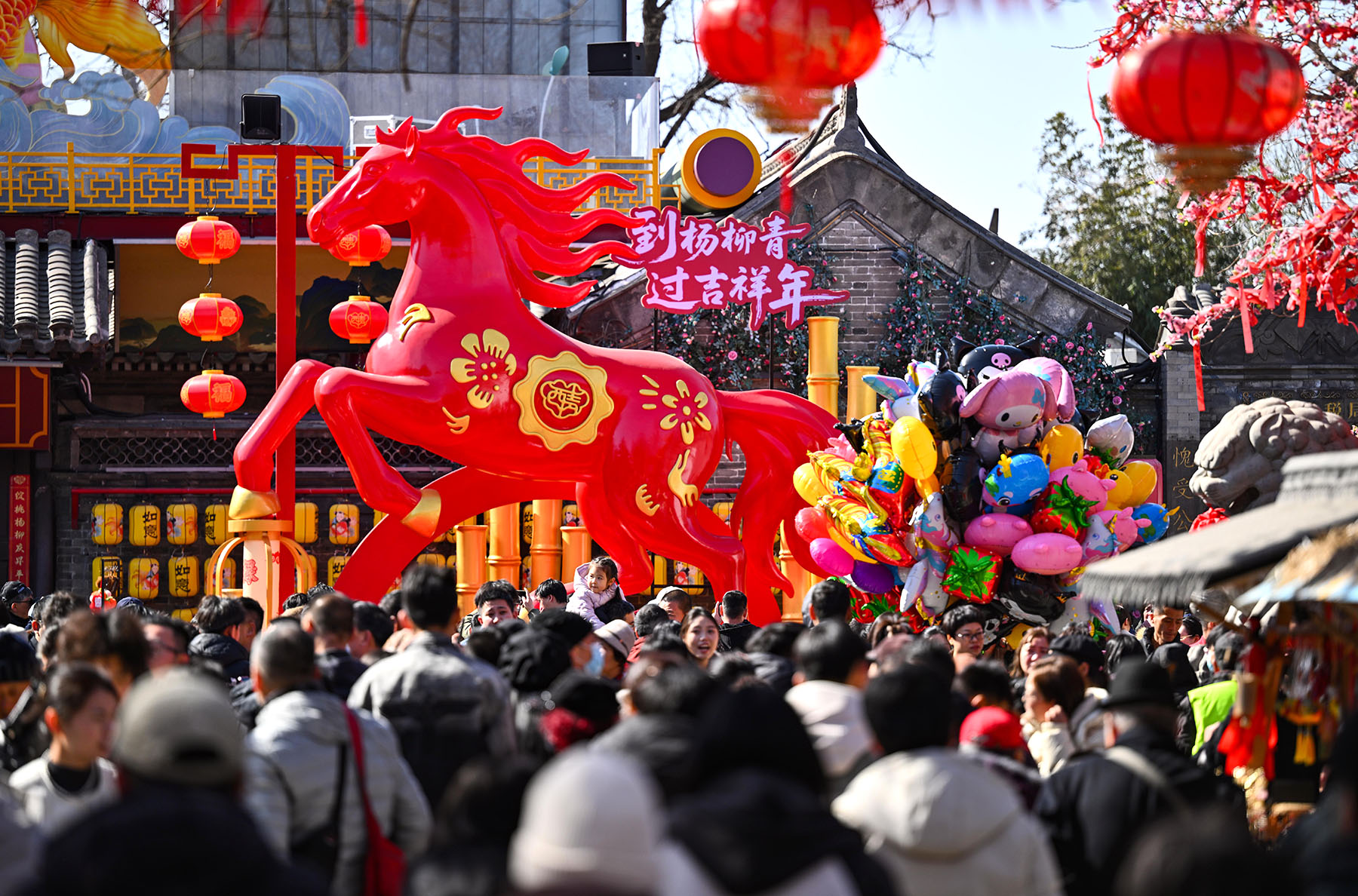
China has witnessed robust consumer activity across sectors during the record nine-day Spring Festival holiday, offering an encouraging signal for consumer confidence as the world’s second-largest economy seeks to cement its recovery momentum, according to economists and executives.
They said that the longer holiday period, which ran until Feb 23, has provided an extended window for robust consumer activity across the travel, dining, entertainment and retail sectors, offering an early-year boost to the consumption sector. This has been amplified by a targeted policy package, they added.
Data from the Ministry of Commerce showed that the country’s key retail and dining enterprises recorded an 8.6 percent year-on-year increase in average daily sales during the first four days of the Spring Festival holiday.
China launched a nationwide campaign for the holiday to ignite consumer spending, including consumer goods trade-ins, a prize invoice pilot program in which consumers with valid purchase invoices above a set threshold can enter a lottery to win cash prizes, and local consumption vouchers.
Gu Qingyang, an associate professor at the Lee Kuan Yew School of Public Policy at National University of Singapore, noted that Chinese authorities have prioritized consumption as a key economic driver, with Spring Festival holiday spending serving as a crucial barometer.
“The growth demonstrates that the consumption-promotion policies have yielded tangible results,” Gu said.
Consumer goods trade-in program has emerged as a powerful engine of holiday spending in China, driving about 196.39 billion yuan ($28.4 billion) in sales as of Feb 18 and benefiting 28.44 million consumers.
Notably, consumer appetite for intelligent products has accelerated dramatically. During the holiday’s first three days, sales of smart wearable devices on major platforms surged 19.7 percent year-on-year, with smart glass sales more than doubling and that of smart blood glucose monitors increasing 48.6 percent.
“At the start of this year, the first group of fiscal funds totaling 62.5 billion yuan has been disbursed to local commerce departments for this year’s consumer goods trade-ins,” Vice-Commerce Minister Sheng Qiuping told a news conference ahead of the holiday.
In addition, a total of 2.05 billion yuan has been allocated by local governments for direct consumer benefits via vouchers, subsidies and digital cash red packets, Sheng said.
Gold jewelry has maintained its status as a favored purchase during the peak Spring Festival consumption season, with Chinese zodiac-inspired pieces and investment-grade bullion flying off shelves despite gold prices hovering at high levels.
Gold products infused with Year of the Horse imagery and auspicious cultural themes, alongside lightweight items such as one-gram “golden beans”, have emerged as standout bestsellers during the holiday, said Lin Yu, an industry insider.
Gold prices have charged back to the $5,100-per-ounce mark, with China’s jewelry prices vaulting back above 1,500 yuan per gram, according to data released over the weekend.
“Traditional heavy gold bangles are just too expensive for me right now,” said Chen Sisi, a 26-year-old consultant in Beijing. “But buying a little bean each month is affordable. It feels like I’m treating myself, but I’m also saving money. It’s much more motivating than just putting cash in a bank account.”
Service consumption also emerged as a standout performer, with domestic travel spending on major platforms rising 4.5 percent year-on-year during the first three days of the Spring Festival holiday, while car rental orders jumped 26 percent, according to Commerce Ministry data.
Dai Bin, president of the China Tourism Academy, observed that folk activities, technology and cultural tourism — along with study tours for teenagers — are encouraging longer-distance travel.
Contact the writers at wangkeju@chinadaily.com.cn
