

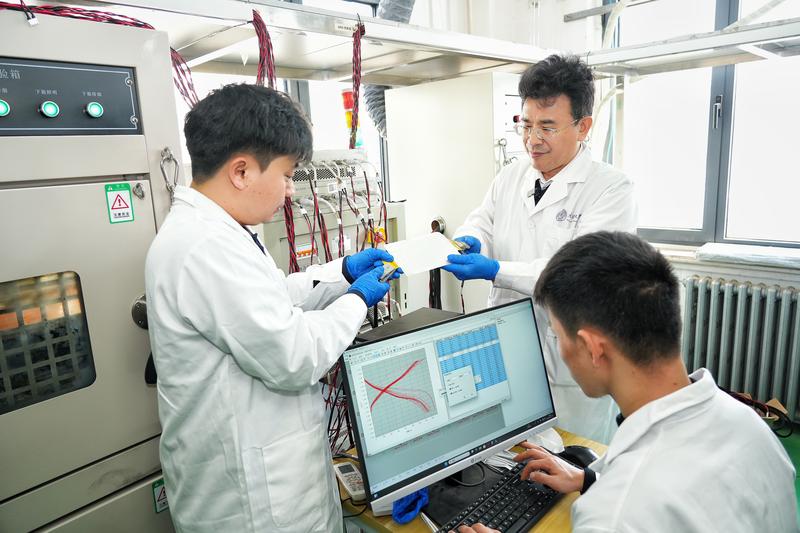
Chinese scientists have developed a lithium metal battery that boasts an energy density of more than 700 watt-hours per kilogram and stable performance at extremely low temperatures, marking a significant advancement in the production of high-energy batteries for electric vehicles. The research paper was published on Thursday in the science journal Nature.
Chen Jun, an academician of the Chinese Academy of Sciences and vice-president of Nankai University in Tianjin, was among the researchers who led the breakthrough. Chen said the team has replaced oxygen atoms with fluorine ones. It designed and synthesized novel fluorinated hydrocarbon solvent molecules, creating a new electrolyte system based on lithium-fluorine coordination.
Laboratory tests showed that the battery could achieve energy density above 700 watt-hours per kilogram, maintaining nearly 400 Wh/kg at — 50 C.
READ MORE: Battery tech progress to power EV sector's future
Energy density and low-temperature performance are the biggest bottlenecks hindering the widespread adoption of EVs, Chen said.
To address this challenge, his team redesigned the battery electrolyte at the molecular level. By developing fluorinated hydrocarbon solvent molecules and establishing a lithium-fluorine coordination system, the researchers improved ion transfer and enabled stable operation at ultrahigh energy densities and extremely low temperatures.
"High-energy batteries using this electrolyte have vast potential in new energy vehicles, embodied intelligent robots and the low-altitude economy, as well as in polar regions, aerospace and aviation," he said.
Chen's team has also made significant progress in advancing cutting-edge technologies toward practical applications. Earlier this month, the team collaborated with Chinese automaker Hongqi to release a mass-producible ultrahigh energy density lithium-rich manganese solid-liquid battery system. The system boasts a cell energy density exceeding 500 Wh/kg, which translates into a driving range of more than 1,000 kilometers on a single charge for equipped vehicles, according to the research team.
Yan Zhenhua, a professor at Nankai University's College of Chemistry, said that in comparison, current mainstream lithium-ion batteries typically offer energy densities of 160 to 300 Wh/kg, support vehicle driving ranges of up to about 800 kilometers per charge, and operate reliably at temperatures between — 20 C and — 30 C.
He said the vehicle-mounted battery uses a self-developed composite electrolyte that improves both safety and durability.
"It not only achieves a leap in energy density but, more important, solves the high-cost and high-risk challenges associated with lithium metal batteries, significantly enhancing cycle life and intrinsic safety," Yan added.
Lu Tianjun, Party secretary and general manager of China Automotive New Energy Battery Technology Co, said that vehicles equipped with the batteries and capable of exceeding 1,000 kilometers per charge are expected to enter mass production by the end of this year.
ALSO READ: China achieves breakthrough in extracting lithium from salt lakes
"This serves as a model and a leading example of collaboration between universities and enterprises," he said.
"This battery, whether in terms of energy density, technological advancement or progress in application, represents a leading level both domestically and internationally," Lu said. "Conservatively, its performance would mean an improvement of about 50 percent compared with current technologies."
Chen, the Nankai University researcher, said that translating scientific breakthroughs into practical technologies requires close collaboration between researchers and industry. "We can't always stay in the ivory tower. Our goal is to address real industrial challenges," he said.
Contact the writers at yandongjie@chinadaily.com.cn
