

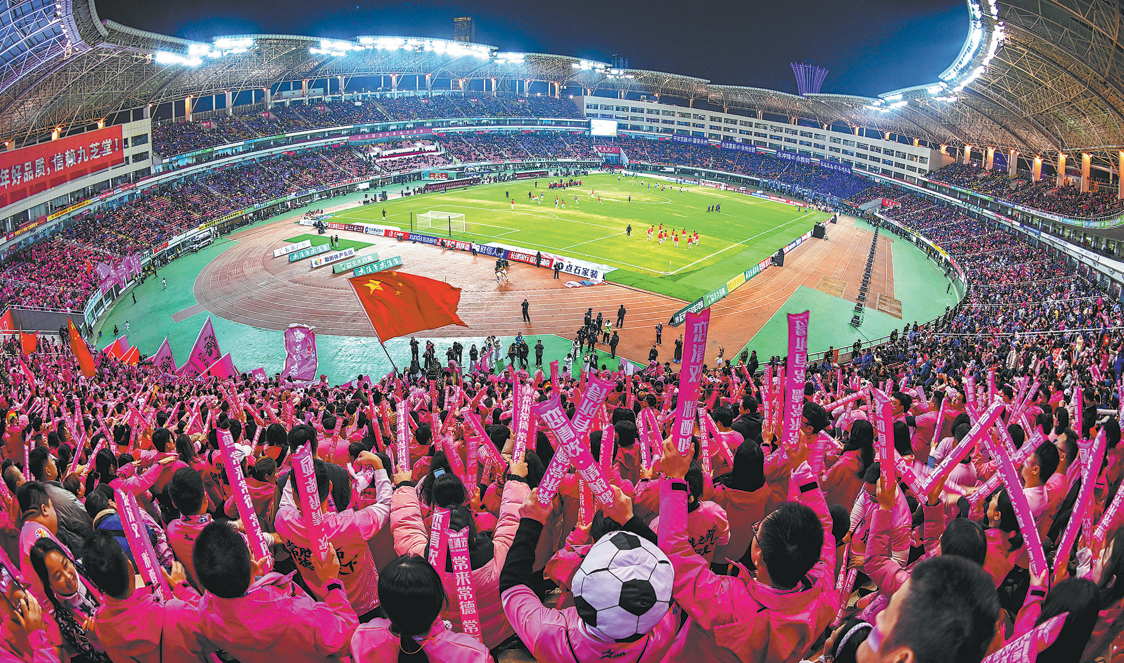
Affectionately dubbed the "wild stadium", the renovation of the once-crumbling Yongzhou venue in Hunan province has thrust the city into the spotlight as the latest national grassroots soccer phenomenon.
Before repairs and upgrades were started by the Yongzhou local government in July, the stadium resembled a decaying amphitheater and was the butt of many good-natured jibes by locals and netizens.
Brick debris and building materials littered parts of the stadium, vegetation grew head-high and there were online jokes that "snakes might crawl out from under the seats", a reference to Yongzhou's reputation for having a large reptile population.
Come late January all that had changed when Yongzhou hosted the inaugural CMG Mass Football Invitational Tournament — or Yangchao — in its modernized stadium. The seven-day event from Jan 18 to Jan 24, organized by the China Media Group and the Yongzhou government, brought together grassroots soccer teams from six provincial-level regions — Hunan, the Inner Mongolia autonomous region, Heilongjiang, Shandong, Guangdong and Qinghai.
The stadium's seating sections had been upgraded, spectator standing areas tidied up, and the pitch surface and drainage and lighting systems improved.
When the final whistle was blown on Jan 24 in front of 16,000 roaring fans, the team from Zhanjiang, Guangdong, had defeated hometown favorite Yongzhou 2-1 to lift the trophy.
Yet, the victory also belonged to the host city and its contribution to the ongoing surge of grassroots soccer across China that this tournament, and the new-look stadium, embodied.
City roars to life
Yongzhou's fairy-tale journey began when the young team battled through a series of tough opponents to win the 2025 Hunan Football League, or Xiangchao, on Dec 27.
In a keenly contested match in Changsha, the capital of Hunan province, in front of 43,695 spectators, Yongzhou defeated Changde 1-0 to take the championship.
Just months earlier, Yongzhou had played their home games in their rundown home venue, also called the "beggars' stadium".
ALSO READ: Grassroots soccer fever spreads across nation
Although the stadium underwent a two-month renovation before the league kicked off to meet the tournament's venue standards, several early matches were played while repair work was underway.
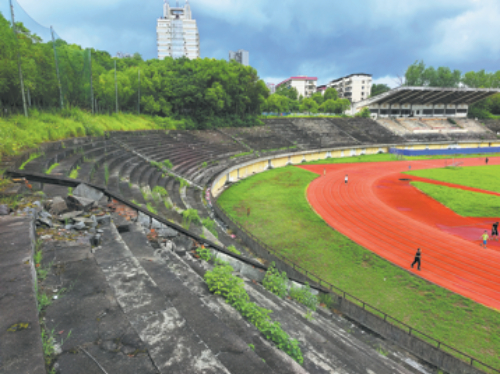
Facing reduced seating capacity, fans created ingenious methods to watch matches from vantage points in trees outside the ground and standing on makeshift platforms of bricks, calling them "tree tickets" and "brick tickets".
The supporters' passion never wavered. In the quarterfinals, when the Yongzhou team played an away game, more than 30,000 fans packed their home stadium to watch the match via a live broadcast. After the team emerged victorious, the fans spilled onto the streets for a citywide celebration.
These scenes, widely shared on social media, drew international attention, with netizens abroad describing the support as "what every team dreams of".
This raw enthusiasm and passion was a compelling reason why the national broadcaster chose Yongzhou to host the inaugural Yangchao tournament.
The city, virtually unknown beforehand, became a national focal point for showcasing the spirit of grassroots soccer.
Organizers embraced the fans' idea of "tree tickets". After ensuring their safety, 15 trees surrounding the stadium were designated as official viewing spots.
As a friendly gesture, 14 of the "tree tickets" were offered to visiting fans from outside provinces. The visiting supporters adorned their allocated trees with symbols representing their cities as well as encouraging slogans.
When the home team was not playing, local fans cheered for visiting teams, celebrating every goal.
Ahead of the championship match, supporters from Zhanjiang performed a vibrant Guangdong lion dance, offering their own cultural heritage as a "thank you" gift for the hospitality they had received.
Even after the Yongzhou team lost the final, giant screens in the city center glowed with a warm message for the players: "We love you when you win, we love you when you lose."
"The city has completely changed because of soccer," Chen Kexin, a local journalist, told People's Daily.
"Now, even when there is no match, you hear people talking about the sport on every street corner. Kids can turn a plastic water bottle or a crumpled piece of paper into a ball and start playing anywhere."
Surging phenomenon
The ripple effects of soccer fever extended far beyond the pitch, giving a powerful kick along to the tourism and catering sectors.
During the tournament, the Yongzhou government launched a series of tourist-friendly initiatives inviting all traveling soccer fans to explore the city. Thirty-eight scenic areas waived entrance fees, star-rated hotels offered discounts for visitors, and public parking lots in the city center were free for out-of-town vehicles.
The economic impact was significant. According to provincial government data, the tournament attracted 148,000 stadium attendees. Outside the stadium, 1.8 million tourists visited the city during the seven-day event, with approximately 800 million yuan ($115 million) spent across the tourism, dining, accommodation, and retail sectors.
During the Yongzhou team's championship run in the Xiangchao league from September to December, the city leveraged that tournament to provide a massive boost to the local economy, resulting in 13.6 billion yuan in consumer spending across the province.
These powerful benefits to Yongzhou are a microcosm of a much broader, nationwide enthusiasm for grassroots soccer.
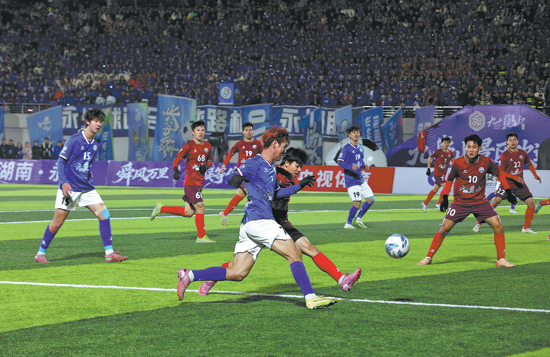
According to the Chinese Football Association, 2025 saw an explosive growth in grassroots soccer across the country, with city leagues established in 16 provincial-level regions.
In 2025, nationwide, 432,400 amateur matches were held across 14,400 tournaments, representing growth rates of 88 percent and 140 percent, respectively, with 39,300 teams taking part. The number of registered amateur players surged to 980,000, marking a 95 percent increase from the previous year, according to the CFA.
ALSO READ: Jiangsu's city soccer league sparks tourism boom, boost economy
The trend was led by the breakout success of the Suchao, or the Jiangsu Football City League, which ran from May to November. The league drew a total of 2.43 million stadium spectators, with an average attendance of 28,600 per match — a record for provincial soccer leagues in China — as well as 1.2 billion online livestream views.
The Suchao not only captured the imagination of ordinary people, and their love of the sport and their hometowns, but also inspired many to take up soccer, said Liu Hongming, Party secretary of the Nanjing Sport Institute.
"Some of my relatives and friends excitedly told me that their children wanted to play soccer," he said.
The league's popularity was successfully converted into economic opportunities, inspiring the rise of similar city soccer tournaments across the country, Liu added.
Home and away
The leagues are also inspiring cultural, economic, and friendship exchanges between cities and regions.
At the beginning of this year, fans from Jiangsu and Hunan provinces, although hundreds of kilometers apart, engaged in warm interactions in and outside the stadiums.
After fans from Jiangsu cities visited Yongzhou and put signs up to cheer for the Yongzhou team, local residents sent large quantities of local specialties, including thousands of boxes of oranges, to thank their new friends.
These grassroots gestures of goodwill, amplified through social media, prompted officials to act.
City governments from both provinces stepped in, forging cross-regional economic cooperation. In late January, a delegation of entrepreneurs and officials from Jiangsu visited Yongzhou, which led to the signing of strategic agreements and the unveiling of an industrial park.
In South China's Guangxi Zhuang autonomous region, a county-level soccer league is currently in full swing, boasting 28 teams from 14 cities. As a distinctive feature of the event, host cities actively incorporate local traditions, such as ethnic performances and folk arts, into the match day schedules, turning the soccer field into a lively stage for local cultural presentations.
Before a match between the Lingchuan team from Guilin and the Wuxuan team from Laibin in January, folk songs filled the air in the stadium. As team captains exchanged gifts, the Lingchuan team presented their opponents with regional specialties, including fresh fish, handmade rice balls, and packaged rice noodles.
Outside the stadium, the event turned into a vibrant street carnival. Stalls lined the area, with vendors enthusiastically offering samples and sales of iconic local foods, creating a festive atmosphere and offering a unique match day experience for fans and visitors.
Expansion plans
In Northeast China, a new league, although still in its preparatory phase, has already generated significant anticipation.
The new league, planned to begin in May, is set to bring together eight city teams from across three provinces — Liaoning, Jilin, Heilongjiang — and the Inner Mongolia autonomous region.
Liu Zheng, president of Shenyang Sport University in Liaoning, suggested that the new league integrate soccer with the region's winter activities.
Beyond the regular season from May to October, organizers could consider holding soccer-themed winter carnivals, merging soccer elements with ice-snow tourism to attract more visitors, Liu proposed during a recent legislative session of Liaoning.

Song Kai, president of the Chinese Football Association, said the multiregional approach is the league's key innovation.
"We've seen many provincial mass soccer leagues, but none that span a major multi-province region like this," Song said, adding he hopes the league plays a role in both boosting the sport and regional development.
Flourishing grassroots competitions across the country, driven by immense public interest, are signs of the revitalization and development of Chinese soccer, Song said.
ALSO READ: Grassroots soccer captivates fans, bolsters economy
At a recent meeting, Song said that the association will launch a system this year to track the economic impact of local events on host cities. It will also refine the statistical standards for the "soccer population" across the country and implement regular monitoring, providing reliable data to guide future decisions and investment in the sport.
Grassroots tournaments are also sowing the seeds for soccer's long-term future in China. According to the CFA, the number of registered elite U21 players in China has increased 24.9 percent over the past two years to 109,200. On Jan 24, China finished runner-up at the AFC U23 Asian Cup — its first-ever appearance in the U23 final.
Chen Xiaowen, a player from the Changsha team, has witnessed this significant shift.
"I have recently seen many more parents playing soccer with their children in parks than before, even if they are not good at the sport. They are simply having fun," he said.
Chen believes that watching their local team play can have a profound motivational impact on children. "Seeing players represent their hometowns might inspire them to dream of doing the same in the future," he said, "Eventually, these dreams may open doors to even greater opportunities."
Yu Ying, head of the training department at a soccer school in Dalian, Liaoning province, echoed this sentiment.
"I understand how much an exciting match can influence a child," Yu told Xinhua News Agency. "Hopefully, the new regional league will inspire more kids to fall in love with the sport."
Zhu Youfang in Changsha contributed to this story.
Contact the writers at limuyun@chinadaily.com.cn
