

While Chinese regulators and car makers are making concerted efforts along the industrial chain to shape rules for the global autonomous driving industry, executives from leading manufacturers of self-driving vehicles in the United States (US) are busy painting Beijing's rapid advances in the sector as a so-called direct threat to Washington's role.
During last week's US Senate Commerce Committee hearing, executives from Waymo and Tesla urged lawmakers to ease regulatory constraints and pass legislation to accelerate the deployment of autonomous vehicles.
According to testimony seen by Reuters, Waymo said that the US leadership in the autonomous vehicle sector is now "under direct threat" and is locked in a global race with Chinese companies.
READ MORE: China accelerates push for autonomous driving sector
Lars Moravy, Tesla's vice-president of vehicle engineering, said at the hearing that the US must modernize regulations that inhibit the industry's ability to innovate. "If the US does not lead in autonomous driving development, other nations — particularly China — will shape the technology, standards and global market."
Senate Commerce Committee Chair Ted Cruz echoed these concerns, arguing that outdated rules risk driving innovation abroad. "If Congress fails to act, we won't stop innovation. We'll simply push it elsewhere. China is moving aggressively to deploy autonomous transportation at scale," he said.
While US lawmakers debate regulatory reform, China has been advancing on two fronts — international standard-setting and large-scale deployment.
In recent years, Chinese institutions and companies have led or participated in dozens of international automotive standards projects, including more than 10 for autonomous driving.
Those engagements have culminated in the release of ISO 34505 last year, a new international standard that defines how test scenarios for automated driving systems should be evaluated and how test cases should be generated.
ISO 34505 was developed under the International Organization for Standardization's road vehicles committee (ISO/TC 22) and its automated driving subcommittee, in coordination with China's Ministry of Industry and Information Technology and the China Automotive Technology and Research Center, as well as other international partners.
Developers said the new standard could streamline research and commercialization by giving companies a shared technical language for simulation and real-world validation.
Cui Dongshu, secretary-general of the China Passenger Car Association, said: "Having a voice in standards-setting is strategically important as autonomous driving enters a phase of rapid global growth. It supports Chinese vehicles and technologies gaining wider international recognition."
READ MORE: Autonomous driving firms revved up on biz growth
Chinese companies are testing their systems in harsher overseas environments, which industry experts said helps validate system resilience and feed back into both product development and standards discussions.
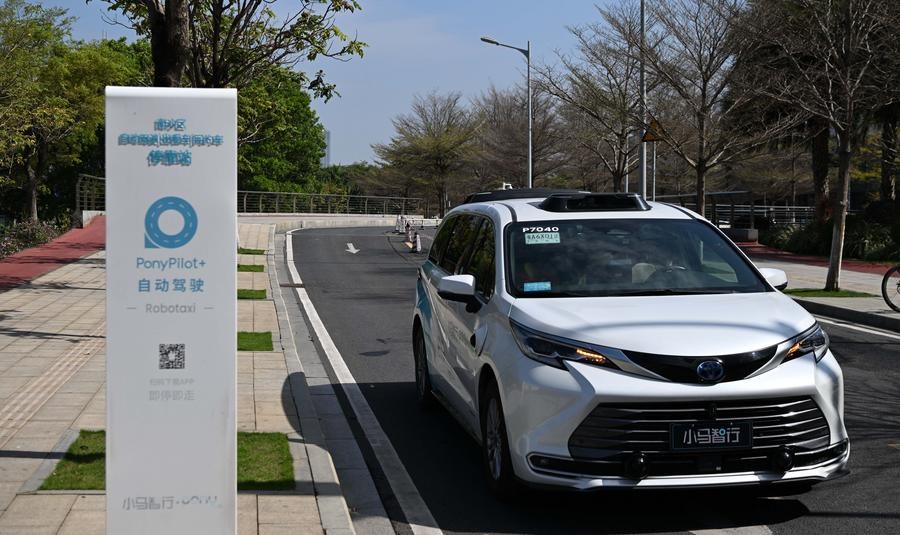
Notably, the standards push is unfolding alongside faster real-world rollout. Robotaxi pilots are expanding in major Chinese cities, with companies such as Pony.ai and Baidu increasing fleet sizes and operational zones.
Sun Hang, chief engineer at the China Automotive Standardization Research Institute, said: "China's regulatory environment has also shown notable continuity, with a series of national standards and road testing regulations guiding the sector since 2018, providing stable long-term guidance for industry development."
Contact the writer at chengyu@chinadaily.com.cn
