

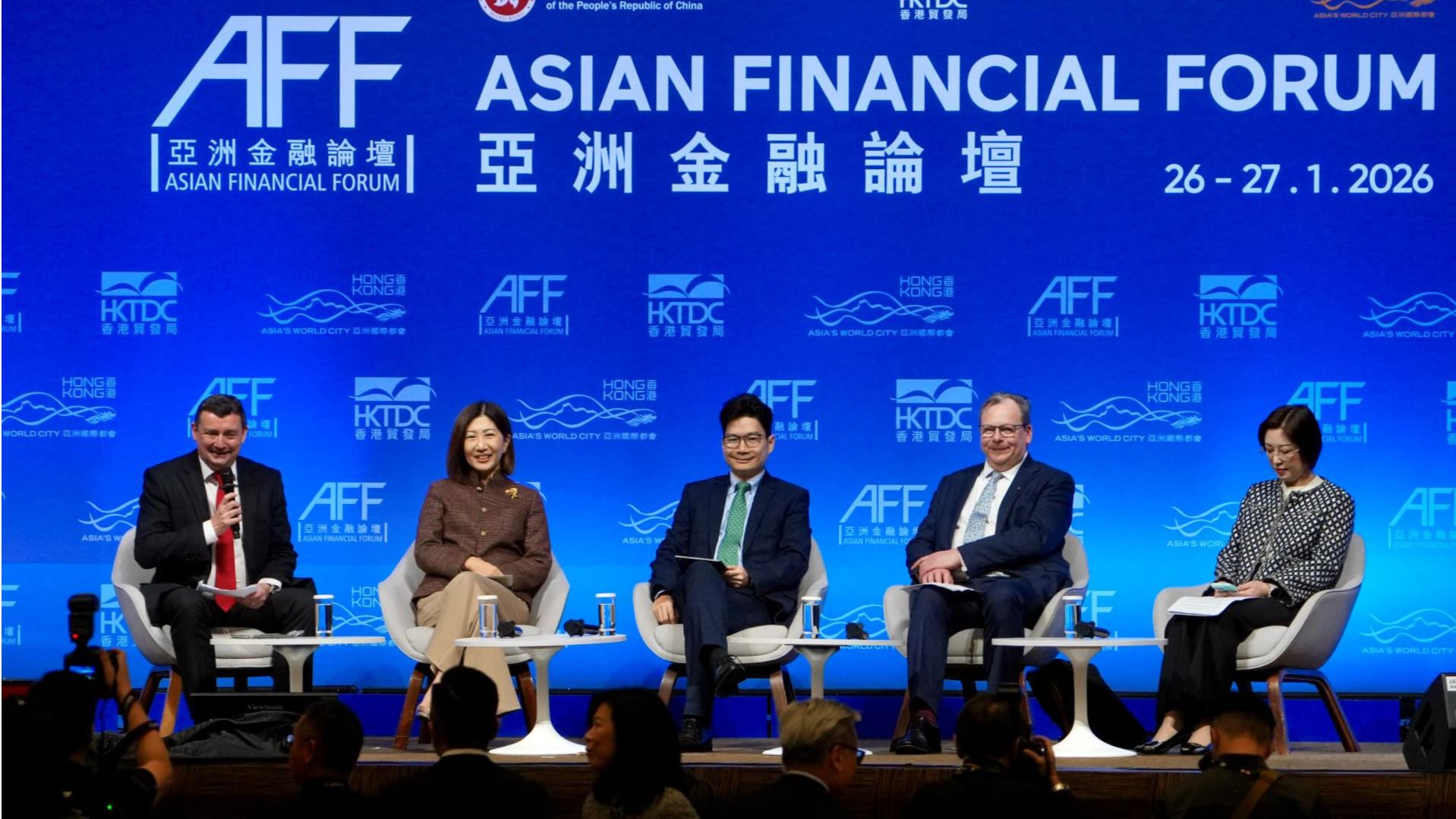
Geopolitical tensions, global supply chain changes driving investors toward Chinese currency, forum hears
The renminbi’s internationalization is gaining more traction as traders and investors increasingly turn to the Chinese currency as they seek a stable foreign exchange regime amid a volatile global economy, a regional forum heard on Jan 27.
Senior banking and finance executives who participated in a panel event at the 19th Asian Financial Forum (AFF) also cited the Hong Kong Special Administrative Region’s role as an offshore renminbi business hub.
“Renminbi (internationalization) is becoming a very hot topic,” Jerry Zhang, global head of banks and broker dealers at Standard Chartered Bank, said at the panel discussion on capital markets at the AFF in Hong Kong.
Zhang, who also serves as Standard Chartered’s head of coverage, corporate and investment banking for Greater China and North Asia, said geopolitical tensions and changes in the global supply chains are pushing investors to look for security, certainty, resilience and a stable foreign exchange regime. She cited China’s 5 percent GDP growth in 2025 and how this has boosted investor confidence in the country.
ALSO READ: HKMA: City’s banking a launchpad for Chinese firms going abroad
Zhang also noted that RMB internationalization is part of China’s 15th Five-Year Plan (2026-30), and mentioned how CNH (offshore renminbi) bond issuance has surpassed over one trillion yuan ($143.8 billion) in 2025, with Hong Kong taking the lion's share of those issuances.
“From the trade finance perspective, CNY (the Chinese yuan) has, for the first time, reached 8 percent global market share, only second to US dollar, which showcased that people actually are thinking this RMB financing makes commercial sense,” Zhang said.
Mary Huen Wai-yi, executive director and chief executive officer for Hong Kong and Greater China and North Asia at Standard Chartered, cited two latest policy moves that are building the foundation for Hong Kong’s next phase of growth in connectivity.
On Jan 26, the Hong Kong Monetary Authority announced that it will double the size of its Renminbi Business Facility from the current 100 billion yuan, to 200 billion yuan, effective Feb 2 to boost renminbi trade financing liquidity in Hong Kong.
READ MORE: HK inks MoU with Shanghai Gold Exchange in bullion trade boost
Hong Kong has also signed a memorandum of understanding (MoU) with the Shanghai Gold Exchange to build a joint gold ecosystem and expand the special administrative region’s global bullion trading role.
Finance executives, meanwhile, noted that Hong Kong needs to offer more diversified asset classes as investors want to manage risks amid global uncertainties.
“The world of capital is being reshaped by two forces. One is innovation, which is changing how capital is raised, priced and distributed. Another one is geopolitics, which is reshaping where capital feels safe and chooses to go,” Huen said.
She said Hong Kong is uniquely positioned at the intersection of both, thanks to its global connectivity, capital and innovation.
Bonnie Chan Yi-ting, chief executive officer of Hong Kong Exchanges and Clearing Ltd, which operates the city’s stock exchange, said “equities has always been our highlight”, as she cited Hong Kong’s top ranking in the global IPO market in 2025.
“Investors around the world are seeking to diversify. They want more exposure once again to China. We need to be able to offer more than just equities,” Chan said, adding that the signing of the MoU with the Shanghai Gold Exchange is a “very exciting development”.
READ MORE: Asia tipped to remain ‘growth engine’
Hong Kong’s Under Secretary for Financial Services and the Treasury Joseph Chan Ho-lim said Hong Kong needs to keep adapting because the global financial market is evolving. He cited green finance as an example.
“It's a highly evolving segment. So over the years we have done different things to make sure our green finance standards are up to speed,” Chan said, noting that Hong Kong launched a road map on sustainability disclosure.
Chan said Hong Kong’s position as one of the world’s major financial centers is supported by various factors including preferential access to the Chinese mainland market, free flow of capital, common law system, simple and low tax regime, and a regulatory system that is highly compatible with those of the major international markets.
“If we want to serve as a super connector between the mainland market and the rest of the world and we want to serve as a superconductor between the East and the West, we have to uphold those standards.
“We have to ensure the confidence from investors, from financial institutions; and with that confidence, we can do our job effectively in terms of linking the issues from this region to the rest of the world, and helping the institutions here to connect and transact with those from the rest of the world as well,” Chan said.
Contact the writer at prime@chinadailyapac.com
