

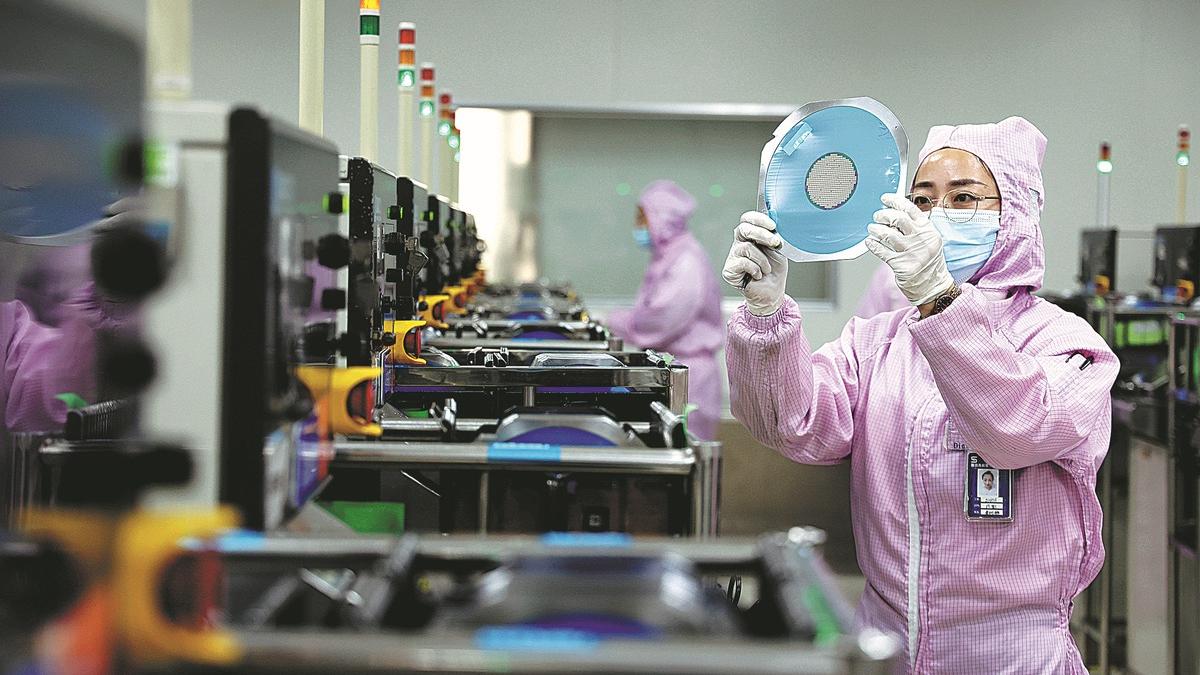
China has achieved a major breakthrough in its quest for semiconductor self-reliance with the successful development of its first domestic tandem-type high-energy hydrogen ion implanter.
This development is expected to end the long-standing dependence on foreign technology in a critical segment of the chip-making process.
ALSO READ: Semiconductor makers eye self-sufficiency amid US technological curbs
The machine, dubbed the POWER-750H and developed by the China Institute of Atomic Energy under the China National Nuclear Corporation, marks a milestone in China's effort to shield its industrial supply chain against external technological blockades, the institute said.
The ion implanter is considered one of the four major essential tools in semiconductor manufacturing, alongside photolithography machines, etching equipment, and thin-film deposition systems.
READ MORE: China opposes US removal of semiconductor firms from validated end-user list
While China has made strides in the latter categories, high-energy ion implantation has remained a persistent bottleneck, with domestic manufacturers historically relying almost entirely on imports.
The development of the POWER-750H signifies that China has mastered the full-link R&D technology for tandem-type high-energy hydrogen ion implanters, the institute said.
