

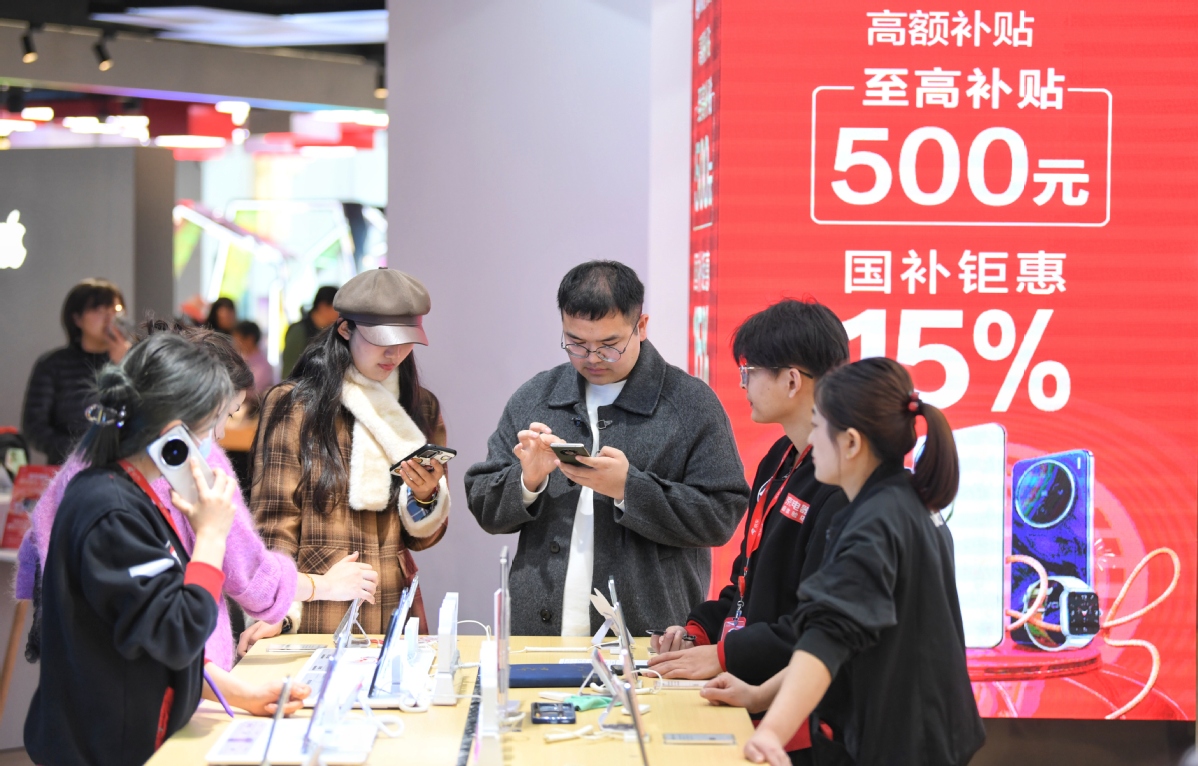
China will step up efforts to boost domestic demand through targeted consumption stimulus, expand service-sector spending, and push ahead with retail and distribution reforms in 2026, the country's top commerce official said.
Speaking at a national commerce work conference held in Beijing over the weekend, Commerce Minister Wang Wentao said that measures to further unleash China's market potential this year will include pushing forward the "Shopping in China" initiative, expanding service-led and digital consumption, upgrading consumer goods trade-in schemes, and promoting greener and healthier spending.
To support high-quality and more sustainable growth, Wang said the government will expand trade-in services, support innovation-driven development in digital and green trade, and facilitate closer integration between trade and investment this year.
READ MORE: China to boost consumption, opening-up in 2026
"There will also be efforts to build a unified national market, foster innovation in the retail sector, establish a more efficient and modern distribution system, and further advance pilot-city initiatives," he added.
The "Shopping in China" campaign, which was launched in April 2025, aims to create an internationally friendly consumption environment and enhance China's appeal as a consumption hub through measures such as streamlining visa procedures and improving departure tax refund arrangements.
As part of the initiative, the Commerce Ministry will support provinces in hosting locally tailored shopping events and organizing dedicated programs in 15 pilot cities this year to build an internationalized consumption environment.
Denis Depoux, global managing director of management consultancy Roland Berger, said these policy measures will help shift consumption from quantitative satisfaction toward qualitative enrichment, spurring supply-side innovation and supporting high-quality growth.
"China's consumption structure is rapidly shifting from survival-oriented to development — and experience-oriented," said Depoux, noting that the government has elevated the expansion of domestic demand to a strategic priority.
Zhou Mi, a senior researcher at the Chinese Academy of International Trade and Economic Cooperation in Beijing, said that China's consumption market "still possesses significant potential, with the key lying in enhancing people's consumption capacity and willingness".
Measures such as building"15-minute convenience shopping circles" and developing rural e-commerce would help support better and higher-quality consumption infrastructure, Zhou added.
In late November, the Commerce Ministry and five other government departments released an action plan, mapping out key measures to better align the supply and demand for consumer goods and further stimulate consumption.
According to the plan, by 2027, the supply structure of consumer goods is expected to be significantly optimized, with the building of three consumption sectors each valued at around 1 trillion yuan ($143 billion) and 10 consumption hot spots each exceeding 100 billion yuan.
The action plan also sets out targets to steadily raise the contribution of consumption to economic growth by 2030.
The policy blueprint is beginning to translate into concrete market responses, with multinational companies adjusting their investment plans and product strategies to tap into China's evolving consumption landscape.
Hubert de Haan, senior vice-president for China at German home appliances company BSH, said that Chinese consumers are keen to experiment with new products and display a strong appetite for innovation. "The sheer scale and diversity of the market — spanning top-tier cities and increasingly affluent lower-tier ones — offer vast, untapped potential," he said.
As China pivots toward more consumption — and innovation-led growth, the German group plans to further deepen green manufacturing in the country while rolling out products tailored to changing local demand.
Chris Kenneally, president for Asia-Pacific at Amcor, a packaging group based in Zurich, Switzerland, with 400 plants worldwide, said the Chinese government's measures are not only meeting the evolving needs of domestic consumers, but also opening new avenues for global companies to engage with one of the world's most resilient and promising markets.
The Swiss company plans to build a new factory this year in Jiangyin, Jiangsu province, to expand production of consumer goods and medical and pharmaceutical packaging.
ALSO READ: China's shopping campaign seen to unleash market potential
Data from the National Bureau of Statistics shows that in the first three quarters of 2025, final consumption expenditure contributed 53.5 percent to China's economic growth, up 9 percentage points from a year earlier.
Liu Xiangdong, a researcher at the China Center for International Economic Exchanges in Beijing, said that China's move to improve the consumption landscape for both domestic consumers and foreign tourists is crucial to accelerating its institutional opening-up and strengthening its integration with the global economy.
As China's consumption environment becomes more internationalized, the nation's global visibility and influence will be elevated, making it a more attractive destination for foreign visitors and investors, Liu added.
John Quelch, a professor of social science and executive vice-chancellor of Duke Kunshan University, said that China has the opportunity to redefine what modern consumption means. "Modernization doesn't necessarily mean copying the Western consumption model. It means redefining prosperity for an era of constraint, where balance, moderation and foresight become the hallmarks of progress," he said.
Contact the writers at zhongnan@chinadaily.com.cn
