


As the gates swing open on a chilly mid-December morning, a wave of eager visitors hurries into the Harbin Ice-Snow World in northeastern Heilongjiang province.
Against a backdrop of ceremonial drums and dance, visitors are greeted by a breathtaking expanse crystallized in ice and snow.
Hundreds of visitors line up before slippery ice chutes across the park. At the same time, many take photos near meticulously replicated ice-sculpted ancient Chinese architecture, such as the Yellow Crane Tower, and other internationally recognized structures, like a Belgian castle.
READ MORE: China expects huge surge in winter tourism
This year's edition is themed around the core concepts of "cultural essence, historical continuity, and international exchange", according to the park's administration.
Along with awe-inspiring sculptures, the calendar is packed with events ranging from snow football tournaments to massive New Year's concerts and dances, aiming to shift the visitor experience from passive sightseeing to memorable participation.
This season promises to be the most impressive yet, with the park expanding to a record 1.2 million square meters using 400,000 cubic meters of ice and snow, says Cong Peiyu, director of design and research and development with the iconic tourist site.
"Beyond vistas, the park offers many interactive experiences for visitors (this winter), such as hot springs in the snow and hot pot served in snow houses," he adds.
Cong has set a clear and ambitious vision for the park's future.
He outlines a threefold strategy to make the ice and snow fun "smarter" through greater digital investment and personalized services, enriching diverse visitor experiences and activities with cross-country skiing and ice-themed concerts, thereby making the brand more "international" through cooperation with global winter destinations and hosting more international events.
Reflecting on his eight years with the park, Cong says, "I've watched this winter landscape evolve from a simple ice sculpture exhibition into a cultural tourism household name."
The winter festival's transformation into a comprehensive, culturally resonant, and experientially driven destination exemplifies the move from scale to quality, from singular attraction to holistic ecosystem. This model is expected to be deepened and promoted in the next stage of national development.
China's tourism industry, bolstered by robust policy support and evolving market trends, is poised to enter a new phase of high-quality development during the 15th Five-Year Plan period (2026-30), experts and industry players say.
They concur that the sector will play a pivotal role in expanding domestic demand, enhancing cultural exchanges, and contributing to the nation's modernization.
The country will develop a broader range of high-grade products and improve the quality of services to boost the tourism sector, according to the Recommendations of the Central Committee of the Communist Party of China for Formulating the 15th Five-Year Plan for National Economic and Social Development in October.

The recommendations also propose enhancing the convenience and internationalization of inbound tourism, promoting the deep integration of culture and tourism, vigorously developing cultural tourism, and empowering economic and social development through cultural means.
Liu Feng, executive president of the China Chamber of Tourism with the All-China Federation of Industry and Commerce, says the recommendations outline top-level design, strategic pathways, and key directions for the cultural and tourism industry over the next five years.
Building China into a leading tourism nation is the core objective, and the plan emphasizes deepening the integration of culture and tourism as a central pathway driven by technological empowerment and aligning with national strategies such as rural vitalization, domestic demand expansion, and the promotion of Chinese civilization, Liu explains.
Liu notes that the 15th Five-Year Plan period represents a critical transitional phase, bridging past achievements with future goals.
While facing a complex and evolving external environment, he points out that China possesses four significant advantages: the institutional strengths of socialism with Chinese characteristics, a massive domestic market, a comprehensive industrial system, and a rich pool of talent.
The foundational conditions for development remain stable, with numerous strengths, strong resilience, and vast potential, ensuring that the fundamental positive trends remain unchanged, he says.
Since late 2013, the Harbin Ice-Snow World has generated approximately 3 billion yuan ($429 million) in revenue. The ice and snow construction phase provides seasonal work for tens of thousands, with nearby rural homestays often operating at full capacity, Cong observes.
The past peak season (Nov 2023-Feb 2024) marked a breakthrough for Harbin's tourism sector, with the city emerging as a top national destination for winter travel, notes Zhu Zhanchun, deputy director of the city's bureau of culture, radio, television, and tourism.
The city received 87.4 million visitors, generating total tourism revenue of 124.9 billion yuan, both of which set historical records, Zhu says.
He attributed this growth to the support from vibrant cultural and creative industries, which launched innovative products such as AR-enabled seasonal souvenir magnets and popular mascots.
Local equipment manufacturers also contributed by supplying high-quality ice and snow equipment, spicing up visitors' winter experiences.
In late November, Heilongjiang outlined a clear strategy in its 15th five-year plan to advance the ice and snow economy.
The plan calls for the integrated development of winter sports, culture, equipment, and tourism, with key initiatives, including accelerating construction of the China-Shanghai Cooperation Organization ice and snow sports demonstration zone in Harbin, establishing a national ice and snow sports college, and developing an elite winter sports training center for Asia.
Additional efforts will focus on building professional venues, cultivating talent, expanding public participation in winter sports, and hosting high-level competitions.
The province also aims to enrich its offerings of ice and snow cultural and creative products and develop high-end winter gear. Landmark destinations, such as the Harbin Ice-Snow World and Yabuli Ski Resort, will be further elevated, establishing the region as an international platform for ice and snow exchange and a globally influential leader in the winter economy, according to the plan.
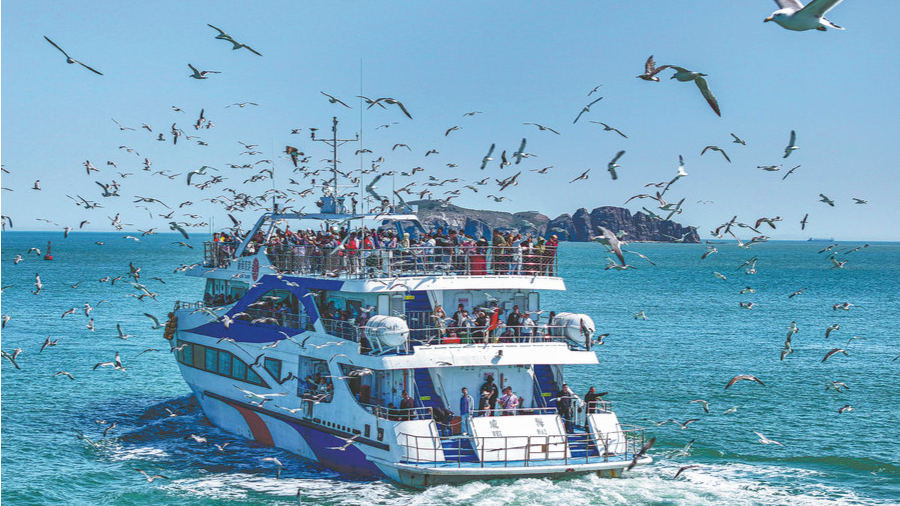
Eastern Shandong province's Qingdao will also develop a high-level tourism plan for the 15th Five-Year Plan period, says Zhao Fahai, director of the city's culture and tourism bureau.
It will stimulate consumption momentum, expand market space, precisely align with demand, and enhance supply efficiency, thereby contributing to the building of a new development pattern, Zhao says.
He emphasizes that the city will leverage its coastal advantages to expand maritime, land and aerial tourism offerings, strengthening emerging sectors such as marine tourism and the performance economy.
Zhang Le, a senior official with Hubei Three Gorges Tourism Group, reveals the company's plan to focus on the Yangtze River as a core strategy for its cruise business.
He believes experience-driven tourism and the silver (referring to the retirees) economy will be the major emerging markets. At the same time, sustainable development driven by scientific innovation will remain a priority, in line with the country's 15th Five-Year Plan for tourism.
The company is now advancing hydrogen-powered cruise projects following its 2022 launch of one of the world's largest pure-electric sightseeing vessels.
The company sees positive achievements in transport-tourism integration, with its river cruise passenger volume expected to exceed 3 million in 2025, Zhang says.
However, he also recognizes there's room for improvements in integrating culture and tourism, noting that the full potential of world-class tourism resources remains underutilized.
Reflecting on past performance, river cruise passenger volume reached 2.78 million during the 14th Five-Year Plan period. Zhang acknowledges that cultural empowerment remains an area for improvement.
"We will further deepen our expertise in the cruise segment," Zhang says.
"The shore is dotted with cultural and tourism projects, like scattered pearls. Our strategy is to use cruise routes as the thread that strings these pearls together into a valuable necklace," he adds.
Dai Bin, president of the China Tourism Academy, projects significant changes in tourist behavior and industry dynamics over the next five years.
"The demand for personalized, high-quality travel experiences is rising, with younger generations favoring independent itineraries and 'low-effort' tourism," Dai shared during a recent online lecture.
He cites examples such as travelers opting for flexible schedules and alternative sightseeing methods, like using escalators to reach mountain summits.
Meanwhile, the rising number of retirees will reshape the silver-haired tourism market.
"They may choose long-term stays in scenic areas or luxury train journeys, creating new opportunities for the industry," Dai adds.
The influx of young professionals, including post-90s and post-00s generations, into the tourism workforce will also drive change.
Their emphasis on work-life balance and tech-savviness will shift the industry's focus from investing in infrastructure to investing in people, Dai notes.
READ MORE: Beijing ranks among world's top tourist cities
Dai points to the widespread adoption of AI, big data, and autonomous vehicles to optimize visitor flows and create immersive experiences.
"Technology itself has become a scenic attraction, as seen in renewable energy parks and smart tourism platforms," he says.
"By fostering cultural and technological empowerment, we can build a modern tourism system that supports high-quality growth and showcases China's image to the world."
