

Top-grossing genre helps nation retain its title of world's second-largest movie market

Despite multiple challenges — from the rapid expansion of the microdrama sector and shifting audience tastes to the unprecedented impact of artificial intelligence — the domestic film industry wrapped up 2025 on a high note.
As of Dec 22, the box-office revenue this year surpassed 51.4 billion yuan ($7.3 billion), a year-on-year increase of more than 20 percent, with over 80 percent of the total ticket earnings generated by about 1.2 billion admissions to domestic films, according to major industry trackers Maoyan and Beacon.
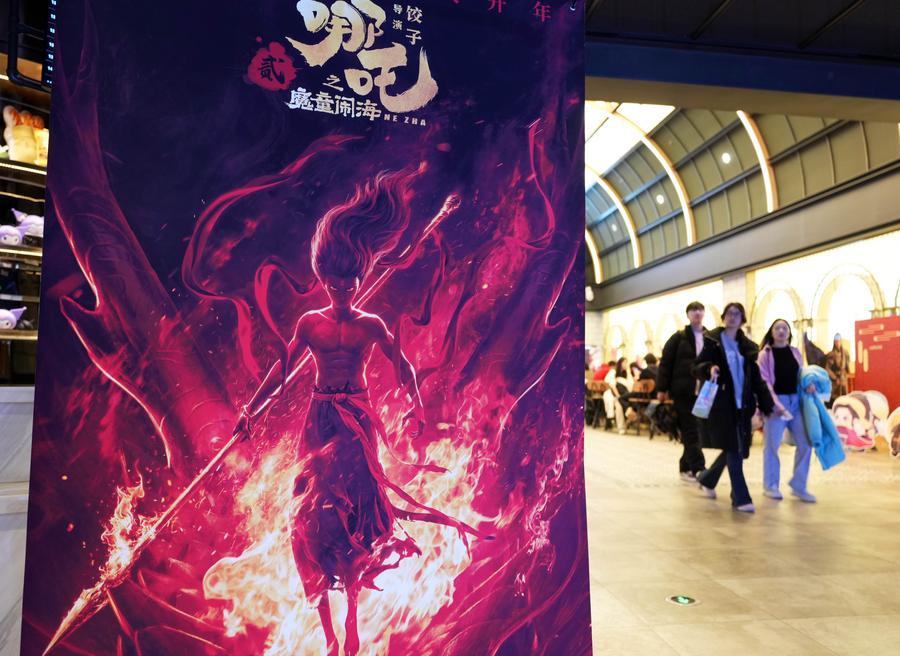
The overwhelming popularity of Ne Zha 2, the animated sequel tracking the titular protagonist's new adventures, made it the biggest blockbuster of the year.
READ MORE: Animated films top draw at China's box office
A runaway hit during Spring Festival — the most lucrative box-office season in China annually — the film collected over 15.9 billion yuan in revenue globally, including 15.4 billion yuan on the Chinese mainland, overtaking Star Wars: The Force Awakens to become the world's fifth highest-grossing film of all time.
The stunning commercial success of Ne Zha 2 also significantly lifted Chinese cinema's standing on the global box-office rankings, underscored by the fact that all other titles in the global top 50 are Hollywood blockbusters.
"Marking the 120th anniversary of the birth of Chinese cinema, the phenomenal success of Ne Zha 2 has showcased the humanistic spirit and aesthetic power of Chinese animation to the world," said Yin Hong, vice-president of the China Film Association.
Award-winning quality
After years of efforts to expand their global reach, Chinese filmmakers and distributors have finally made some inspirational progress this year. As of Oct 20, the overseas box-office revenue for Chinese films reached $140 million, a figure that surpassed the earnings for the whole of 2024, according to China Film News.
A total of 46 countries and regions have screened Chinese films, with each of the 13 films earning more than $1 million. With positive reviews of Ne Zha 2 gaining traction online, the film was released in North America, some European and Asian countries, Australia and New Zealand, and it grossed $69 million overseas.
As this year marks the 80th anniversary of the victory in the Chinese People's War of Resistance Against Japanese Aggression (1931-45) and the World Anti-Fascist War, several big-budget Chinese films set during the period garnered attention overseas.
Dead to Rights, China's fourth highest-grossing film this year, which highlights the extraordinary efforts of ordinary people to expose Japan's atrocities during the Nanjing Massacre, has been screened in 11 countries and regions, earning over $5 million overseas.
Dongji Rescue, a film inspired by the real-life story of Chinese fishermen saving British prisoners of war from a sinking Japanese cargo ship, was released in the United States and Canada. The film's remarkable portrayal of courage and compassion during a brutal chapter in history resonated well with local audiences.
The list of such popular films is quite extensive. It includes the historical drama Evil Unbound, which exposes the inhumane experiments carried out by Unit 731 of the Japanese army; the documentary Mountains and Rivers Bearing Witness, the first-of-its-kind film to reflect the Chinese people's 14-year war against Japanese invaders; and pop idol Xiao Zhan-starrer Gezhi Town, which tells the story of an ordinary family's resistance to the invasion in a mountainous town in Hubei province.
Liu Lisha, a scholar at Beijing Film Academy, said the key to winning over a global audience lies in a film's artistic quality and its compelling storytelling. "China's distinctive cultures provide a treasure trove of inspirational stories, giving Chinese films a natural advantage abroad."
Chinese art-house films also made their mark abroad.
In February, director Huo Meng won the Silver Bear for Best Director at the 75th Berlin International Film Festival for Living the Land. Through the eyes of a 10-year-old boy, the film explores how centuries-old traditions in rural China are challenged by modernity.
In May, director Bi Gan's Resurrection, a sci-fi ode to the history of cinema, received the Special Award at the 78th Cannes Film Festival.
In September, actress Xin Zhilei took home the Volpi Cup for Best Actress at the 82nd Venice International Film Festival for her role in the film The Sun Rises on Us All, an emotional saga of love, betrayal and redemption.
Jing Runcheng, a Beijing-based film critic, said that Chinese films have seen a remarkable rise at major international film festivals. Since last year, domestic films submitted or short-listed for these events have shown progress both in terms of quality and reach.
China's film authorities should encourage more filmmakers to venture abroad with works on diverse themes, Jing added.
Creativity at work
Brimming with creativity, vitality and dynamism, animations have emerged as the top-grossing film genre in China this year, allowing the country to remain the world's second-largest movie market after the US.
According to the China Film Association, animated films accounted for over 49 percent of the total box-office revenue this year, a remarkable increase from 6.2 percent in 2021. Also, nearly half of surveyed moviegoers said that among all film genres, animations primarily drew them to the theaters.
While Ne Zha 2 ruled at cinemas, the Disney sequel Zootopia 2 collected more than 3.9 billion yuan to become the second-highest-grossing film of 2025 in China. Shanghai Disney Resort, where the world's first Zootopia-themed land opened, contributed the highest ticket revenue among all Chinese cities.
Some industry observers said they believe Zootopia 2 owes its popularity to the strong fan base established by its prequel, which earned 1.54 billion yuan in China in 2016, as well as elements that resonate with Chinese audiences.
For instance, the sequel still features the giant panda news anchor, and its Mandarin dub casts A-list stars such as Zhang Ziyi and Huang Xuan. A new viper character, whose introduction coincided with the Chinese Year of the Snake, even prompted some young fans to keep pet snakes.
Lai Li, a veteran analyst at Maoyan, said this year has seen a strong output of high-quality animated films, demonstrating the great potential of the genre and highlighting its creative ability to blur borders.
In addition to Chinese and Hollywood animations, some European titles also gained popularity in China. Flow, an 85-minute feature jointly produced by Latvia, France and Belgium, is a curious tale of feline adventures. The movie, released on Feb 26, emerged as the dark horse at the 97th Academy Awards, winning the title of the Best Animated Feature, which significantly boosted its popularity and saw its rating on Chinese review aggregator Douban rise to 8.5 out of 10.
Xu Sanshan, a producer and scriptwriter at Shanghai-based Pearl Studio, said that animated films have become hugely popular in recent years, because many people prefer imagination to reality, particularly in the wake of an economic downturn and other real-life challenges.
"The box-office performance of animations has exceeded expectations globally, and the future market is substantial," he added.
Growing role of tech
Artificial intelligence, virtual reality, and the use of blockbuster films to drive growth in sectors such as tourism and catering are also reshaping China's cinematic landscape, bringing profound transformations.
This year, blockbusters such as Detective Chinatown 1900 — the third highest-grossing film in China — have helped boost tourism during the country's most lucrative box-office seasons, which often overlap with holidays such as the Spring Festival and the National Day breaks.
Laoling in Shandong province, where sets were built to replicate San Francisco's Chinatown at the turn of the 20th century, received 150,000 visitors and generated more than 90 million yuan in tourism revenue during the Spring Festival holiday.
Zhi Feina, a professor at the Chinese National Academy of Arts, said that film-related consumption has emerged as a phenomenal trend this year, with popular movies encouraging fans to spend across related sectors, ranging from cultural products to themed air travel.
New technologies have revolutionized the century-old film industry. In January, Palace Banquet in the Tang Dynasty, a 15-minute virtual reality film, received a public screening permit from the China Film Administration, becoming the first VR film in the country to gain such official approval. VR films require audiences to wear special devices, creating an immersive experience.
"VR films have added a new dimension to the moviegoing experience, drawing young audiences back to the theaters," Zhi said.
Over the past 130 years since French brothers Auguste and Louis Lumiere held the first public film screening in 1895, widely regarded as the birth of cinema, the film industry has continuously evolved alongside technological innovation, and it is now entering an era reshaped by rapidly developing AI technology, she said.
On Dec 20, Tuan Yuan Ling (The Reunion Journey), China's first AI-generated content slated for theatrical release, held a preview. The story follows two giant panda siblings who, separated, embark on a journey to find each other and are eventually reunited. With its entire production powered by AI, the animators compressed the typical yearslong timeline for a feature-length animation to just over five months.
ALSO READ: China's 2025 animated film box office tops 25b yuan, hitting record high
Even in Ne Zha 2, which brought together more than 4,000 animators from 138 companies and took six years to make, AI played a pivotal role. The film used AI motion-capture technology to transform performances by human actors into those of animated characters, said Zhang A'li, a professor at Northwest University.
Currently, AI has been applied across multiple stages of filmmaking — from early research and subtitle translation to the initial generation of conceptual images for creative reference — significantly improving efficiency and saving time, he added.
Huo Tingxiao, president of the China Film Art Direction Academy, said that in the past, an artist would need at least five days to complete the conceptual illustration of a setting or a character. "With AI, such images can now be generated quickly based on the description given by the director."
However, AI cannot replace the human eye's ability to observe the real world or the human mind's capacity to perceive subtlety and emotion, Huo said, adding that when used as a tool, rather than a substitute, AI can help enhance both production efficiency and the overall artistic quality of Chinese films.
Contact the writers at xufan@chinadaily.com.cn
