

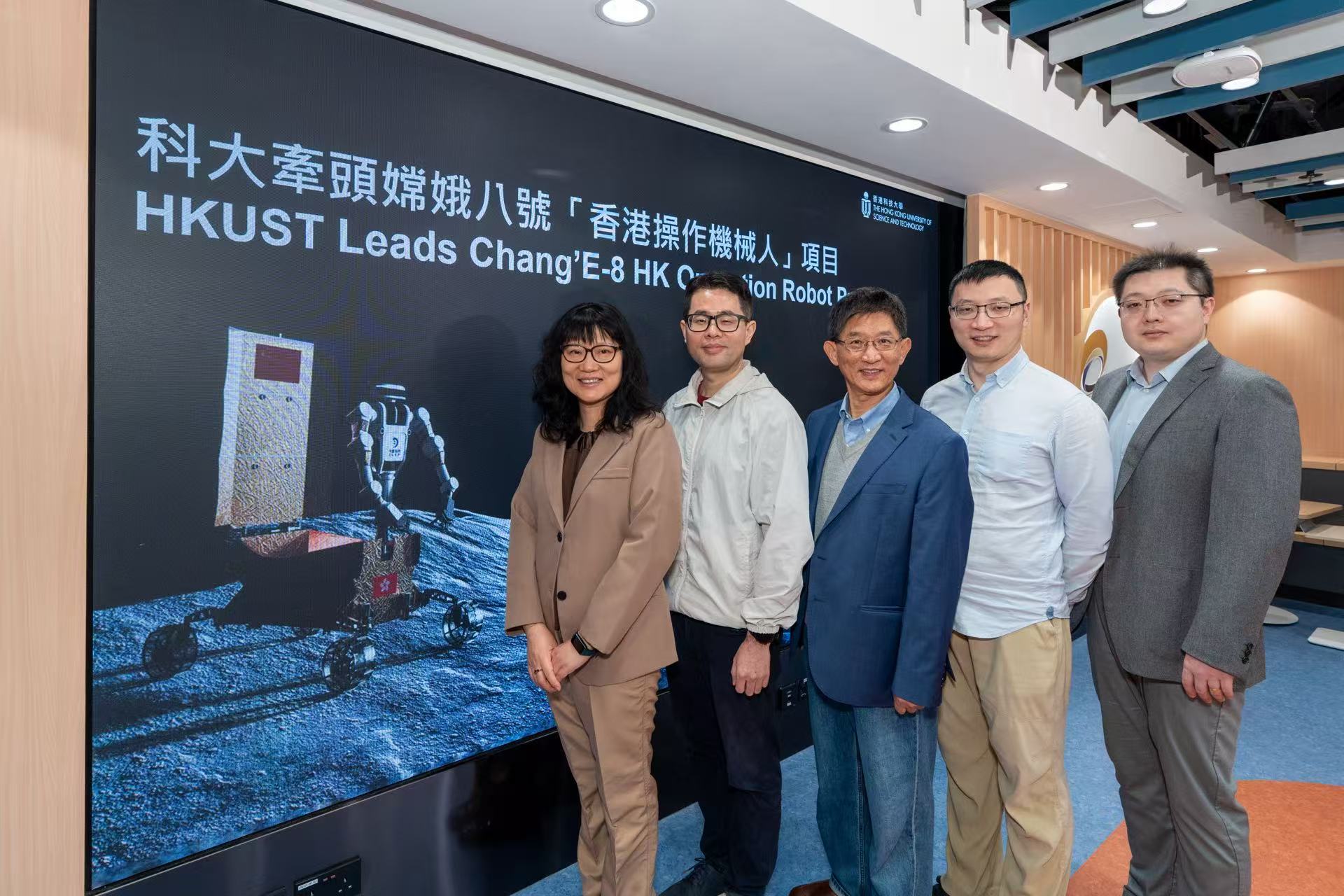
A Hong Kong tertiary education institution is bringing together global aerospace scholars and experts to develop a multifunctional lunar surface operation robot that will contribute to the country’s lunar exploration program and the development of the aerospace industry in Hong Kong.
The Hong Kong University of Science and Technology (HKUST) has been appointed by the China National Space Administration (CNSA) to develop the operation robot, equipped with a mobile charging station and capable of operations requiring dexterity, to participate in the national Chang’e 8 lunar exploration mission.
As part of the fourth phase of the country’s lunar exploration program, the Chang’e 8 probe is scheduled for launch around 2029, with the mission to advance the establishment of the future International Lunar Research Station. The spacecraft will land at the moon’s south pole with a suite of international surface robots to conduct scientific research in an extreme lunar environment amid temperature fluctuations.
The operation robot is part of the “Hong Kong Operation Robot” project established by the Hong Kong Space Robotics and Energy Center (HKSREC) under the Hong Kong Science Park’s InnoHK research clusters. HKSREC collaborates with academic and research institutions in the Hong Kong Special Administrative Region, the Chinese mainland and overseas, to drive a value chain for the aerospace industry — from conceptualization, research and development and production, to testing and system integration.
ALSO READ: HK, Macao payload specialists on track for 2026 space missions
The robot is equipped with dual robotic arms — a global first in deep space exploration — which will facilitate deploying and installing instruments, collecting lunar surface samples, and other tasks.
“Capitalizing on its robust scientific research capabilities, Hong Kong is actively advancing the development of aerospace science and technology and bolstering the space economy,” said HKUST vice president for research and development Tim Cheng Kwang-Ting.
The vice president said that HKUST’s efforts in aerospace R&D will elevate Hong Kong’s global competitiveness in aerospace technology and strengthen the city’s role as an international innovation and technology hub, while generating a meaningful economic impact.
READ MORE: HK, Macao add thrust to nation's space exploration
Gao Yang, director of HKSREC and professor at HKUST’s Department of Mechanical and Aerospace Engineering, said HKSREC is leveraging aerospace technology to generate a significant impact across industries such as artificial intelligence, robotics, computer science, microelectronics, and communications.
“The HKSREC will build Hong Kong’s foundational capabilities in aerospace technology while cultivating high-caliber talent,” Gao added.
