

Newly established GBU positions itself as catalyst for GBA innovation growth
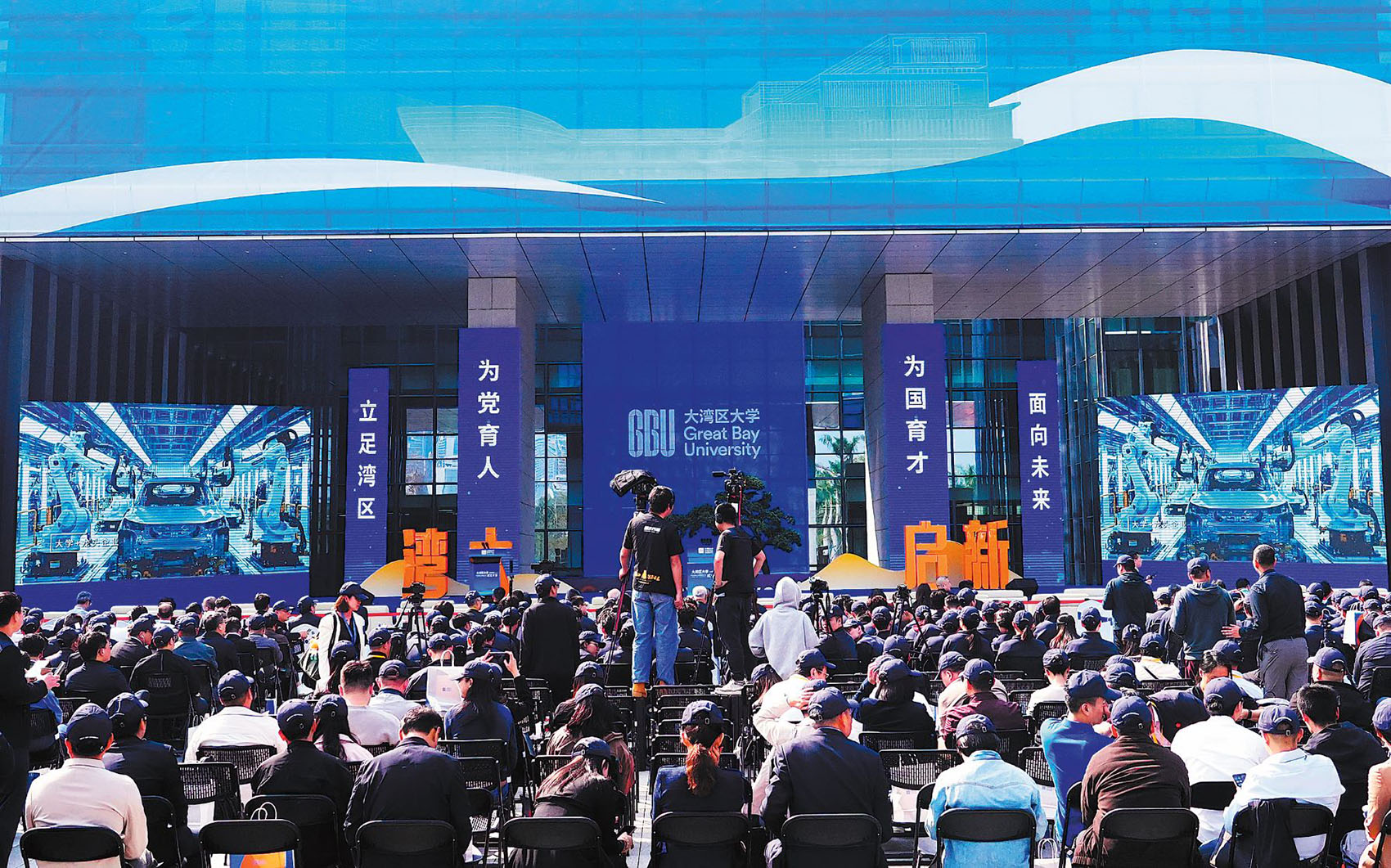
Despite only being established earlier this year, the Great Bay University in Dongguan, Guangdong province, is already building up expectations that it will provide a solid flow of talent for the Guangdong-Hong Kong-Macao Greater Bay Area, and help accelerate the development of new quality productive forces, technological innovation and emerging industries.
Tian Gang, founding president of GBU, said the university has adopted an innovative education model that will allow freshmen to enroll without declaring a major, giving them a year for self-exploration.
READ MORE: New university in Dongguan to provide talent support for GBA
"Starting from their second year, they can freely choose their majors based on their talents and interests, and cross-disciplinary minor programs are also available," he said.
Tian, an academician at the Chinese Academy of Sciences, made the remarks at the university's inauguration ceremony held on Saturday in Dongguan, a major manufacturing hub.
He said GBU defines itself as a "science and engineering-based, small yet elite, high-level research-focused institution".
By utilizing the advantages and development needs of the GBA, the university will focus on six disciplines — materials science, advanced engineering, life sciences, information science and technology, fundamental science, and financial management — to nurture research-oriented talent capable of solving complex problems and driving innovation, Tian said.
The university has already launched joint graduate programs with institutions including The Chinese University of Hong Kong, the University of Macau, Harbin Institute of Technology, Southern University of Science and Technology, and Sun Yat-sen University. It has established collaborative research centers with universities in Hong Kong to build an innovation network across the GBA.
By drawing on the region's institutional strengths, industrial ecosystem and innovation environment, GBU aims to deliver sustained research advances in fundamental science, pioneering innovation, the integration of science and education, industry-education collaboration, and the cultivation of top-tier innovative talent, Tian said.
He said he looks forward to forging closer ties with other universities, research institutions, enterprises and like-minded partners in the GBA and beyond.
"Many of GBU's faculty members have previously worked in Hong Kong and Macao, which greatly facilitates our efforts to deepen cooperation with higher education institutions in these regions," Tian said.
According to Tian, GBU is recruiting globally and has more than 300 research faculty members, all holding doctoral degrees. More than 70 percent have overseas study or work experience.
GBU's campus near Songshan Lake is located in the pilot zone of the GBA's Comprehensive National Science Center, adjacent to major scientific infrastructure including the China Spallation Neutron Source and the Songshan Lake Materials Laboratory. Several leading enterprises, including Huawei, have operations nearby.
Wang Shuguo, president of Fuyao University of Science and Technology in Fujian province, said a new round of technological revolution is giving rise to new university models, with emerging research universities being a product of the times.
"When the new technological revolution arrives, new types of research universities emerge in response to the demands," Wang said. "Together, they will engage in collaborative exploration and frequent exchanges, integrate deeply with industry, further support the pursuit of high-level technological self-reliance and strength, and provide a reference for the future development of other universities."
Lu Xiaozhong, dean of the Institute for Advanced Study of Educational Development in Guangdong-Hong Kong-Macao Greater Bay Area at South China Normal University, said GBU represents the direction of "future research universities".
"In its pioneering exploration, it should also play a leading and exemplary role, providing valuable insights for the reform and development of traditional institutions of higher education," Lu said.
The Ministry of Education approved the establishment of the university on June 19, and GBU began operations in August, enrolling its first cohort of 80 students from 53 middle schools across 16 cities in Guangdong province.
Contact the writers at zhengcaixiong@chinadaily.com.cn
