

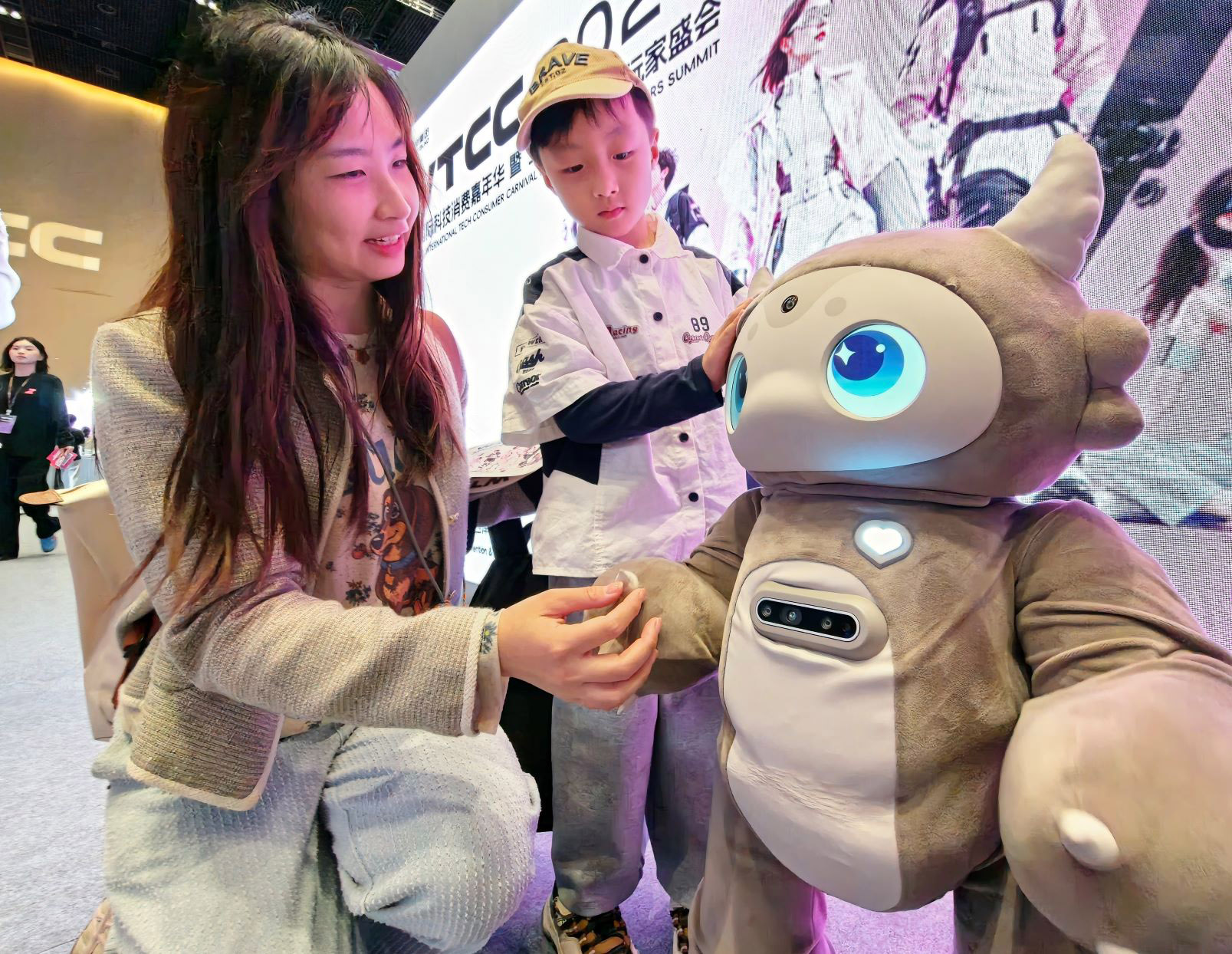
When a preschooler swipes a card against a parenting robot and magical things happen, many "traditional" flesh and blood parents realize clearly: this generation's childhood is fundamentally different from those prior to artificial intelligence.
The 2026 West Bund Tech Consumer Carnival (WTCC), held at Shanghai West Bund International Convention and Exhibition Center from Oct 22 to Oct 25, brought together more than 400 cutting-edge tech brands sporting eye-catching items like AI-powered maternity feeding devices, child companion robots and smart interactive toys, offering a clear glimpse into how AI is reshaping child rearing in the country.
The carnival showcased tech applications across the entire life cycle, with a significant focus on China's AI boom in maternity and parenting, which began in earnest in 2025. In just one year, the civilian rollout of large language models and demand for refined parenting among younger generations have driven AI into every aspect of feeding, companionship and early education, moving the sector from incremental upgrades to a paradigm shift.
READ MORE: AI pet market cat's meow for the lonely
In daily feeding scenarios, AI is setting new precision standards for maternity appliances. Snow-Bear's AI milk warmer uses ambient temperature recognition and infrared sensing to adjust heating based on seasonal changes and bottle materials, ensuring a stable preset temperature.
"The core is AI-powered temperature calibration, which solves the pain point of traditional devices being disrupted by environmental factors," said Lin Li, brand supervisor at SnowBear.
AI companion products are transforming childhood companionship. TCL-backed HeyAiMe's AiMe family companion robot, launched in August, offers visual recognition, movement tracking, and modules for music and role-playing for children aged 3 to 8, focusing on good habit formation and character building.
"We aim to alleviate the burden on exhausted parents by providing quality companionship. Our focus is on play-driven learning, nurturing hands-on skills and imagination through interaction," said Weng Xuwei, TCL's marketing manager.
Babycare's AI plush toys, embedded with AI chips and LLMs, enable smart dialogue with children. "The biggest change brought by AI is greater humanity. What used to be just a toy can now be a child's companion," said Yu Jiale, account manager at Babycare. Previously, the brand's smart AI interactive toy duck topped 2 million yuan ($300,238) in sales in its debut month.
Shanghai Aiyuhui Technology's Egg Baby connects to a WeChat mini-program via near-field communication (NFC). Users hatch virtual pets after building up intimacy points, with each pet having a unique personality and shifting moods, and can even generate interactive postcards from user-uploaded photos. Targeting all age groups, the product will launch between late 2026 and the 2027 Spring Festival holiday.
Official data underscore the sector's momentum. China's AI toy market hit 24.6 billion yuan in 2024 and likely reached 29 billion yuan last year, said the Ministry of Industry and Information Technology.
He Yaqiong, director general of the ministry's Department of Consumer Goods Industry, said AI and LLMs have injected new vitality into toys. "Interactive, nurture-capable AI toys with distinct personalities and memories are widely embraced by consumers and have become a new competitive track," said He.
ALSO READ: China scales up embodied AI's reach
Zhang Di, founder and CEO of Aiyuhui, said: "AI will definitely revolutionize early childhood education. Even the best teacher cannot match AI's knowledge base."
AI will permeate all age groups in both hardware and software forms, fundamentally reshaping education and companionship. For the generation growing up with AI, technology will become a natural part of their upbringing — with impact far beyond today's products.
The WTCC also linked early-stage projects with industrial resources and incubation support through forums, investment roadshows and innovation contests, thus speeding up the adoption and commercialization of tech advances.
Contact the writers at heqi@chinadaily.com.cn
