

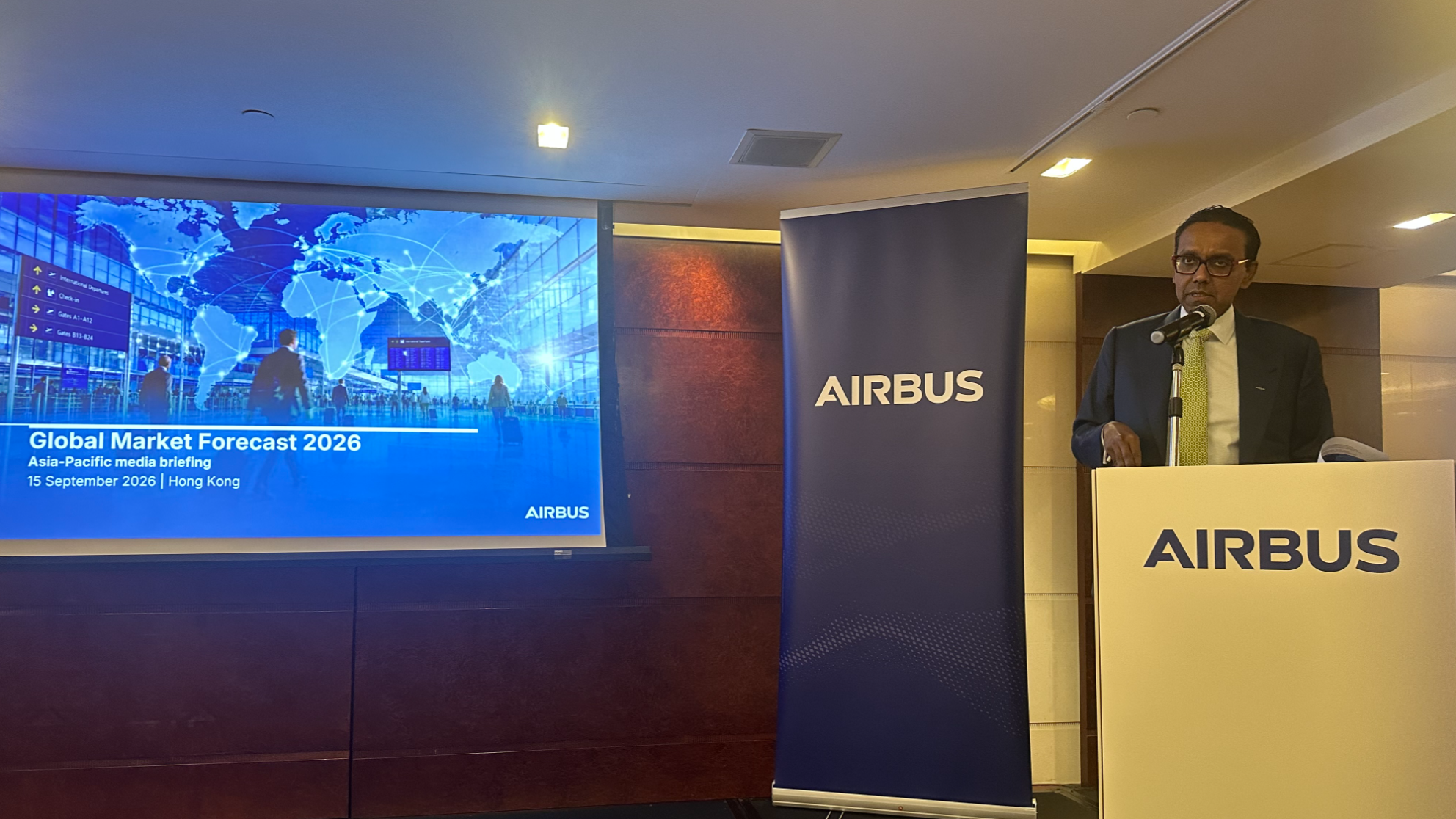
Airbus expects the Asia-Pacific region to dominate global aviation demand over the next two decades, propelled by China’s market expansion and the Hong Kong Special Administrative Region’s role as a premier aviation hub.
The market forecast was made by the European aircraft maker on Tuesday at a media briefing in Hong Kong, as part of the company’s forecast envisaging the global market up to 2045.
While Airbus acknowledged that Middle East tensions significantly disrupted the industry starting in late February, flight networks in the affected areas had already rebounded to about 85 percent of pre-conflict levels by early July.
Francois Cabaret, head of global market forecast at Airbus, said global travel demand remains resilient, with Airbus forecasting that world air traffic would increase at a compound annual growth rate of 3.9 percent over the next two decades fueled by faster urbanization and a growing middle-income population worldwide.
“Despite headwinds, we see tremendous growth, especially driven by the engine of Asia-Pacific,” said Anand Stanley, president of Airbus Asia-Pacific.
The Asia-Pacific region will see a compound annual growth rate of 5.1 percent in passenger traffic over the next two decades, outpacing the world’s average, according to Airbus.
ALSO READ: Airbus banks on China supplier base
China will spearhead this boom, Airbus said, with its aviation sector growing at a compound rate of 5.2 percent annually. This surge will generate demand for over 8,800 new passenger jets in the following two decades, representing 46 percent of the Asia-Pacific region’s order and 21 percent globally.
By 2045, China’s domestic routes will surpass the internal aviation networks of the United States and India to become the worlds’ busiest air traffic flow, said Cabarets.
Hong Kong carriers are backing this upbeat outlook with major fleet investments. “Cathay has looked at almost 150 aircraft orders from Airbus,” said Stanley.
Since mid-2025, Cathay Pacific has flown A350-1000 aircraft, Airbus’ latest long-range, wide-body passenger jet, between Hong Kong and Dallas in the US, a journey spanning over 14 hours and 13,000 kilometers.
The Asia-Pacific region also remains a powerhouse for global air freight, with the Hong Kong-North America route playing a major role.
“We have seen airlines which go out of Hong Kong looking at replacing their long-range freighters with an A350F freighter,” said Stanley.
As the freight variant of the Airbus 350 family, the A350F carries payloads of up to 111 metric tons.
Carriers’ capacity expansion will not only enhance connectivity to Hong Kong, but to the Guangdong-Hong Kong-Macao Greater Bay Area, and the wider Asia-Pacific region, Stanley said.
