

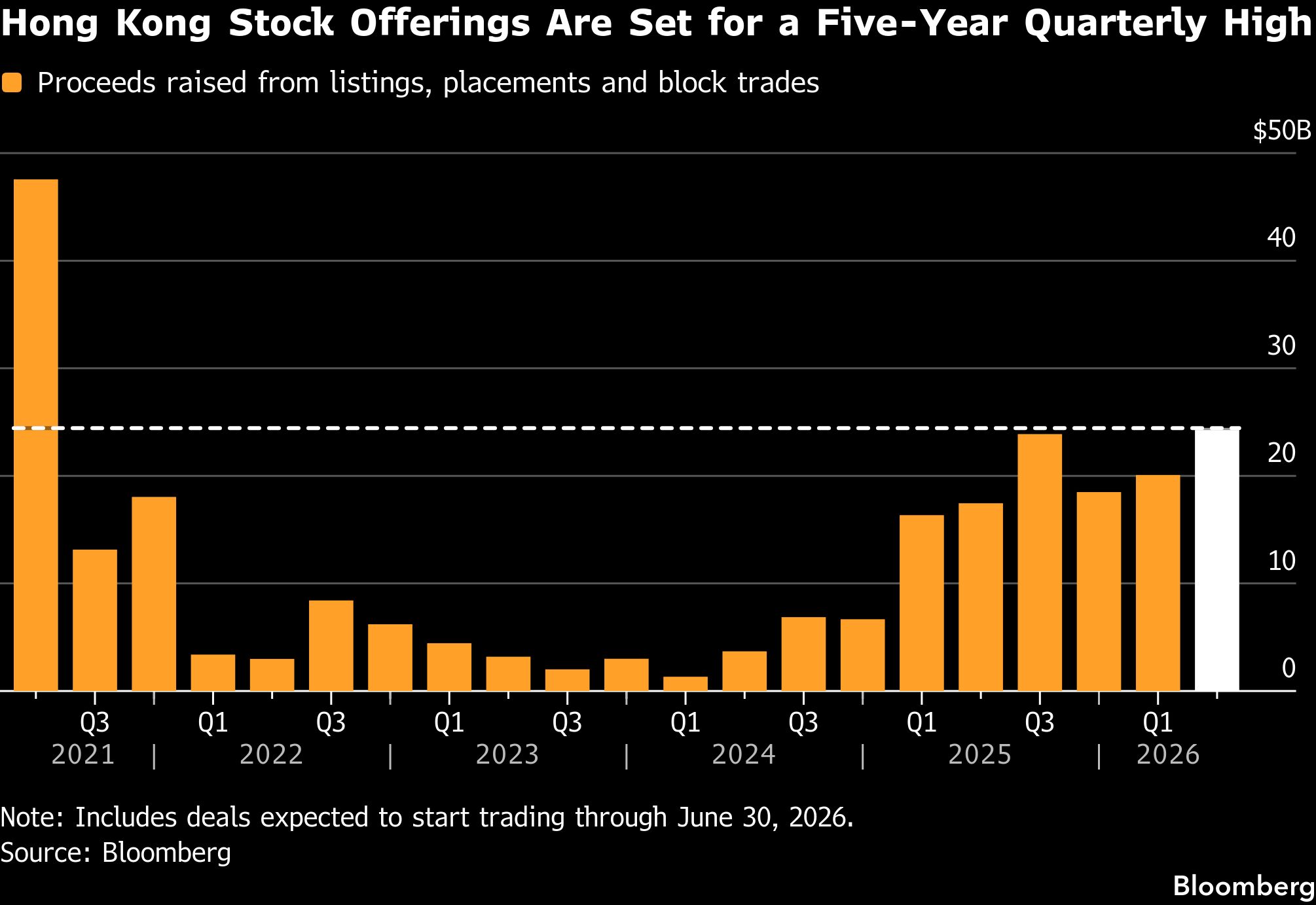
Hong Kong share sales surged to a five-year high in the first half of 2026 as investor enthusiasm around the artificial intelligence boom overpowered the drag of a sluggish equity market, according to Bloomberg.
Initial public offerings, placements and block trades raised almost $44 billion in the Hong Kong Special Administrative Region, a 29 percent jump from a year ago, data compiled by Bloomberg show. Chinese mainland corporate giants including Contemporary Amperex Technology Co Ltd and Victory Giant Technology Huizhou Co led the charge with multibillion-dollar offerings. Hong Kong accounted for the biggest portion of the $122 billion raised in all of the Asia-Pacific region.
The deals were undeterred by the Hang Seng Index falling almost 12 percent this year and the war in the Middle East fanning inflation fears. Hong Kong has emerged as the key hub for mainland companies along the AI supply chain to raise funds as they race to build out capacity in competition with rivals across the Pacific. The mood remains firmly optimistic, with companies lining up for more deals.
ALSO READ: HK equity market to face HK$255 billion lock-up expiry in July
Companies that recently listed are also wasting no time in tapping the market for more funds. Mainland battery maker CATL raised $5 billion in a placement after its similar-sized Hong Kong listing last year, while AI model maker Zhipu, which went public in January, is already planning to raise several billion dollars as soon as next month, people familiar with the matter have said.
“Last year, the Hong Kong IPO market reopened in the second quarter after a couple of large and successful deals,” said Peihao Huang, head of APAC equity capital markets at JPMorgan Chase & Co. “Now the market has proven repeatedly it can absorb multibillion-dollar offerings.”
AI is powering deal activity across much of APAC too, particularly South Korea, the Chinese mainland and Taiwan. Korean memory chipmaker SK Hynix Inc. filed for a jumbo $29 billion US listing, putting it on track for one of the biggest share sales of all time.
The deals come after SpaceX held the largest IPO in history earlier this month and will serve as a further test of appetite for AI-related companies as US tech giants such as Alphabet Inc lay out plans to raise tens of billions of dollars to fund their AI endeavors. That’s against the backdrop of trader concerns that the AI rally might have got ahead of itself.
READ MORE: Hong Kong takes crown as top wealth hub, likely to keep it
In Taiwan region, there’s been a surge in non-IPO fundraising as tech firms seek to keep up with soaring demand. Companies raised a record $4.8 billion via convertible bonds this year, already outpacing every full-year haul on record, while billions more are expected to flow in through GDRs.
In the mainland, memory chipmakers ChangXin Memory Technologies Inc and Yangtze Memory Technologies Co are also planning multibillion-dollar offerings, Bloomberg reported.
The one market punching well below its weight in Asia is India, where share sales have raised just over $14 billion this year, a 32 percent drop from a year ago. The outbreak of war in the Middle East delivered a shock to the economy that’s dependent on oil imports and the country’s equities have taken a drubbing as a result, according to Bloomberg.
The NSE Nifty 50 Index is down 7.9 percent this year, prompting issuers to downsize or postpone IPOs. One of them was Walmart Inc-backed PhonePe Ltd, which pushed back a deal that could have raised as much as $1.5 billion.
READ MORE: Survey: HK retail investors spend HK$7.34b a year on trading fees
Still, India’s IPO market often picks up in the second half of the year and there are large deals on the horizon. Billionaire Mukesh Ambani’s Jio Platforms Ltd this month filed for an IPO that could be the country’s largest ever, while National Stock Exchange of India Ltd, the operator of the world’s busiest derivatives market, also submitted paperwork for what’s expected to be a multibillion-dollar listing.
“The challenge with India is not so much a question of supply,” said Saurabh Dinakar, head of Asia-Pacific global capital markets at Morgan Stanley. “It’s more a question of demand and valuations because obviously there’s been a pretty meaningful correction.”
India is also suffering from the absence of large AI names to capture investors’ attention.
“We are seeing a clear shift in existing liquidity: money flowing out of traditional secondary market stocks is migrating directly into AI supply-chain equities and the primary IPO market for tech listings,” said Edison Zhou, head of ECM for China Merchants Bank International.
