

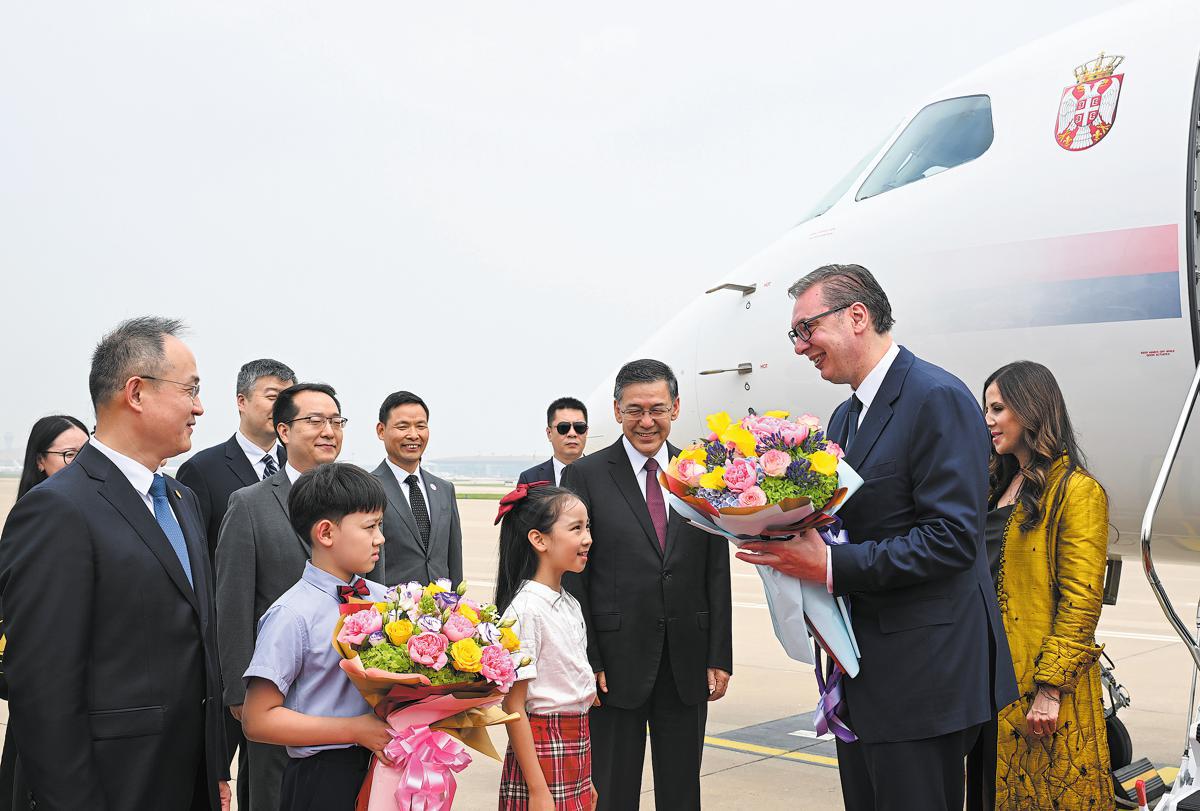
Serbian President Aleksandar Vucic arrived in Beijing on Sunday for his first state visit to China, a trip that is aimed at striving for more tangible outcomes in building a China-Serbia community with a shared future for the new era.
President Xi Jinping and Premier Li Qiang will respectively meet with Vucic during the visit, which runs from Sunday to Thursday, to exchange views on bilateral relations, as well as international and regional issues of mutual interest.
Before leaving for China, Vucic described his visit as "undoubtedly the most important trip abroad" in his political career, according to Serbian news agency Tanjug.
He said that Serbia attaches great importance to building strong partnerships with friendly countries that respect its independence, development and right to choose its own path.
He said the support and friendship shown by Xi toward Serbia remain a lasting testimony to the ironclad ties between Serbia and China, as well as to the deep mutual trust between the two countries.
The visit comes two years after Xi paid a state visit to Serbia in May 2024, when the two heads of state signed a joint statement on deepening and upgrading the comprehensive strategic partnership and building a China-Serbia community with a shared future for the new era.
Over the years, bilateral relations have maintained strong momentum, becoming an example of peaceful coexistence and mutually beneficial cooperation between countries with different civilizations and social systems.
Wang Yiwei, director of the Institute of International Affairs at Renmin University of China, said Vucic's visit highlights Serbia's pursuit of strategic autonomy as the world faces economic pressures, security challenges and growing uncertainties.
"The signal sent by the visit is that Cold War thinking is outdated, and that all countries have the right to choose their own development paths," Wang said.
He said that Serbia shares some similar experiences with many developing countries, making the European country a potential bridge between China, Europe and the Global South.
Ahead of his visit, Vucic said he would meet Chinese industrial and business leaders during his stay in China.
He described China as "a model of what a strong and stable economy should be", as well as "an example of a principled state" that, through its consistent positions, prudent policy and international reputation, has made serious efforts toward peace, stability and cooperation in the world.
Such efforts, he said, are "needed by humanity today more than ever before."
Earlier, Serbian Foreign Minister Marko Djuric said that Vucic's visit at the highest state level would be of historical significance for Serbia and would give a strong impetus to further strengthening the extraordinary strategic relations and even closer and more fruitful cooperation between Serbia and China in a wide range of areas.
