

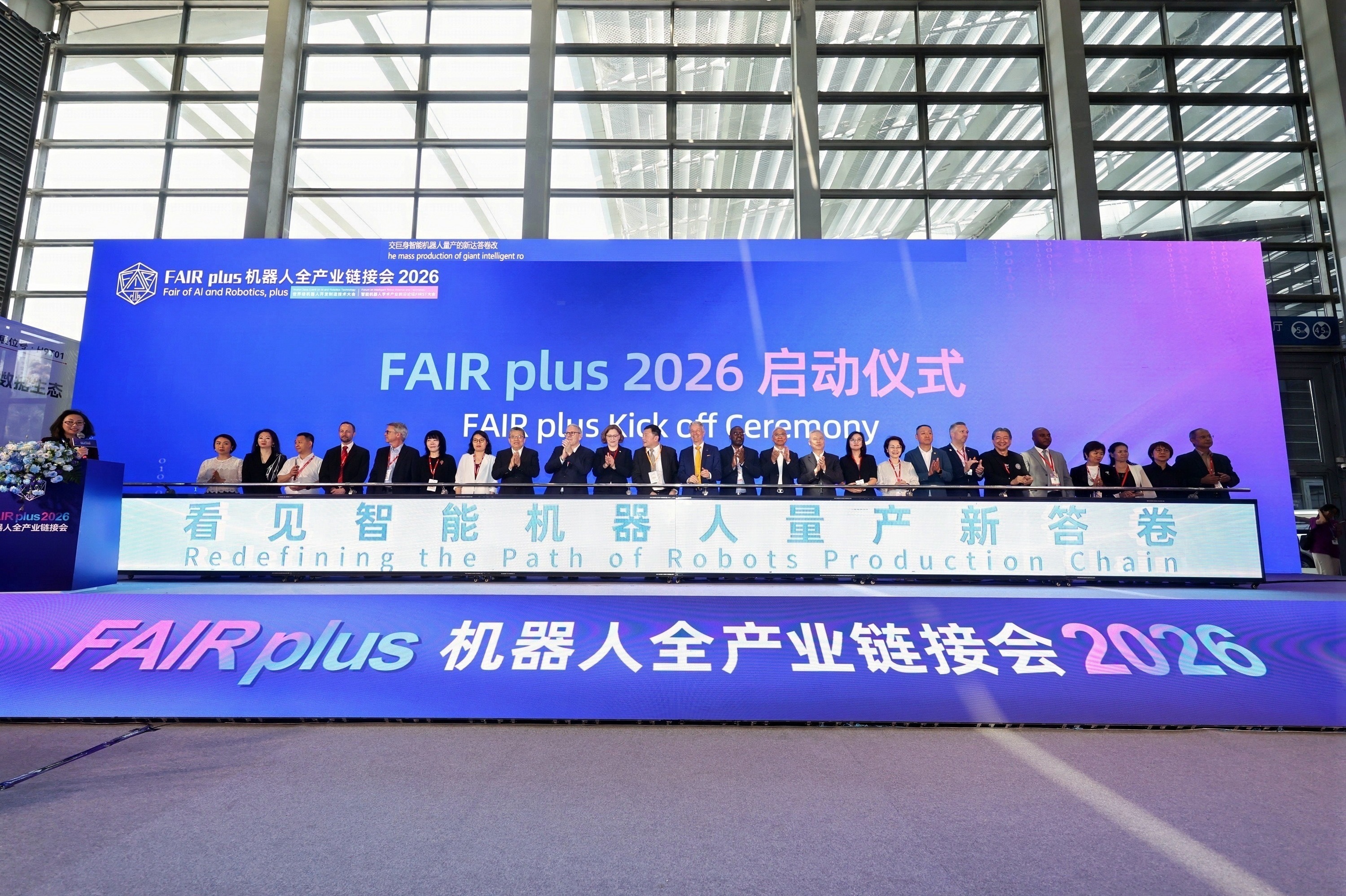
International robotics experts said that, given China’s rapid development in the robotics field, they hope to strengthen cooperation with it as a major player to promote the higher-quality development of robots and to expand their wider global adoption.
They expressed their intention at the main forum of FAIR plus 2026, an international event focused on strengthening the entire robotics industry chain, which kicked off in Shenzhen, Guangdong province, on Wednesday.
According to the World Robotics Report 2025 released by the International Federation of Robotics (IFR), China has about 2 million robots — the most in the world, and roughly 4.5 times the number in Japan, which ranks second. Of all robots installed worldwide in 2024, about 54 percent were deployed in China.
Experts said at the 2025 World Robotics Conference that China has maintained the world’s largest industrial robot market for 12 consecutive years, with industrial robot output rising from 33,000 units in 2015 to 556,000 units in 2024.
READ MORE: Canton Fair, GBA Chinese theatre culture fest, FAIR plus robotic expo
German expert Patrick Schwarzkopf, managing director of VDMA’s robotics and automation branch, said that Germany and other European economies have a high number of robots and are among the world leaders in this field. VDMA is one of the largest network organizations in the European mechanical engineering industry.
As population aging accelerates, there is a growing need for more automation techniques to support social development. Schwarzkopf said he hopes to attract more investment to speed up growth in Germany’s robotics sector.
He added that robotic training and deployment require large amounts of data. However, much of that data is now controlled by the companies that develop the robots. He hopes to work with partners in China to make the ecosystem more open and to further enhance the robots’ interactive capabilities.
READ MORE: Flying librarian: Shenzhen library gets drones for book inventory
Bongki (Scott) Choi, vice-president of International Business Development at Samsung SDS (South Korea), praised China’s tremendous achievements in physical AI, which — combined with its world-class national standards system in this field — have produced excellent results.
However, amid the current geopolitical environment, safety standards certified solely by the producer country may raise concerns about neutrality. He said he hopes to promote third-party organizations to certify robot safety standards, and thereby enable robots to be deployed more effectively across borders. South Korea has a relatively rich experience in this area, and maintains strong trade relationships with both China and the United States. He said he believes South Korea can play a meaningful role in this area.
Jyrki Latokartano, chairman of the Robotics Society in Finland, told the forum that robots developed in Finland are better suited to working in harsh environments such as outdoors, off-road, and in snowy conditions, and said he believes Finnish components can help China build robots better adapted to extreme environments.
READ MORE: China's home-cleaning robot service grabs overseas attention
He said that compared with lightweight robots, Finnish companies are more interested in heavy machinery and intelligent systems, adding that he is looking forward to business cooperation in this area.
Jacques Eone, chairman of Cameroon Robotics Association, underlined the significance of robots in advancing productivity in Africa, but said that the region’s industrial ecosystem is still in its early stages.
He said that African countries cannot simply make use of Chinese products and services; they need to enhance their own capabilities and build the necessary infrastructure first, to better utilize these intelligent solutions.
Besides exporting products, Chinese companies are invited to set up robot production lines in Africa to create more jobs; otherwise, widespread robot use could disrupt the current job market, Eone said.
At the forum, the Shenzhen Robot Industry Development White Paper (2025) was also released, indicating that Shenzhen’s robotics industry is entering a new phase of development characterized by simultaneous growth in both scale and quality.
During the 14th Five-Year Plan period (2021-2025), the total output value of Shenzhen’s robotics industry surged from 158.2 billion yuan ($23.18 billion) to 242.6 billion yuan, with an annual compound growth rate exceeding 11 percent.
Its service robots accounted for over 40 percent of the national market, while industrial robots made up over a quarter. By 2025, the number of enterprises in Shenzhen holding robotics patents had increased to 4,676.
Contact the writer at bingcun@chinadailyhk.com
