

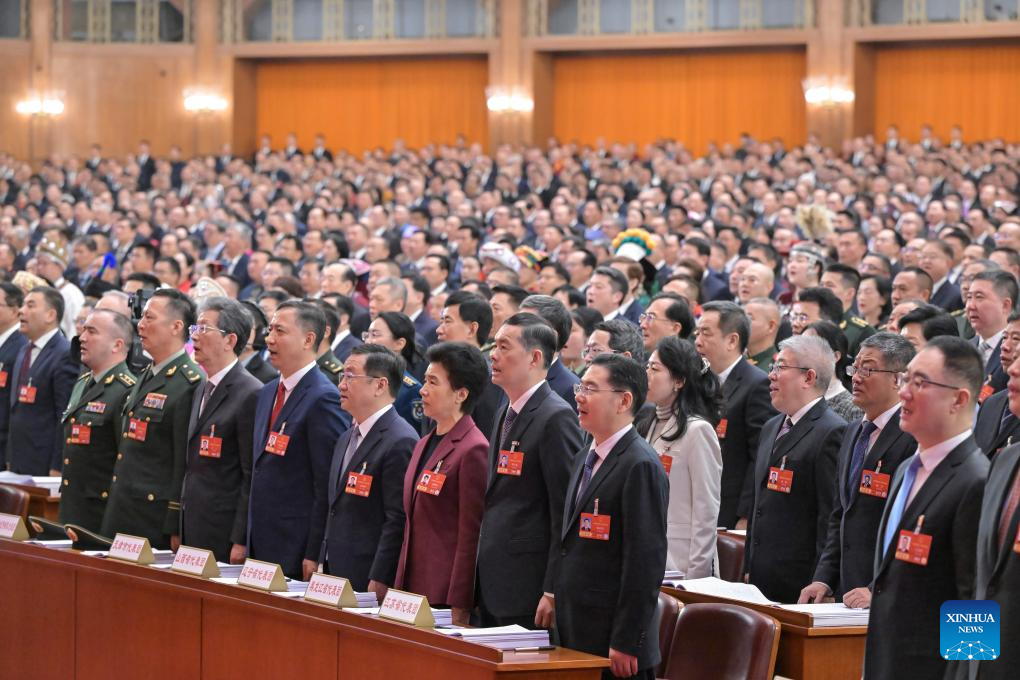
China is aiming for a GDP growth rate of at least 4.5 to 5 percent in 2026, according to a government work report that was submitted Thursday to the country's top legislature for deliberation.
Premier Li Qiang, who delivered the report at the opening of the fourth session of the 14th National People's Congress in Beijing, said that the growth target is well aligned with the country's long-range objectives through the year 2035 and is broadly in line with the long-term growth potential of China's economy, with favorable conditions in place for achieving this target.
ALSO READ: China's national legislature opens annual session
Government at local level should, taking into account their own conditions, make solid efforts to deliver positive outcomes, Li said.
He added that this year's targets, including the economic growth target, took into account the need to leave some room for structural adjustments, risk prevention and reform in what is the opening year of the 15th Five-Year Plan (2026-30) period, so as to lay a solid foundation for delivering better performance in the coming years.
Analysts have said the 2026 target reflects the government's pragmatic approach in recognizing the structural and cyclical challenges faced by the world's second-largest economy, while proactively pursuing a reasonable growth rate in line with high-quality development.
ALSO READ: China ramps up efforts to boost consumption and domestic market
Setting this year's GDP growth target at between 4.5 percent and 5 percent is "reasonable and necessary", said Sun Xuegong, director-general of the department of policy study and consultation at the Chinese Academy of Macroeconomic Research. The academy is an affiliated research institution of the National Development and Reform Commission.
If China is to double its per capita GDP from its 2020 level by 2035 to achieve socialist modernization, Sun says the economy would need to grow by around 4.2 percent annually in the coming years, making this year's target necessary.
Calling the target achievable, Sun cited the fact that macroeconomic policy support is poised to continue, laying the foundations for steady growth in consumption and a potential rebound in investment.
READ MORE: China seen to remain an attractive destination for foreign investment
Economists also noted that lowering the GDP growth target for 2026 does not mean the Chinese economy is losing its engines for growth. While traditional engines such as the property sector and demographic factors fade, new drivers including consumption spending, innovation-driven productivity gains and the expansion of the services sector are emerging.
Marshall Mills, the International Monetary Fund's senior resident representative in China, said that demand, supply and reform can combine to drive China's economic growth, with significant potential for further expansion in the 15th Five-Year Plan period.
On the demand side, China's vast savings pool signals strong potential for private consumption to become a core growth engine, Mills said, while on the supply side, deeper reforms to improve resource allocation can help translate innovation into productivity gains across broader sectors of the economy.
