

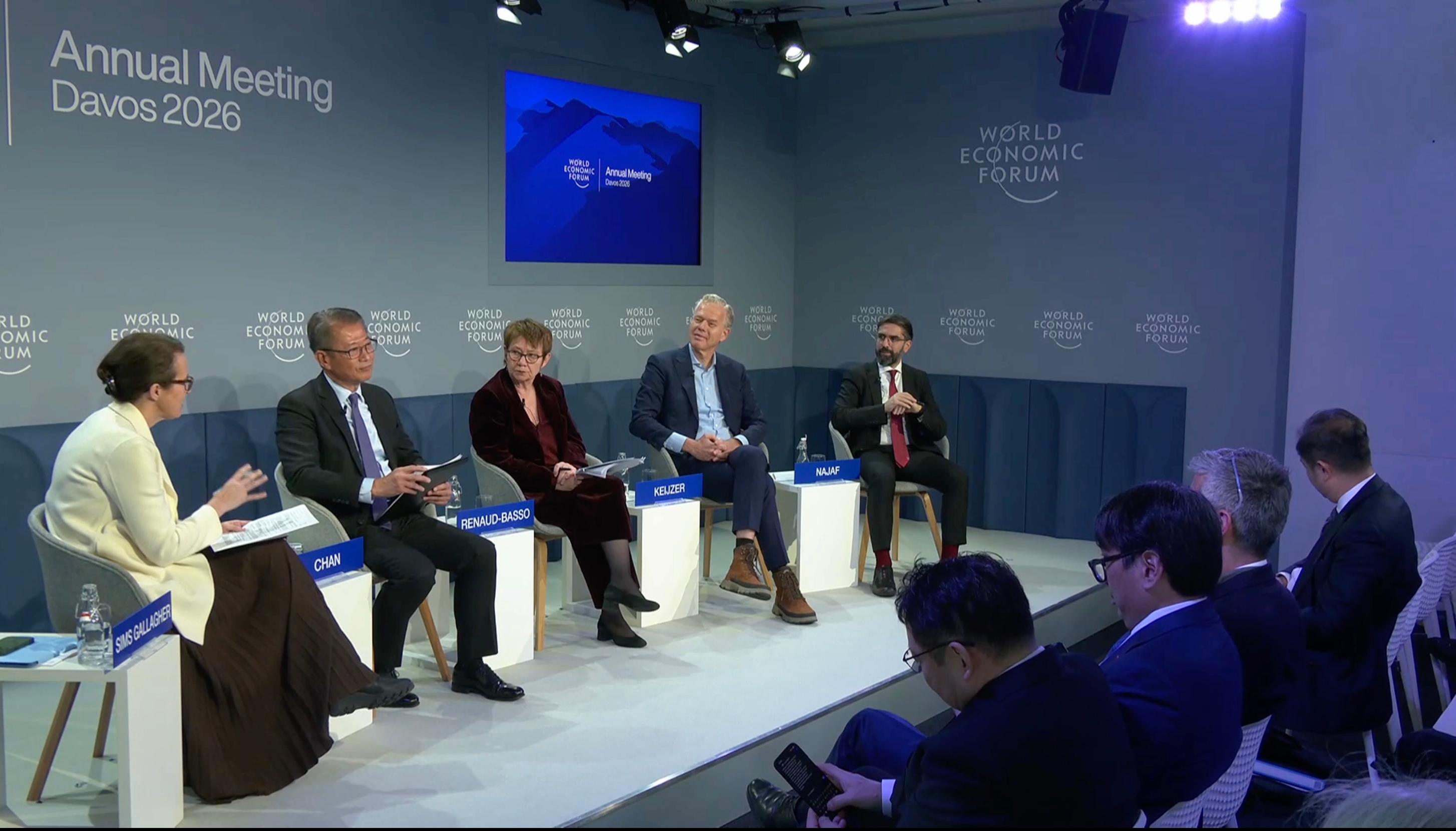
HONG KONG – A top Hong Kong official told the World Economic Forum (WEF) Annual Meeting on Thursday that both the country and the Hong Kong Special Administrative Region are firmly and steadily progressing towards the goal of carbon neutrality.
Speaking at a thematic session titled "How to Finance Decarbonization?" of the WEF meeting in Davos, Switzerland, Financial Secretary Paul Chan Mo-po shared the SAR’s target of achieving carbon neutrality by 2050 and the strategies to realize it.
These include leveraging government policy to steer behavioral changes among enterprises and consumers, such as providing tax concessions for electric vehicles and incentives for green buildings, he said.
The session focused on how, amid global economic slowdown, high debt levels in advanced economies and geopolitical developments, public-private collaboration can continue to support the goal of achieving carbon neutrality.
RELATED ARTICLES
- HK sees 27% fall in greenhouse gas emissions from 2014 peak
- Survey: HK biz has greater carbon awareness, resources, costs loom large
- HK’s milestone $10m carbon trading deal showcases unique strength
- HK unveils world’s first spaceborne payload for monitoring emissions
- In Davos, Chan promotes HK as worthwhile investment destination
Pointing out financial support provided by the authorities for trials of innovative technologies, such as sustainable hydrogen-powered transport, to encourage innovation, the financial secretary stressed that public support and trust are key to achieving a green transition.
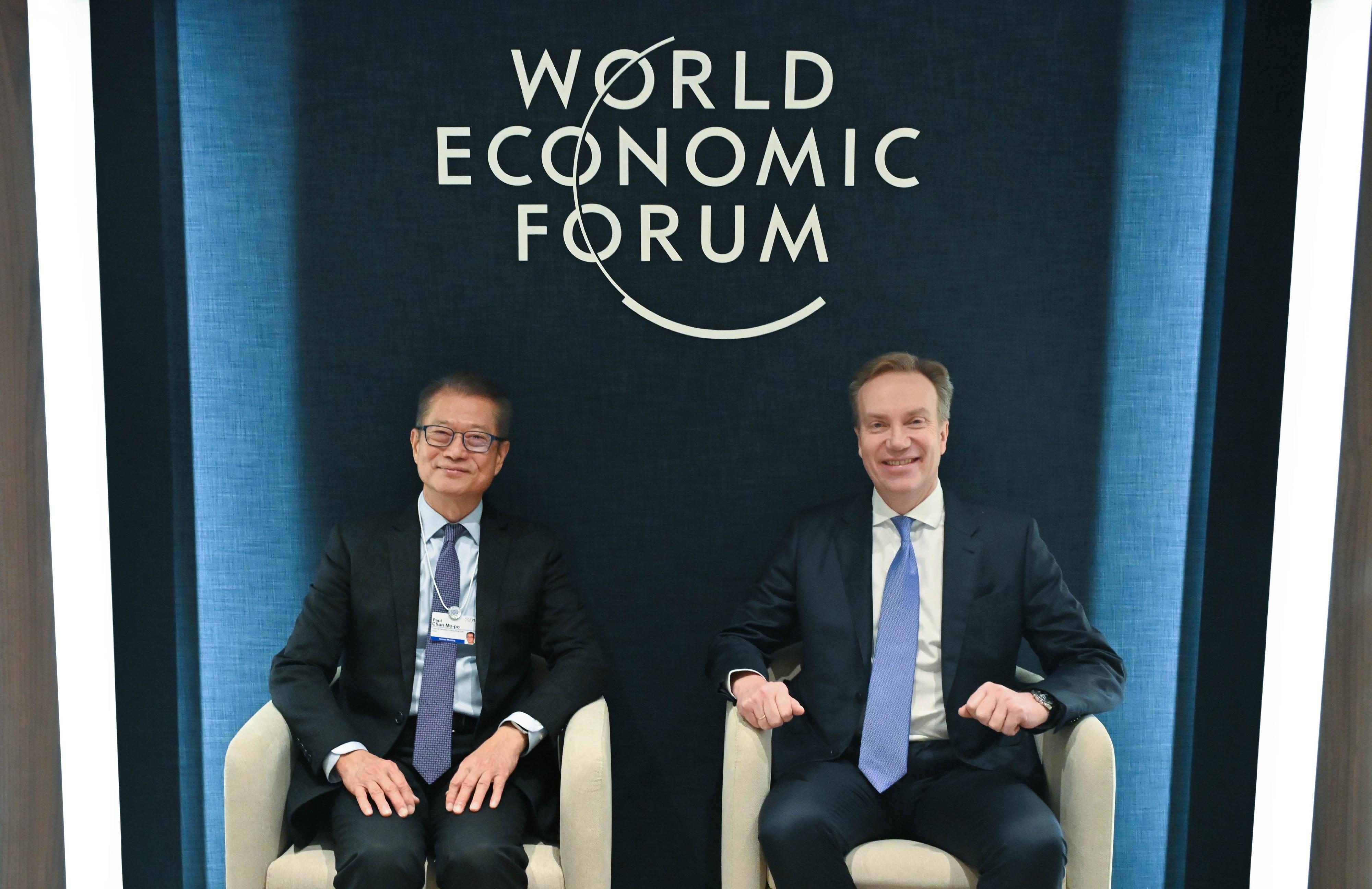
On the concluding day of his five-day itinerary at the WEF annual meeting, Chan also met President and Chief Executive Officer of the WEF Børge Brende, and First Deputy Managing Director of the International Monetary Fund Dan Katz and exchanged views on global finance and issues of mutual concern, and shared Hong Kong's perspective, the government said in a statement.
He also held separate meetings with the Global Chairman of PricewaterhouseCoopers Mohamed Kande, Chief Executive Officer of AXA Group Thomas Buberl, and Vice President of Global Public Policy of Amazon Web Services Michael Punke to exchange views on the current global economic and market situation, as well as technological development.
As an international financial center, Hong Kong actively facilitates private capital participation in the decarbonization process through a rich green finance ecosystem, such as green bonds and Environmental, Social and Governance funds, said the government.
Besides encouraging financial innovation, including the issuance of tokenized green bonds to allow wider investor participation in green projects, and the securitization of loans for infrastructure projects to release capital for reinvestment into new projects, the HKSAR government said it ensures that funds are genuinely used for green projects by formulating internationally aligned standards, including a green taxonomy and disclosure requirements.
“For high-emission enterprises, such as mining companies, listing in Hong Kong not only enables them to access capital to support their development but also helps enhance their corporate governance, transparency and recognition in global markets,” reads the government statement.
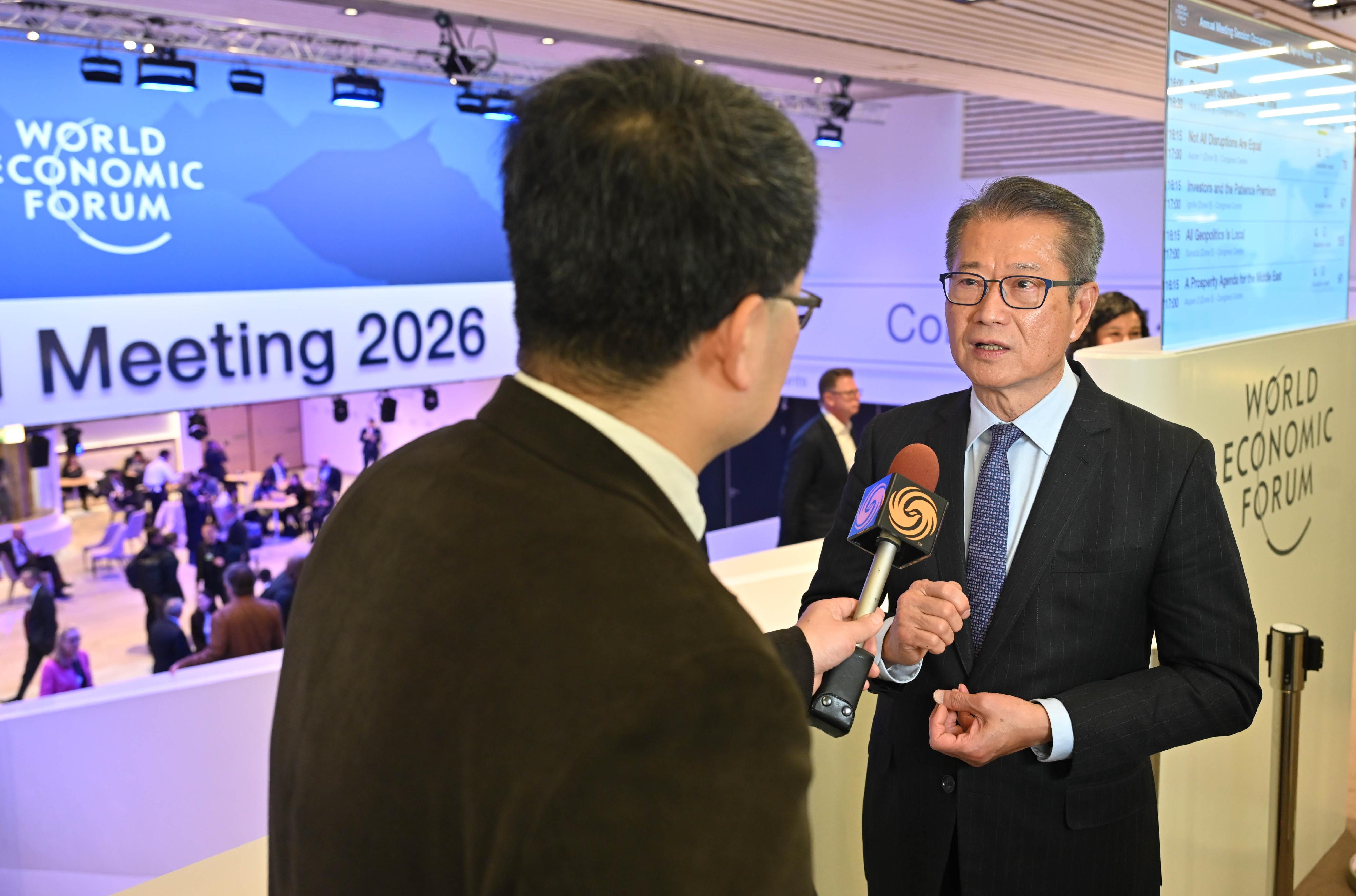
On Wednesday, Chan promoted Hong Kong’s advantages to global leaders during multiple luncheons and networking sessions at the WEF.
"Under ‘one country, two systems’, Hong Kong is actively exploring and piloting initiatives in financial and technological innovation. With strong collaboration with the Guangdong-Hong Kong-Macao Greater Bay Area’s neighboring cities that boast robust innovation and technology industrial chains, Hong Kong holds tremendous development potential and is a worthwhile investment destination," he said.
He met with various officials from different economies and regional organizations at the WEF annual meeting. He attended the special address session delivered by Vice-Premier He Lifeng and met World Trade Organization Director-General Ngozi Okonjo-Iweala to exchange views on the current and future international trade landscape.
"The Hong Kong SAR firmly supports free trade and multilateralism, and we support the WTO’s efforts to pursue reforms in response to current global challenges, with a view to enhancing its agility to address emerging issues in international trade," he said.
The finance chief also met with senior management of various technology companies and encouraged them to consider expanding their business in Hong Kong. As an international financial center, Hong Kong adopts a proactive yet prudent approach to the development of digital assets, and follows the principle of ‘same activity, same risk, same regulation’ to promote responsible and sustainable market development, he said.
"Since 2023, Hong Kong has issued licenses to 11 virtual asset trading platforms, and a licensing regime for stablecoins is expected to be launched later this year. In addition, regulatory sandboxes have been introduced to encourage innovative applications in the market," he added.
