

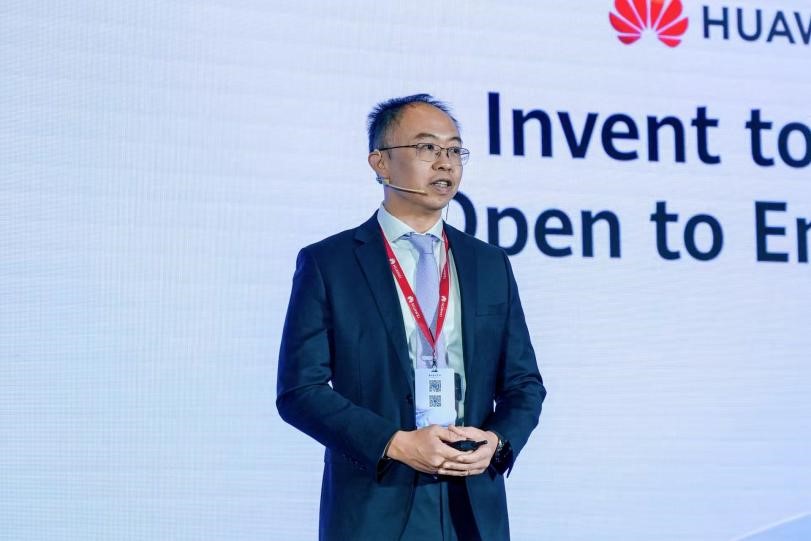
Huawei's cumulative revenue from external patent licensing has exceeded $6.9 billion, including about $800 million in 2025, the company disclosed at the seventh Innovation and IP Forum in Beijing, tracing its patent strength back to a decades-long innovation DNA built on basic research, sustained R&D investment and open collaboration.
By the end of 2025, more than 3.2 billion 5G devices, more than 1.6 billion Wi-Fi consumer electronics terminals and more than 4.1 billion multimedia devices had received Huawei patent licenses, according to the forum.
Among Huawei's active patents, wireless communications accounted for 41 percent, terminal devices 16 percent and artificial intelligence and computing 13 percent, ranking as the top three technology fields.
"At Huawei, a patent is not merely a legal right; it represents an innovation achievement and the pride of the inventor behind it," said Fan Zhiyong, Huawei vice-president and chief IP officer.
ALSO READ: Huawei's homegrown HarmonyOS tops 100 million devices
Francis Gurry, former director general of the World Intellectual Property Organization, said global IP institutions set shared, balanced rules to encourage inventors, while innovative enterprises translate those rules into practice through voluntary licensing, open collaboration and responsible technology diffusion. "Together, they encourage outstanding invention while opening pathways for broader innovation empowerment, benefiting the entire global ecosystem," Gurry said.
Robin Jacob, former judge of the Court of Appeal of England and Wales, said Huawei has become one of the world's major standard essential patent holders, and that the SEP licensing system is not only a foundation for open cooperation but also stimulates competition and innovation.
Behind the licensing portfolio is Huawei's long-standing innovation gene. At the forum, core R&D representatives of the Tau Scaling Law, Lingqu architecture, near-packaged optics (NPO) optical engine and 6G technology shared their "from zero to one" breakthroughs.
ALSO READ: Huawei posts strong H1 revenue despite rising R&D spending
For instance, the logic-folding breakthrough behind the Tau Scaling Law drew inspiration from traditional Chinese mortise-and-tenon joinery, pushing hybrid bonding toward near-zero-distance interconnection.
The commercial launch of the Hi-ONE NPO optical engine marks another success in AI based on Huawei's more than 30 years of accumulation in optical technologies.
Ren Zhengfei, Huawei director and CEO, said, "It takes decades to form a basic theory. If everyone shouts slogans instead of doing theory seriously, we will not be stronger in decades."
That tradition dates back to 1992, when China's telephone penetration rate was only 1 percent. Huawei, then with just over 100 employees, devoted half its workforce to R&D of the C&C08 digital program-controlled switch. In 2009, Huawei launched 5G-related research nearly a decade before the first 5G standard release, becoming a major contributor to 5G standards and one of the world's largest 5G patent holders.
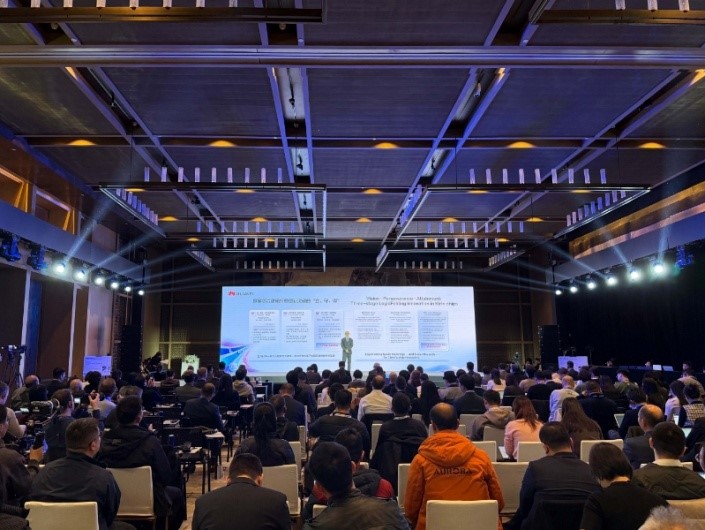
In 2011, Huawei integrated global R&D resources to establish the 2012 Laboratories, targeting frontier basic research for the next five to 10 years in ICT network architecture, standards and materials, rather than short-term product returns. "To find our 'Noah's Ark' in the coming digital information torrent, we strengthened basic research. 5G, autonomous driving and Ascend are all industries incubated by 2012 Laboratories," said Xu Zhijun, Huawei's deputy chairman and rotating chairman.
Huawei also built the non-profit online platform Huang Danian Chasiwu, or Tea-for-Thought House, advocating that "a cup of coffee absorbs cosmic energy," allowing scholars from diverse fields to exchange ideas, offering free global sci-tech information queries and advancing basic research through open cooperation with universities.
Ren said such inputs are strategic and not assessed for short-term commercial interests.
READ MORE: Huawei-proposed new theory promises to transform chipmaking
Huawei's R&D intensity has stayed above 20 percent over the past five years. In 2025, R&D expenditure reached 192.3 billion yuan ($28.8 billion), about 21.8 percent of annual revenue, bringing the past decade's cumulative total to more than 1.382 trillion yuan. Huawei has long ranked first among Chinese enterprises in R&D spending and has been in the global top six for nine consecutive years on the EU Industrial R&D Investment Scoreboard. By the end of 2025, Huawei had about 114,000 R&D employees, 53.7 percent of its workforce.
From its first Chinese patent application in 1995 to an average of 11.1 patent grants per hour in 2025, Huawei now holds more than 55,000 valid Chinese patents and has ranked first globally in published PCT applications for nine consecutive years.
"We will always adhere to innovation and openness," Fan said. "We look forward to working with partners across industries to advance technology and industrial development and let innovation benefit everyone."
