

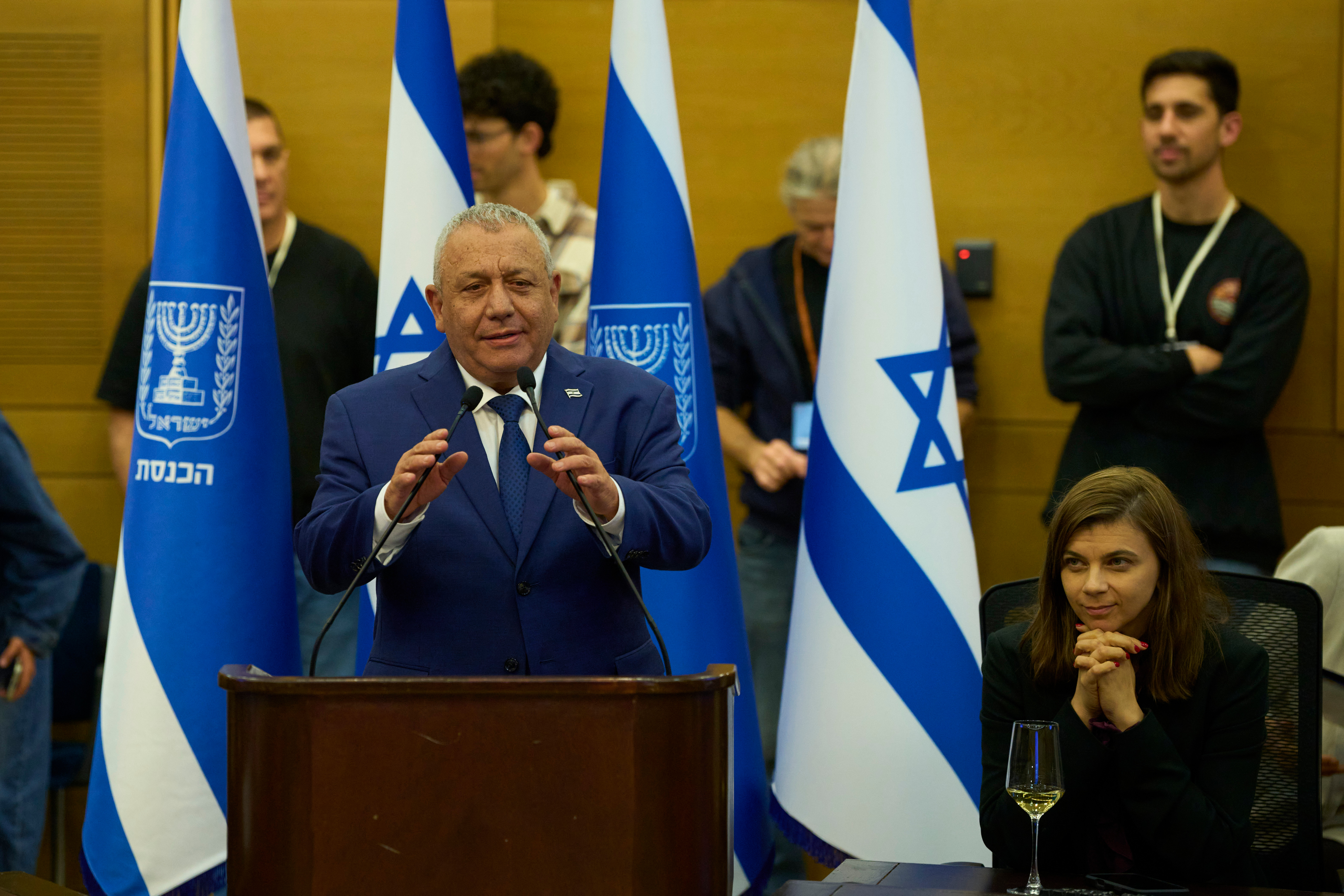
JERUSALEM/TEHRAN — Head of Israel's opposition bloc Gadi Eisenkot said on Monday that he does not currently see a direct and immediate threat that would justify military action against Iran in the coming weeks or before a new government is formed.
"The gravest threat from Iran is the 440 kg of enriched uranium that have not yet been destroyed or removed," Eisenkot said in a broadcast statement. "That is what we need to focus on."
His remarks came amid ongoing government-formation negotiations and Israeli media reports that outgoing Prime Minister Benjamin Netanyahu is urging US President Donald Trump to launch an immediate joint military strike against Iran, and is even pushing for an independent Israeli strike.
At the opening of his Likud faction meeting at the Knesset, Netanyahu said anyone downplaying the immediate threats was doing so for political reasons.
"The threat is real and serious," he said.
Meanwhile, former Israeli Defense Minister Avigdor Lieberman, an ally of Eisenkot in the opposition bloc, said during a faction meeting that an order by Netanyahu for an independent Israeli strike on Iran would constitute a manifestly illegal order, Israel's state-run Kan News reported.
On Feb 28, Israel and the US launched joint attacks on Tehran and other Iranian cities. Iran responded with waves of missile and drone attacks targeting Israel and US bases and assets in the region, and tightened its grip on the Strait of Hormuz.
A ceasefire was achieved between the warring parties on April 8. On June 18, Iran and the US signed a memorandum of understanding (MoU) on ending the war in the region on all fronts.
Under the MoU, the two countries were scheduled to hold negotiations within 60 days, ending on Aug 17, to reach a final agreement on Iran's nuclear program and the removal of sanctions. However, they failed to make sufficient progress toward a deal as tensions continued to escalate.
In September, Iran conveyed to the US a seven-day proposed plan to cease hostilities and reopen the Strait of Hormuz. The country later voiced its readiness to reduce the proposal's implementation period to two days should Washington meet Tehran's conditions.
Iran summons Qatari envoy
Iran on Monday protested a joint statement issued by Qatar and Germany criticizing Tehran's regional actions, while reiterating that it could reopen the Strait of Hormuz in the shortest possible time if the US meets its conditions.
At a weekly press conference, Iranian Foreign Ministry spokesman Esmaeil Baghaei said the ministry had summoned Qatar's charge d'affaires in Tehran to convey its protest over the joint statement issued on Saturday during Qatari Emir Sheikh Tamim bin Hamad Al Thani's official visit to Germany.
The statement condemned what it described as Iranian attacks on Qatar and other regional countries, as well as attacks and threats targeting commercial vessels. It also called on Iran to fulfill its international nuclear obligations.
Baghaei described the statement as "completely baseless and unacceptable," expressing surprise and regret at Qatar's participation in its issuance.
ALSO READ: US eyes lasting agreement to end Iran war
Turning to the Strait of Hormuz, Baghaei said Iran could fulfill its commitments to restore security in the strategic waterway in the shortest possible time if the US complied with the relevant conditions.
He said Iran's conditions included the lifting of US sanctions and the naval blockade against the country, as well as ending the war in the region on all fronts, including Lebanon.
Iran knows what it wants and is aware of the Iranian people's rights and their dimensions, and will in no way back down in that regard, Baghaei added.
ALSO READ: Report: IDF warns Israeli PM strike on Iran could spark wider regional war
On Iran's nuclear program and membership in the Treaty on the Non-Proliferation of Nuclear Weapons (NPT), he said Iran has made no decision yet about withdrawing from the treaty, and will remain committed to its obligations as long as its membership continues.
He again rejected allegations by the US and Israel that Iran seeks to develop nuclear weapons, saying they have kept repeating the same claim over the past 30 years.
