

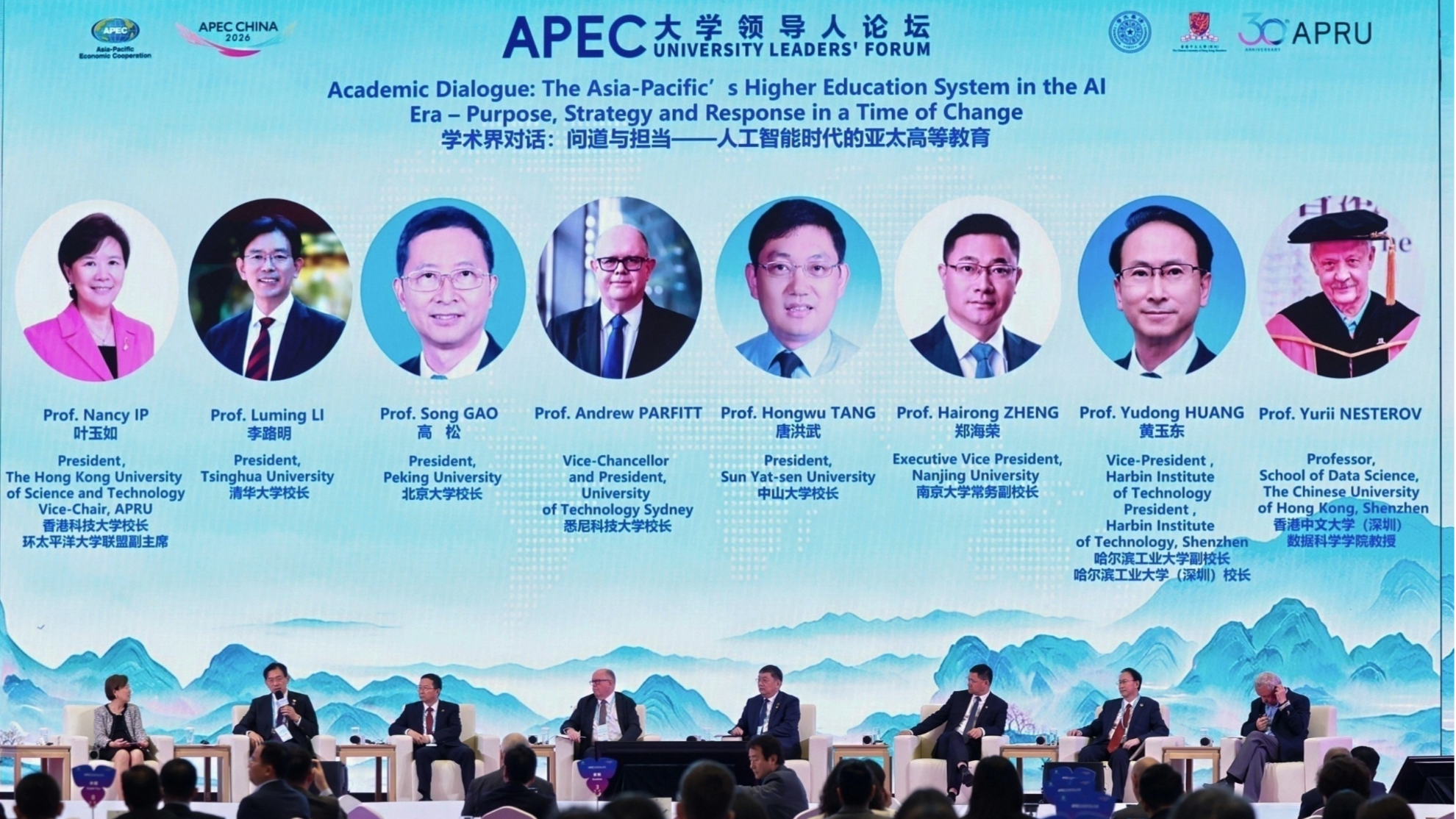
Amid the profound changes brought by the shifting international landscape and advent of artificial intelligence, education leaders have highlighted universities’ vital role in addressing shared development challenges across the Asia-Pacific, and emphasized that only through concerted efforts can sound decisions be made on these critical issues.
During the APEC University Leaders’ Forum held at the Chinese University of Hong Kong, Shenzhen on Monday, delegates pledged to deepen cooperation in joint research, cross-border exchanges, and research outcome commercialization to contribute to a better future for the region and beyond. The forum took place days before the 33rd APEC Economic Leaders’ Meeting, which will be held in Shenzhen on Wednesday and Thursday.
Nancy Ip Yuk-yu, president of the Hong Kong University of Science and Technology and vice-chair of Association of Pacific Rim Universities (APRU), said that the Asia-Pacific is home to some of the world's most dynamic economies and research institutions while also facing increasingly complex and interconnected challenges, including climate change, public health, and technological disruption.
“At universities, we educate the scientists who develop new technologies, the entrepreneurs who bring innovations into society, the policy makers who shape their governance, and the residents whose lives will be transformed by all these technologies,” she said.
Universities must not only adapt to technological change but also help shape and govern it responsibly, in the public interest. This requires closer collaboration among universities, governments, industry, and society, Ip stressed.
Gao Song, president of Peking University, said he believes that the more complex the global environment becomes, the more universities must remain open and strengthen their connections.
In his view, universities are inherently characterized by their ability to transcend national borders and foster cultural exchange. They are both communities dedicated to the creation of knowledge and bridges that promote understanding and build mutual trust.
He said he believes higher education institutions can play a greater role in the Asia-Pacific region’s future by strengthening international and interdisciplinary collaboration, expanding exchanges among students and scholars, and beefing up scientific support for public policy and social governance.
Huang Yudong, president of the Harbin Institute of Technology, Shenzhen, said that the Guangdong-Hong Kong-Macao Greater Bay Area’s industrial strengths have helped bring the university’s engineering innovations into practical use — particularly in the robotics field.
Going forward, the university will leverage its proposed China-ASEAN Digital Academy and joint research and education programs with institutions in the Hong Kong Special Administrative Region to further extend the cluster’s scientific and industrial prowess to wider Asia-Pacific and other regions.
Eduardo Pedrosa, executive director of the APEC Secretariat, said seamless digital trade in services has made cross-border online courses possible, but policy coordination is needed to facilitate credit recognition.
He also called for simpler, faster processes for student exchanges, longer study-abroad opportunities with overseas internships, as well as support for cross-border teaching of professors. He said these could all be important areas for university cooperation under the APEC framework.
Thomas Schneider, chief executive of APRU, said the association’s network comprises about two and a half million students, and includes five member universities in the Greater Bay Area — three in Hong Kong and two in the Guangdong province.
To further leverage the Greater Bay Area’s strengths as a major innovation hub within reach of universities across the Asia-Pacific, the organization is considering an entrepreneurship program that would bring students from around the world to the cluster and learn from its innovation ecosystem, he added.
Contact the writer at bingcun@chinadailyhk.com
