

Experts urge Shanghai to step up efforts to connect technologies with service providers
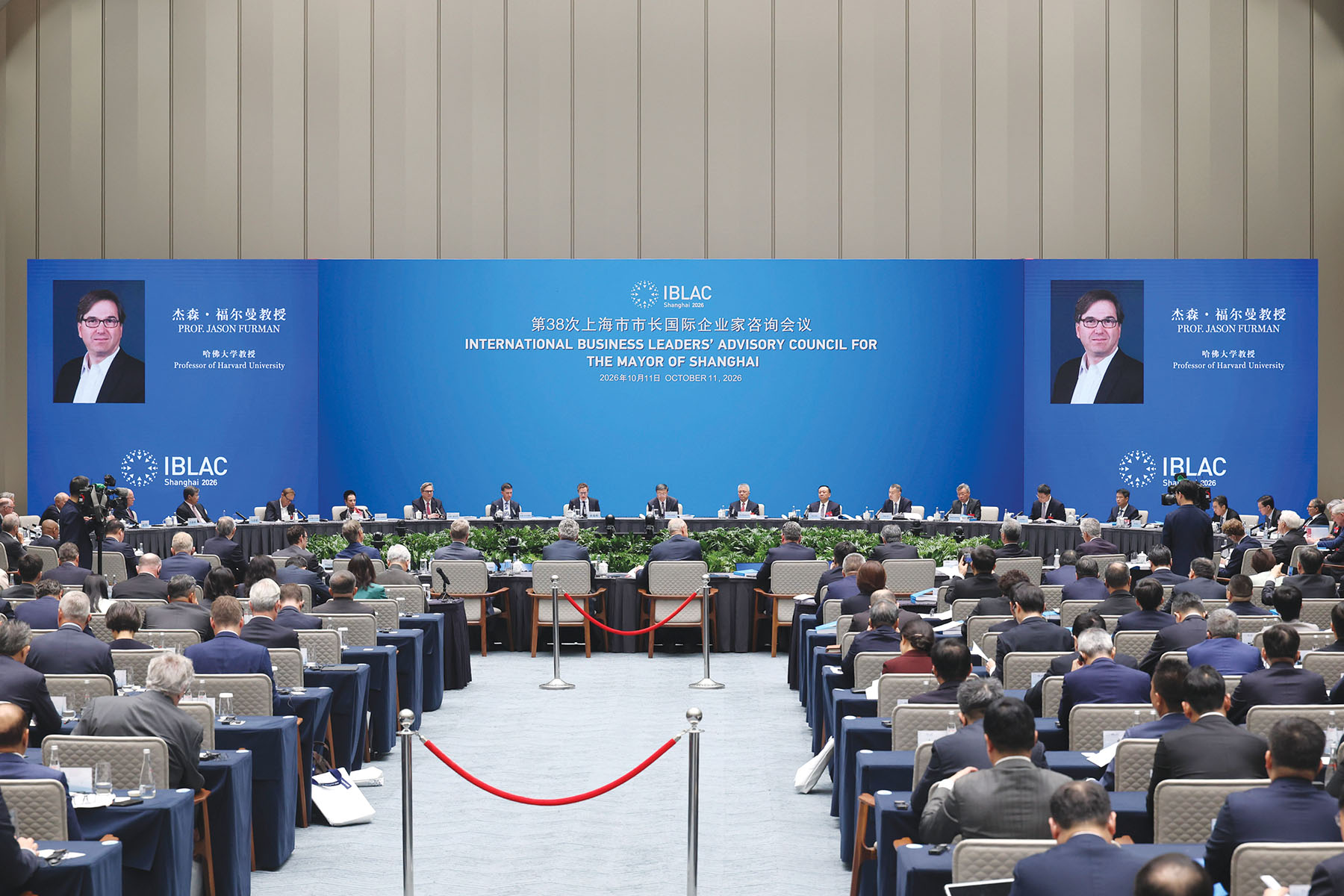
While Shanghai strives to become an international hub for artificial intelligence, the city should better leverage the emerging technology to further integrate services with manufacturing and consumption scenarios to nurture more growth engines, said experts and executives from the world’s leading multinational companies (MNCs).
Their comments were made during the 38th meeting of the International Business Leaders’ Advisory Council (IBLAC) for the Mayor of Shanghai held on Oct 11. Initiated in 1989, the IBLAC has grown into a think tank for Shanghai mayors by soliciting suggestions from MNCs’ top executives and industry experts to better advance Shanghai’s development and opening-up at the annual event. Executives of 42 MNCs from 14 countries attended this year’s edition.
Shanghai is uniquely positioned to leverage the technology thanks to its strong industrial base, its close ties with the rest of the Yangtze River Delta region and a mature service industry, which contributes over 80 percent of the city’s GDP, said Mohamed Kande, global chairman of PwC.
Shanghai’s service industry revenue grew 9 percent year on year in the first eight months of the year, with its added value projected to reach 6 trillion yuan ($896.4 billion) by 2030.
The global AI boom has opened up new possibilities for intelligent mechanics, smart manufacturing, warehousing and transportation. To better ride the tide, Shanghai should make more efforts to connect technologies, research and capital with international service providers so that difficulties in the real economy can be truly addressed, he said.
Martin Sorrell, founder and executive chairman of S4 Capital and former IBLAC chairman, said that Shanghai is becoming a testing ground for global AI governance and the intelligent transformation of the services sector.
For the global service sector, AI has seen its role transitioning from an efficiency tool to a “value-chain restructurer”. Shanghai should thus further align with international rules, facilitate data flow, open up more application scenarios, build up a more talent-friendly ecosystem and seek international coordination to make it a global innovation hub for AI-empowered services, he suggested.
Applauding Shanghai’s strong manufacturing foundation as well as a rich pool of AI companies, professional service providers, MNCs and long-term capital, Zhang Lei, founder and chairman of Hillhouse Investment, said the city should attach greater importance to AI’s practical deployment.
More key scenarios that affect companies’ operations should be opened up. Shanghai should also cultivate a group of forward-deployed engineers, who are highly sought after in the AI industry, and professional service enterprises that understand both AI and industries. In this way, more AI applications and service capabilities successfully tested in the Chinese market can go global from Shanghai, he said.
Jason Furman, an economist and professor at Harvard University and a former chair of the Council of Economic Advisers of the United States, said that Shanghai is naturally suited to building a Gen AI regulatory sandbox for the financial industry. The sandbox supervision, which has been adopted and referred to in 95 countries and regions, can significantly improve companies’ financing probabilities, he said.
According to Gary S. Guthart, executive chair of the board of directors at Intuitive Surgical, combining high-quality medical data with AI and robotics can create new frontiers in medical care. Shanghai has unique advantages for such transformation by piloting the development of high-quality datasets for robot-assisted surgeries, experimenting with new approaches for secure medical data sharing and building a “Shanghai model” for the responsible use of medical data that can be replicated nationwide.
Jean-Paul Agon, chairman of beauty giant L’Oreal Group, said AI is key to seeking high-quality growth by reshaping value chains, empowering talent and renovating commercial paradigms. The new technology can provide consumers with tailor-made products by connecting online and offline shopping experiences. Manufacturing will become more sustainable as AI will make it more flexible and customizable.
While technology should be more inclusive to pave the way for wider economic prosperity, Shanghai should further improve its business ecosystem to make it a hub connecting various innovation rules across the globe, he said.
Shanghai’s mayor Zhu Zhongming said that the new generation of information technology, best represented by AI, is having a profound impact on the development of the service industry by reshaping service methods, restructuring service spaces, expanding service content and enhancing service efficiency.
The city will support the accelerated digital and intelligent transformation of the service industry with AI to nurture new growth drivers and create new competitive advantages, he said.
