

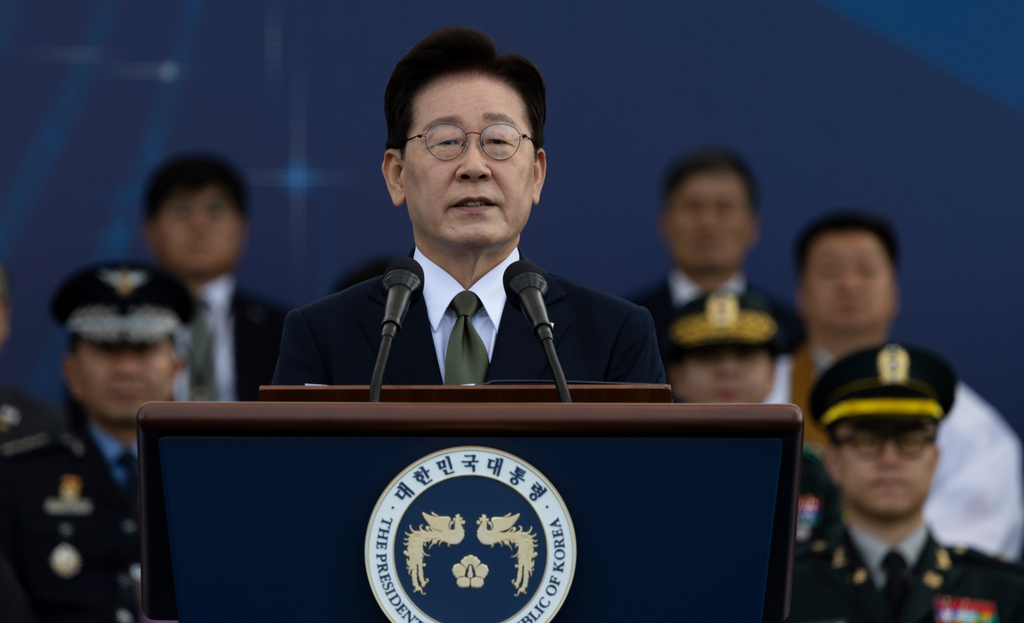
South Korean President Lee Jae-myung has pushed through a sweeping overhaul of the criminal justice system, stripping investigative powers from prosecutors he accuses of abusing their authority, including criminal cases against him before he took office.
A revised law that came into force on Friday focuses on shifting power to police from prosecutors, leaving the latter primarily to decide whether cases should go to trial.
“The purpose of prosecution reform is to ensure that the powers and responsibilities entrusted to investigative and prosecutorial authorities to protect victims, human rights and the social order are not abused for politically motivated investigations and prosecutions,” Lee said last month, vowing to make the reform irreversible.
South Korea’s prosecutors have long been accused of exercising excessive power, but the move has raised concerns that it may create gaps that leave crime victims worse off. The optics of the reform, led by a president who faces pending cases launched by prosecutors, are also feeding into a drop in Lee’s public support.
Supporters of the move claim it will help break up an institution that’s contributed to political instability over the years. Of the eight presidents who served before Lee since the country embraced direct democratic elections in 1987, four have been imprisoned, ousted or both after investigations by prosecutors. Another, Roh Moo-hyun, died by suicide while facing an investigation into allegations of bribery involving his family a year after his term ended.
Lee’s own ascent to the country’s top job last year followed a martial law fiasco triggered by his predecessor and top prosecutor-turned-president, Yoon Suk-yeol.
The overhaul scraps the Supreme Prosecutors Office and launches two new agencies to take on some of the office’s functions. A new Prosecution Service will make decisions on whether to indict suspects and will handle prosecutions in court.
The newly formed Serious Crimes Investigation Agency will take responsibility for launching and carrying out probes into seven categories of crimes, including corruption and national security transgressions. The police and the Corruption Investigation Office for High-Ranking Officials will take the lead on other investigations, though there still may be scope for disagreements over which agency has jurisdiction.
The revision comes as Lee’s own trials have been suspended while he serves as president. Those trials surround accusations over aiding private land developers, misusing public funds and infringing election law. Lee has denied any wrongdoing and called the indictments politically motivated. “I have been, still am, and will continue to be one of those who have suffered the most from the prosecutors’ abuses,” Lee has said.
The overhaul is seen as one of the factors weighing on Lee’s approval rating, now hovering below 40 percent with nearly four years still remaining in his single, five-year term. A Gallup Korea poll in August showed half of respondents were against the reform, while 27 percent supported the plan.
The decline in support is especially steep among women in their 20s and 30s, as experts warn that crime victims, particularly those with limited access to affordable legal services, are likely to be the first to face delays or gaps in probes.
The reform comes amid recent criticism of police following incidents such as the premature closure of a missing person case in Jeju. The missing woman’s body was later discovered. The police agency subsequently ordered the reopening of 310,000 cases nationwide.
“Female victims, who should have been among the first stakeholders, have been largely left out of the discussion process,” said Seo Hwi-won, an adjunct professor of political science at Duksung Women’s University.
Oh Yoon-sung, a professor of police administration at Soonchunhyang University, says politicians stand to gain the most from the overhaul.
“At the end of the day, the police are an organization that’s just a lot easier for politicians to control than the prosecution ever was,” Oh said. “If things go south, a prosecutor can just walk away and become a lawyer. But if a police officer has to leave, they’re basically out of a job.”
In a sign of the unease within Lee’s own government, his first Justice Minister Jeong Seong-ho stepped down after voicing alarm over the ruling Democratic Party’s push to enact the reform at “the speed of light”.
“Watching the process of revising the Criminal Procedure Act, I’m deeply concerned about what’s happening to South Korea and to our criminal justice system,” Jeong was heard saying in remarks caught on a hot mic. Jeong is himself a lawyer and five-term Democratic Party lawmaker. “I’m genuinely so worried that I don’t think I could bear the responsibility later.”
Kim Seung-won, his nominated replacement, then withdrew his candidature after police relaunched an investigation into his alleged lobbying over a COVID-related drug. That leaves the ministerial position open at a time of major reform.
“When Lee’s approval rating was high, these issues didn’t attract as much attention. But as his ratings have fallen and people have begun questioning his ability, concerns about his character and suitability have risen to the surface,” said Eom Kyeong-young, director of the Zeitgeist Institute, a Seoul-based research group. “The pressure will only grow unless he can find a way to turn public sentiment around.”
