

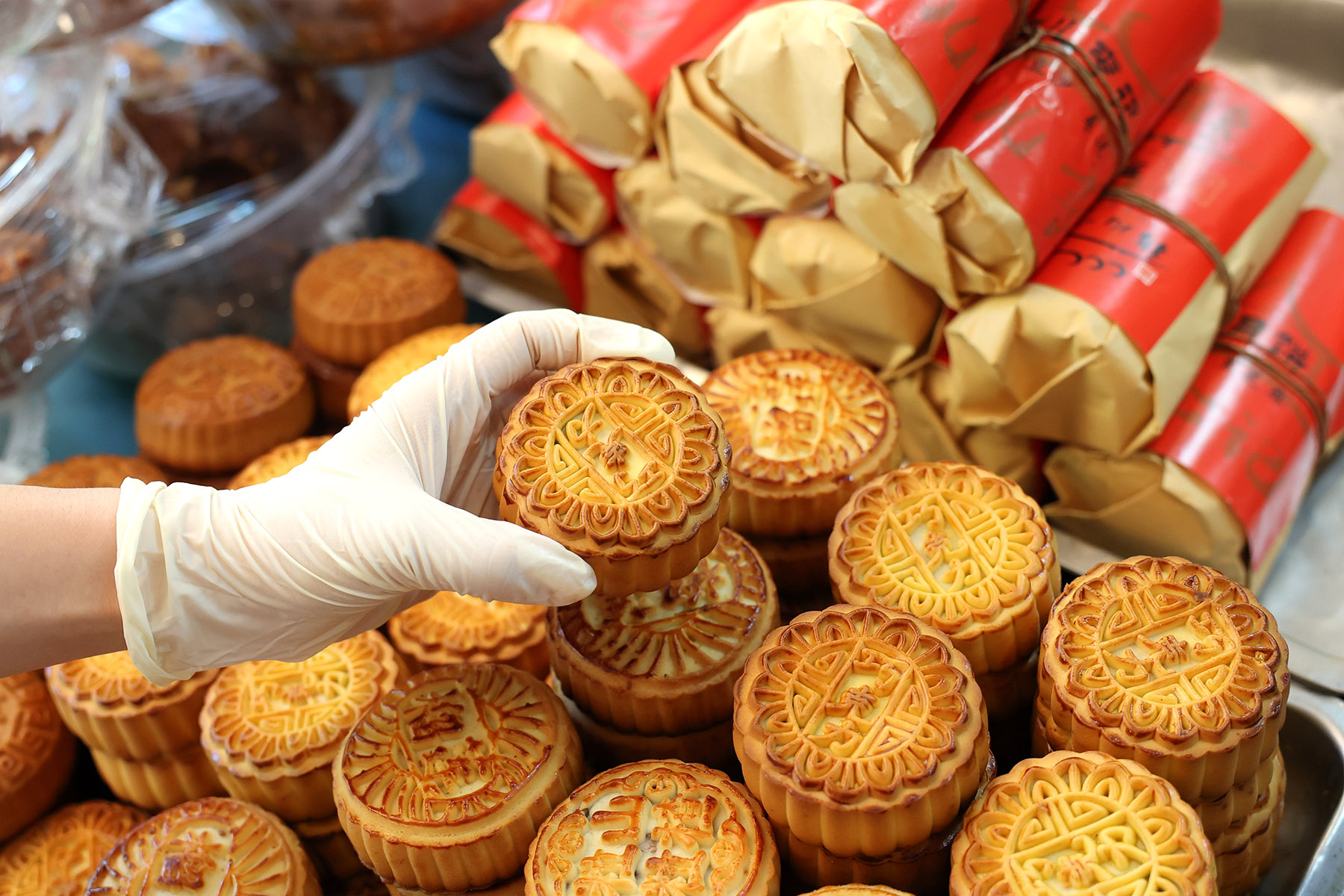
As a significant treat for revelers every Mid-Autumn Festival, Cantonese-style mooncakes are reaching a broader global market with Chinese mainland brands’ expansion tailored to serving overseas Chinese longing for reunion with their families, and international consumers drawn to the growing impact of Chinese culture.
In the first eight months of this year, the value of mooncakes exported under the supervision of Guangzhou Customs reached 49.77 million yuan ($7.42 million) -- up 42.7 percent year-on-year.
Ahead of the annual Moon Festival, data from Joybuy -- a European e-commerce platform launched by mainland retail giant JD.com in March this year -- showed that sales of Chinese-style mooncakes had surged more than 16-fold month-over-month.
Liang Junwei -- a professor at the School of Economics and Trade of the Guangdong University of Foreign Studies -- said factors such as consumers becoming more rational and health-conscious, and the weakening of mooncakes’ social appeal have exerted pressure on the sales of the festive food in the domestic market.
According to last year’s industry figures, sales of national mooncakes saw negative growth for the first time in a decade, marking a significant turning point. Sales in 2026 totaled 29 billion yuan -- a slight increase of 2.7 percent from last year. For the first time, purchases for personal consumption had exceeded those for gift-giving, while high-end gift boxes were sold at 30 to 40 percent discounts to clear inventory.
Against this backdrop, many relevant brands began testing the waters in overseas markets or elevating “going global” to a strategic level starting last year. As a key player in this overseas expansion drive, Cantonese mooncakes are steadily extending their reach beyond the traditional markets of the Hong Kong and Macao special administrative regions, as well as Southeast Asia, to Europe, the United States, Australia and the Middle East.
Southern China is the nation’s core hub for the mooncake industry, with more than 2,200 mooncake-related companies in Guangdong province alone. Liang believes small and medium-sized mooncake brands in Guangdong are particularly well-suited for expanding into international markets, highlighting their flexible production capacity, a spirit of innovation, quick market response, as well as the region’s robust foundation in overseas markets and strong customs clearance.
ALSO READ: As Mid-Autumn Festival nears, mooncakes make their annual return
According to New Food Generation (Foshan) Food Company, its newly launched Dubai-style pistachio chocolate mooncakes and Yashixiang Oolong tea-flavored mooncakes have been well received by consumers in the Middle East and the Hong Kong and Macao SARs.
In recent years, Guangzhou Peninsula Food Company has focused on expanding into the European and American markets. Based on traditional egg yolk mooncakes, it added shredded coconut and red beans to enrich the flavor.
According to Kindly King Foodstuff (Zhongshan) Company, this year’s shipments of mooncakes to Spain were sold out very early, and the company has expanded into the Swedish market. Some mooncake manufacturers in Jiangmen City saw their export volumes having increased by almost 40 percent year-over-year in the first seven months this year.
With the development of cross-border e-commerce, Chinese people living around the world can now more easily enjoy the flavors of home during the festive season for family reunions. China’s deepening opening-up policies and its growing global influence have also increased foreign consumers’ awareness of Chinese products, Liang said.
Lucia Perez -- an exchange student from Spain who’s studying at Shenzhen University -- said she was already very familiar with mooncakes before coming to China and had tried a variety of flavors, including salted egg yolk, ham, chestnut and ice cream mooncakes.
Several Chinese students studying in Denmark, Germany and the United Kingdom said that apart from ordering mooncakes online, they can also get them at local stores. They said overseas student communities have a tradition of sharing mooncakes during the Mid-Autumn Festival. For them, the ritual isn’t just a festive tradition, but also a way to express their cultural identity and a source of comfort in their homesickness.
Liang said requirements for food imports vary significantly among overseas countries, with particularly strict regulations for products containing animal-derived ingredients like meat, eggs and dairy.
For example, if a production line has previously processed pork products, it must undergo a thorough cleaning before it can begin production of halal foods. Japan and the European Union have very strict requirements regarding the use of food additives, and markets in Europe and the United States require that potential food allergens, such as peanuts and soybeans, be clearly labeled on packaging.
Amid the ESG (environmental, social, governance) trend, in addition to end products, the international community is also placing increasing emphasis on environmental sustainability in the production of raw materials.
Liang said meeting these requirements will add further pressure on food production, and urged new entrants to fully understand the rules and run small-scale trials first. He also called for overseas Chinese chambers of commerce to play a stronger role in understanding local dietary preferences and identifying emerging market trends.
Zhou Shunbo -- executive director of the New Economy Institute at the China Development Institute -- believes that traditional products embodying the essence of Chinese festival culture have significant growth potential in overseas markets.
READ MORE: Lanterns' revival illuminates ancient craft
With the rapid rise of cross-border e-commerce platforms run by Chinese internet giants, such as Joybuy, Temu and AliExpress, he suggests that companies fully leverage the platforms’ respective strengths, and deepen collaboration with them in marketing and promotional efforts tailored to local markets.
Chen Yanshan contributed to the story
Contact the writer at bingcun@chinadailyhk.com
