

Restoration of key land route to core disaster area sees rescuers expand operations
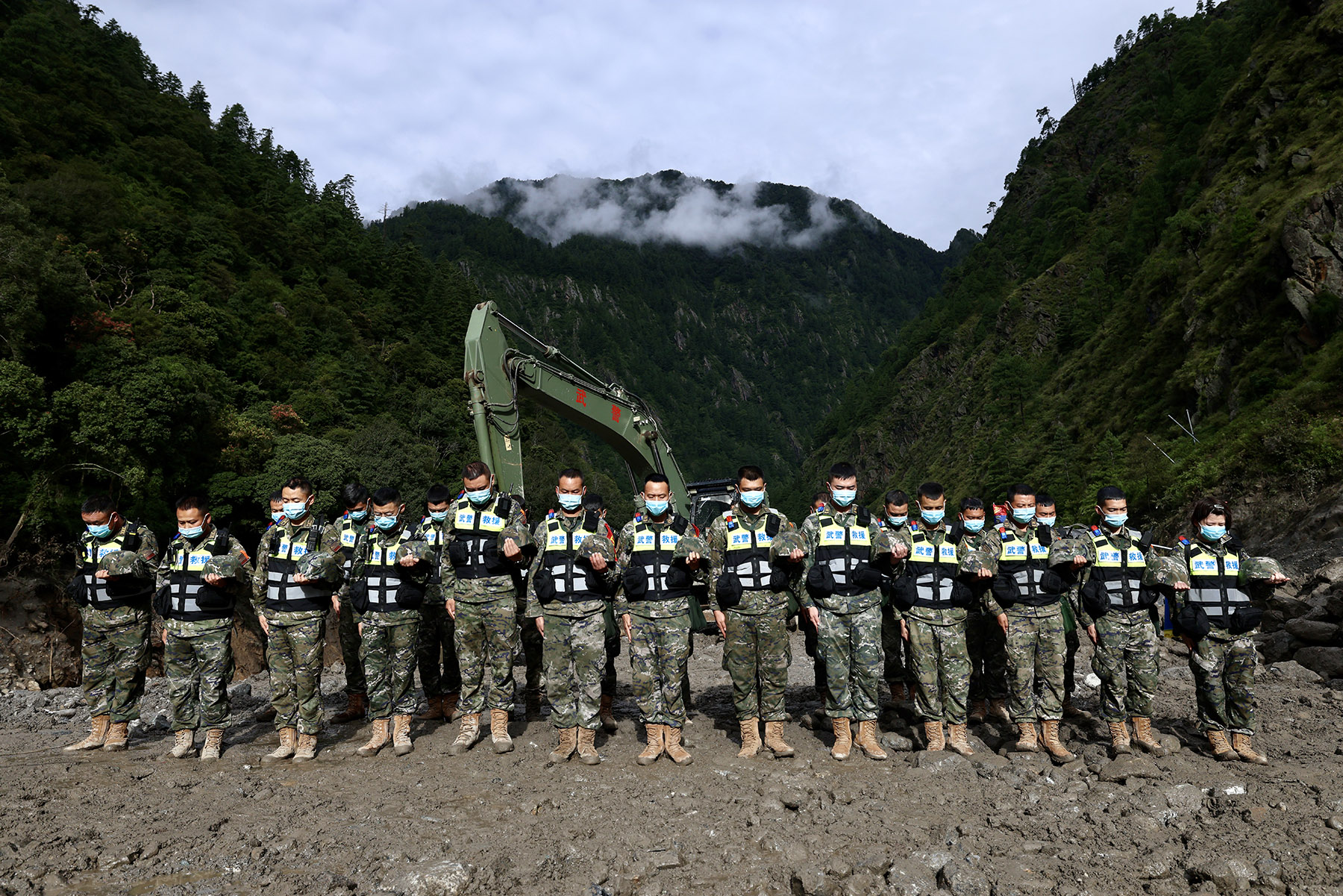
The death toll from the mudslide at a China-Nepal border port rose to 21 on Sept 2, authorities said, while 541 people remained missing as rescuers expanded deep searches in the disaster’s core area after restoring a key land route.
Karma Tsetan, chairman of the government of the Xizang autonomous region, gave the figures at a news conference in Gyirong that day, saying more than 2,300 rescuers had been mobilized for the operation.
The mudslide struck Gyirong Port in Shigatse on Aug 26 after originating on the Nepalese side of the border. It caused major casualties and damaged roads, electricity and communications, cutting off access to the core disaster area.
The reopening of a section of National Highway G216, the main road leading to the port, has allowed rescuers to move heavy machinery into the hardest-hit areas and intensify searches for people buried beneath thick layers of mud and debris.
Karma Tsetan said more than 400 vehicle deployments and more than 8,000 sets of rescue equipment had been mobilized. Drones made about 800 flights, while 5.43 metric tons of personnel supplies and equipment had been air-dropped into the core area.
Before the road was restored, rescuers relied on a combination of land, water, and air operations to reach the disaster zone. Some teams approached by boat along waterways, while others trekked for about 12 hours through mountainous terrain. Helicopters made 24 flights to transport rescuers and supplies.
Communications have also improved, with 12 base stations restored and lighting and power equipment deployed in the core area, Karma Tsetan said.
Rescuers have carried out repeated grid searches covering about 1.59 million square meters since the disaster. More than 10 pieces of heavy machinery have now entered the core area, enabling teams to move from surface searches to more extensive excavation.
The same terrain that amplified the mudslide’s destructive force is now hampering rescue work. Experts said the disaster’s impact was intensified by the steep elevation drop, high speed and narrow valley. The debris flow traveled about 22 km at an average speed of around 50 meters per second, gathering loose material as it descended.
Heavy machinery can only advance along the narrow valley, while search, road repair and debris-clearing teams must share the same confined corridor.
Thubten Nyima, a firefighter with the Xizang fire and rescue brigade, said reaching the core area had already placed heavy physical demands on rescuers, while damaged transportation and communications infrastructure created further difficulties. Deep mud has slowed movement and reduced the effectiveness of some commonly used detection equipment.
The mud in some areas is knee-or even waist-deep, he said. Teams have had to identify relatively stable routes and adjust search plans according to terrain, weather conditions and the likely direction of the mudslide. Rain can further complicate operations, requiring plans to be continuously adjusted.
Conditions along G216 remain difficult, with unstable cliffs on one side and fast-flowing water on the other. Currents reach 6 to 7 meters per second in some sections.
Lin Zhenkui, a technical expert with China Anneng Group, told CCTV that the mudslide raised the riverbed and altered the channel, forcing water onto parts of the former roadway.
In some sections, crews effectively had to build a new road through the water rather than simply clearing debris. Large rocks, reinforced stone cages and diversion structures are being used to stabilize the roadbed and reduce the force of the current.
State Grid said power crews were working around the clock to support road-clearing operations, with power lines extended to within 1.6 km of Gyirong Port.
Three national emergency rescue teams totaling 39 personnel have been deployed with slope radar, drones and life-detection equipment to monitor potential landslides, collapses and barrier lakes, according to the Ministry of Emergency Management.
China Anneng Group is also using laser-based video, artificial intelligence monitoring equipment and drones to track slope changes around the clock.
The Ministry of Water Resources said on Sept 1 that 14 previously identified glacial lakes remained relatively stable, though glaciers around an impact crater near the source area in Nepal could still collapse, posing a significant risk.
Three rope-ladder evacuation routes totaling about 180 meters have also been installed along G216, allowing rescuers to reach higher ground quickly in the event of sudden flooding or another mudslide.
The risk of secondary disasters remains a major concern. More rain was forecast in Gyirong over the coming days, according to the China Meteorological Administration.
Contact the writers at yangzekun@chinadaily.com.cn
